Technical Specifications
| Brand | Dacia |
| Model | Logan |
| Generation | Logan II MCV |
| Type (Engine) | 0.9 TCe (90 Hp) Start&Stop |
| Start of production | 2015 |
| End of production | 2016 |
| Powertrain Architecture | Internal Combustion engine |
| Body type | Station wagon (estate) |
| Seats | 5 |
| Doors | 5 |
| Fuel consumption (urban) | 5.8 l/100 km (40.6 US mpg, 48.7 UK mpg, 17.2 km/l) |
| Fuel consumption (extra urban) | 4.3 l/100 km (54.7 US mpg, 65.7 UK mpg, 23.3 km/l) |
| Fuel consumption (combined) | 4.9 l/100 km (48 US mpg, 57.6 UK mpg, 20.4 km/l) |
| CO2 emissions | 109 g/km |
| Fuel Type | Petrol (Gasoline) |
| Acceleration 0 – 100 km/h | 11.1 sec |
| Acceleration 0 – 62 mph | 11.1 sec |
| Acceleration 0 – 60 mph | 10.5 sec |
| Maximum speed | 175 km/h (108.74 mph) |
| Emission standard | Euro 6 |
| Weight-to-power ratio | 11.5 kg/Hp, 86.7 Hp/tonne |
| Weight-to-torque ratio | 7.4 kg/Nm, 134.9 Nm/tonne |
| Power | 90 Hp @ 5000 rpm |
| Power per litre | 100.2 Hp/l |
| Torque | 140 Nm @ 2250 rpm (103.26 lb.-ft. @ 2250 rpm) |
| Engine layout | Front, Transverse |
| Engine Model/Code | H4B 408 |
| Engine displacement | 898 cm3 (54.8 cu. in.) |
| Number of cylinders | 3 |
| Engine configuration | Inline |
| Cylinder Bore | 72.2 mm (2.84 in.) |
| Piston Stroke | 73.1 mm (2.88 in.) |
| Number of valves per cylinder | 4 |
| Fuel injection system | Multi-port manifold injection |
| Engine aspiration | Turbocharger, Intercooler |
| Engine oil capacity | 4.1 l (4.33 US qt | 3.61 UK qt) |
| Coolant capacity | 4.5 l (4.76 US qt | 3.96 UK qt) |
| Kerb Weight | 1038 kg (2288.4 lbs.) |
| Max. weight | 1620 kg (3571.49 lbs.) |
| Max load | 582 kg (1283.09 lbs.) |
| Trunk (boot) space – minimum | 573 l (20.24 cu. ft.) |
| Trunk (boot) space – maximum | 1518 l (53.61 cu. ft.) |
| Fuel tank capacity | 50 l (13.21 US gal | 11 UK gal) |
| Max. roof load | 80 kg (176.37 lbs.) |
| Permitted trailer load with brakes (12%) | 1150 kg (2535.32 lbs.) |
| Permitted trailer load without brakes | 555 kg (1223.57 lbs.) |
| Permitted towbar download | 75 kg (165.35 lbs.) |
| Length | 4494 mm (176.93 in.) |
| Width | 1733 mm (68.23 in.) |
| Width including mirrors | 1994 mm (78.5 in.) |
| Height | 1550 mm (61.02 in.) |
| Wheelbase | 2634 mm (103.7 in.) |
| Front track | 1493 mm (58.78 in.) |
| Rear track | 1476 mm (58.11 in.) |
| Front overhang | 818 mm (32.2 in.) |
| Rear overhang | 1042 mm (41.02 in.) |
| Ride height (ground clearance) | 142 mm (5.59 in.) |
| Minimum turning circle | 10.82 m (35.5 ft.) |
| Drivetrain Architecture | Front wheel drive |
| Number of gears and type of gearbox | 5 gears, manual transmission |
| Front suspension | Independent type McPherson, Transverse stabilizer |
| Rear suspension | Coil spring, Torsion |
| Front brakes | Ventilated discs |
| Rear brakes | Drum |
| Assisting systems | ABS (Anti-lock braking system) |
| Steering type | Steering rack and pinion |
| Power steering | Electric Steering |
| Tires size | 185/65 R15 |
| Wheel rims size | 6J x 15 |
Introduction
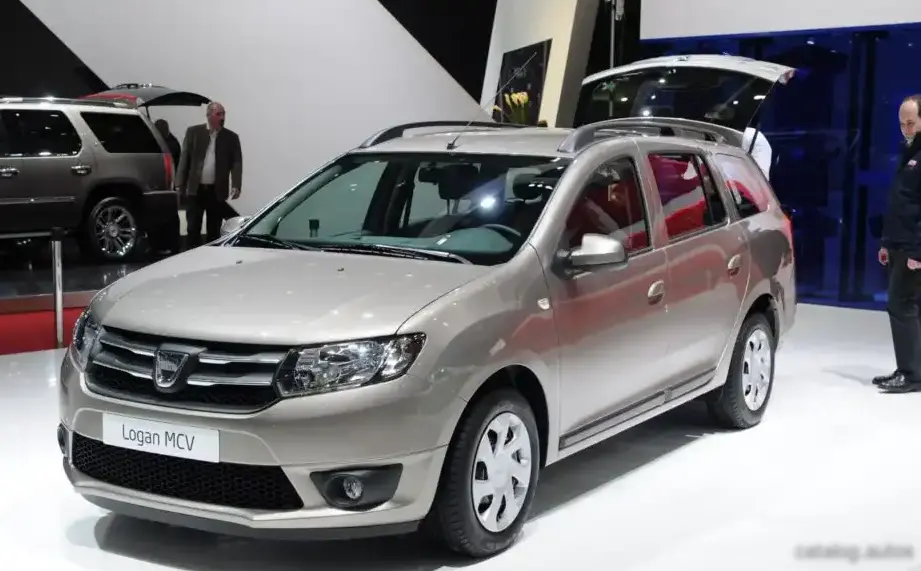
The Dacia Logan II MCV 0.9 TCe (90 hp) Start&Stop is a compact estate car manufactured by Dacia, a Romanian automaker and subsidiary of the Renault Group, between 2015 and 2016. This variant occupied the entry-level position within the Logan II MCV range, designed to offer affordable and practical transportation for families and businesses. The MCV, standing for Multi-Capacity Vehicle, distinguished itself with a significantly expanded cargo area compared to the standard Logan sedan, making it a popular choice in markets prioritizing utility. The Logan II MCV, built on the 1HX0/A3 platform, represented a substantial improvement over its predecessor, offering enhanced comfort, safety, and refinement while maintaining Dacia’s core value proposition of affordability.
Powertrain & Engine Architecture
At the core of the Logan II MCV 0.9 TCe lies the H4B 408 engine, a compact 898cc inline three-cylinder petrol unit. This engine is a member of Renault’s ‘Energy’ engine family, engineered with a focus on fuel efficiency. It features a single overhead camshaft (SOHC) operating four valves per cylinder. The engine employs multi-point fuel injection and is equipped with a turbocharger and intercooler to enhance power and torque output. The turbocharger effectively mitigates the limitations inherent in a small-displacement engine, delivering a more responsive driving experience. The integrated Start&Stop system automatically shuts down the engine when the vehicle is stationary – such as at traffic signals – to further reduce fuel consumption and emissions. The engine is mounted transversely at the front of the vehicle. A five-speed manual transmission was the sole gearbox option paired with this engine, prioritizing fuel economy over outright performance. The engine’s design emphasizes lightweight construction, contributing to the vehicle’s overall efficiency.
Driving Characteristics
The 0.9 TCe engine, producing 90 horsepower and 140 Nm (103.26 lb.-ft.) of torque, provided adequate, though not particularly sporty, performance for the Logan II MCV. Acceleration from 0 to 60 mph took approximately 10.5 seconds, with a top speed of 175 km/h (108.74 mph). The turbocharger provided a noticeable boost in responsiveness at lower engine speeds, but power delivery did diminish as the engine approached its redline. The five-speed manual transmission was well-suited to the engine’s characteristics, with gear ratios optimized for fuel efficiency. Compared to higher-powered Logan II MCV variants, such as those equipped with the 1.5 dCi diesel engine, the 0.9 TCe offered less raw performance but a smoother and quieter driving experience. The lighter weight of the three-cylinder engine also contributed to slightly improved handling characteristics compared to the heavier diesel models. The overall driving experience was geared towards practicality and economy rather than dynamic performance.
Equipment & Trim Levels
The 0.9 TCe variant of the Logan II MCV typically came equipped with a basic level of standard features, reflecting its position as an entry-level model. Standard amenities generally included power steering, electric front windows, central locking, and an ABS anti-lock braking system. Interior upholstery was typically cloth, and the dashboard featured a simple, functional layout. Optional extras available for this trim level included air conditioning, a radio/CD player, and alloy wheels. Higher trim levels offered additional features such as rear electric windows, a trip computer, and more refined interior materials. The focus was on providing essential features at an affordable price point, with optional extras allowing buyers to customize their vehicle to their specific needs.
Chassis & Braking
The Logan II MCV 0.9 TCe utilized an independent MacPherson strut suspension system at the front and a coil spring torsion beam suspension at the rear. This configuration prioritized ride comfort, although it didn’t offer the same level of handling precision as more sophisticated suspension setups. The front brakes were ventilated discs, providing adequate stopping power, while the rear brakes were drums, a cost-saving measure common in this vehicle segment. The electric power steering provided light and easy steering, making it well-suited for maneuvering in urban environments. The suspension was tuned to provide a comfortable ride on a variety of road surfaces, prioritizing practicality over sporty handling.
Market Reception & Comparison
The Dacia Logan II MCV 0.9 TCe was generally well-received by automotive critics for its affordability, practicality, and fuel efficiency. However, some reviewers noted that the engine could feel strained when the vehicle was fully loaded or when driving uphill. Compared to other engines available in the Logan II MCV lineup, the 0.9 TCe offered the lowest running costs but also the least amount of power. The 1.5 dCi diesel engine, while more expensive to purchase, delivered significantly better fuel economy and torque. The petrol engine appealed to drivers who primarily undertook shorter journeys and didn’t require the extra power of the diesel. The Logan II MCV, in general, was praised for offering exceptional value for money, making it a popular choice for budget-conscious buyers.
Legacy
The H4B 408 engine, while generally reliable, has been known to exhibit occasional issues with the turbocharger and fuel injectors. Consistent maintenance, including regular oil changes and air filter replacements, is crucial for ensuring long-term reliability. In the used car market, the Logan II MCV 0.9 TCe continues to be a popular choice for buyers seeking a practical and spacious estate car at an affordable price. Its low running costs and relatively simple mechanical design make it an attractive option for those prioritizing economical transportation. The engine’s fuel efficiency remains a key selling point, even as newer, more technologically advanced vehicles become available. The Logan II MCV 0.9 TCe represents a compelling option for those seeking a no-frills, reliable, and economical vehicle.