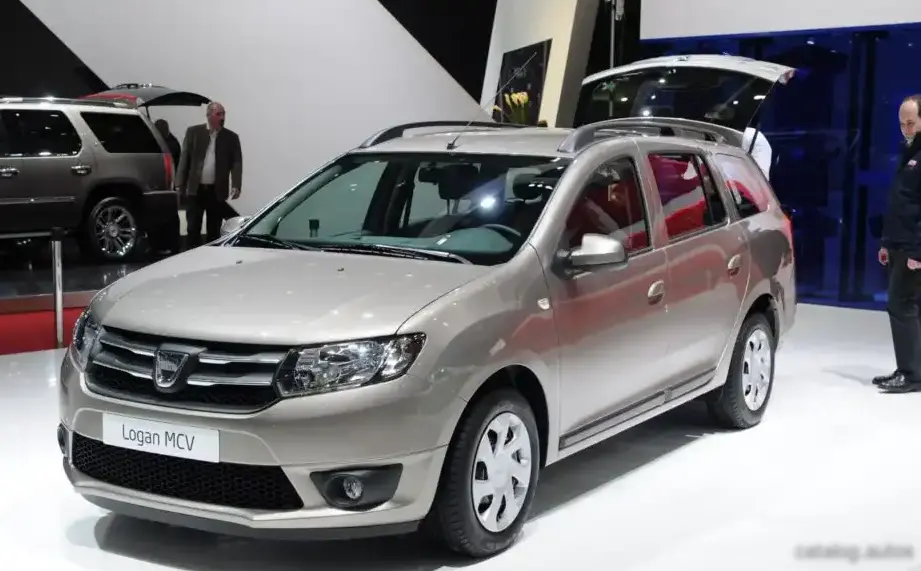
The Dacia Logan II MCV 1.5 dCi (75 hp) Start&Stop FAP is a five-door station wagon produced by the Romanian automaker Dacia between 2015 and 2016. Positioned as an entry-level variant within the second generation Logan MCV (Multi-Capacity Vehicle) lineup, it offered a fuel-efficient and practical option for families and commercial users. This model was primarily sold in European markets, where Dacia established itself as a budget-friendly brand known for offering substantial space and functionality at a competitive price point. The “MCV” designation signifies the estate body style, emphasizing its larger cargo capacity compared to the standard Logan sedan.
Technical Specifications
| Brand | Dacia |
| Model | Logan |
| Generation | Logan II MCV |
| Type (Engine) | 1.5 dCi (75 Hp) Start&Stop FAP |
| Start of production | 2015 |
| End of production | 2016 |
| Powertrain Architecture | Internal Combustion engine |
| Body type | Station wagon (estate) |
| Seats | 5 |
| Doors | 5 |
| Fuel consumption (urban) | 3.7 l/100 km (63.6 US mpg, 76.3 UK mpg, 27 km/l) |
| Fuel consumption (extra urban) | 3.4 l/100 km (69.2 US mpg, 83.1 UK mpg, 29.4 km/l) |
| Fuel consumption (combined) | 3.5 l/100 km (67.2 US mpg, 80.7 UK mpg, 28.6 km/l) |
| CO2 emissions | 90 g/km |
| Fuel Type | Diesel |
| Acceleration 0 – 100 km/h | 14.6 sec |
| Acceleration 0 – 62 mph | 14.6 sec |
| Acceleration 0 – 60 mph | 13.9 sec |
| Maximum speed | 164 km/h (101.9 mph) |
| Emission standard | Euro 6 b |
| Weight-to-power ratio | 14.5 kg/Hp, 68.8 Hp/tonne |
| Weight-to-torque ratio | 5.5 kg/Nm, 183.5 Nm/tonne |
| Power | 75 Hp @ 4000 rpm |
| Power per litre | 51.3 Hp/l |
| Torque | 200 Nm @ 1750 rpm (147.51 lb.-ft. @ 1750 rpm) |
| Engine layout | Front, Transverse |
| Engine Model/Code | K9K 626 |
| Engine displacement | 1461 cm3 (89.16 cu. in.) |
| Number of cylinders | 4 |
| Engine configuration | Inline |
| Cylinder Bore | 76 mm (2.99 in.) |
| Piston Stroke | 80.5 mm (3.17 in.) |
| Number of valves per cylinder | 2 |
| Fuel injection system | Diesel Commonrail |
| Engine aspiration | Turbocharger, Intercooler |
| Engine oil capacity | 4.5 l (4.76 US qt | 3.96 UK qt) |
| Coolant capacity | 4.5 l (4.76 US qt | 3.96 UK qt) |
| Kerb Weight | 1090 kg (2403.04 lbs.) |
| Max. weight | 1670 kg (3681.72 lbs.) |
| Max load | 580 kg (1278.68 lbs.) |
| Trunk (boot) space – minimum | 573 l (20.24 cu. ft.) |
| Trunk (boot) space – maximum | 1518 l (53.61 cu. ft.) |
| Fuel tank capacity | 50 l (13.21 US gal | 11 UK gal) |
| Max. roof load | 80 kg (176.37 lbs.) |
| Permitted trailer load with brakes (12%) | 1150 kg (2535.32 lbs.) |
| Permitted trailer load without brakes | 580 kg (1278.68 lbs.) |
| Permitted towbar download | 75 kg (165.35 lbs.) |
| Length | 4494 mm (176.93 in.) |
| Width | 1733 mm (68.23 in.) |
| Width including mirrors | 1994 mm (78.5 in.) |
| Height | 1550 mm (61.02 in.) |
| Wheelbase | 2634 mm (103.7 in.) |
| Front track | 1493 mm (58.78 in.) |
| Rear track | 1476 mm (58.11 in.) |
| Front overhang | 818 mm (32.2 in.) |
| Rear overhang | 1042 mm (41.02 in.) |
| Ride height (ground clearance) | 142 mm (5.59 in.) |
| Minimum turning circle | 10.82 m (35.5 ft.) |
| Drivetrain Architecture | Front wheel drive |
| Number of gears and type of gearbox | 5 gears, manual transmission |
| Front suspension | Independent type McPherson |
| Front brakes | Ventilated discs |
| Rear brakes | Drum |
| Assisting systems | ABS (Anti-lock braking system) |
| Steering type | Steering rack and pinion |
| Power steering | Electric Steering |
| Tires size | 185/65 R15 |
| Wheel rims size | 6J x 15 |
Powertrain & Engine Architecture
The heart of the Logan II MCV 1.5 dCi (75 hp) is the K9K 626 engine, a 1.5-liter inline-four cylinder diesel engine. This engine is part of the K9K family developed by Renault, and widely used across various models within the Renault-Nissan-Dacia alliance. It features a turbocharger with an intercooler to enhance power and efficiency. The engine utilizes a diesel common rail direct injection system, delivering fuel directly into the combustion chamber at high pressure for improved combustion and reduced emissions. The engine is equipped with two valves per cylinder (SOHC). The Start&Stop system automatically shuts off the engine when the vehicle is stationary (e.g., at traffic lights) to conserve fuel and reduce emissions. A Diesel Particulate Filter (DPF) is included to trap soot particles, further minimizing environmental impact. The engine is transversely mounted at the front of the vehicle. The 5-speed manual transmission was the only transmission option available with this engine configuration.
Driving Characteristics
The 75 hp output and 200 Nm (147 lb-ft) of torque provide adequate, but not particularly brisk, performance. Acceleration from 0-100 km/h (0-62 mph) takes approximately 14.6 seconds, and the top speed is around 164 km/h (102 mph). The engine’s torque peak at 1750 rpm means that it offers reasonable pulling power for everyday driving, especially when loaded with passengers or cargo. However, overtaking maneuvers require careful planning. The 5-speed manual transmission is geared for economy, with relatively long gear ratios. This contributes to good fuel economy but can feel somewhat sluggish when accelerating. Compared to higher-output versions of the 1.5 dCi (90 hp or 110 hp), this variant offers a more relaxed driving experience, prioritizing fuel efficiency over outright performance. The manual transmission provides more driver control than an automatic would, but also requires more driver involvement.
Equipment & Trim Levels
The 1.5 dCi (75 hp) Start&Stop FAP typically represented an entry-level trim within the Logan MCV range. Standard equipment generally included power steering, electric front windows, central locking, and an ABS anti-lock braking system. The interior featured basic cloth upholstery and a functional dashboard layout. Air conditioning was often an optional extra, as were features like a radio/CD player and alloy wheels. Safety features were relatively basic, with driver and passenger airbags being standard, but lacking more advanced driver-assistance systems.
Chassis & Braking
The Logan MCV utilizes a McPherson strut independent suspension at the front and a torsion beam axle at the rear. This setup provides a comfortable ride quality, prioritizing practicality over sporty handling. The front brakes are ventilated discs, offering adequate stopping power, while the rear brakes are drums, a cost-saving measure common in this segment. The electric power steering provides light and easy steering, making it suitable for urban driving. The relatively simple suspension setup and drum brakes on the rear contribute to lower maintenance costs.
Market Reception & Comparison
The Dacia Logan II MCV 1.5 dCi (75 hp) was well-received in markets where affordability and practicality were key considerations. Critics praised its spacious interior, large cargo capacity, and excellent fuel economy. However, the engine’s modest power output and basic interior were often noted as drawbacks. Compared to the 90 hp version of the same engine, the 75 hp variant offered lower running costs but sacrificed some performance. Against competitors like the Skoda Fabia Estate or Peugeot 208 SW, the Logan MCV offered more space for the money, but lacked the refinement and brand prestige of those rivals.
Legacy
The K9K engine family, including the 626 variant, has proven to be relatively reliable, although DPF issues can occur with diesel engines if not properly maintained (regular long journeys are recommended). In the used car market, the Logan II MCV 1.5 dCi (75 hp) remains a popular choice for budget-conscious buyers seeking a practical and fuel-efficient estate car. Its simplicity and robust construction contribute to relatively low maintenance costs, making it a sensible option for those prioritizing value for money over luxury or performance. The engine’s fuel efficiency continues to be a major selling point, especially in times of high fuel prices.