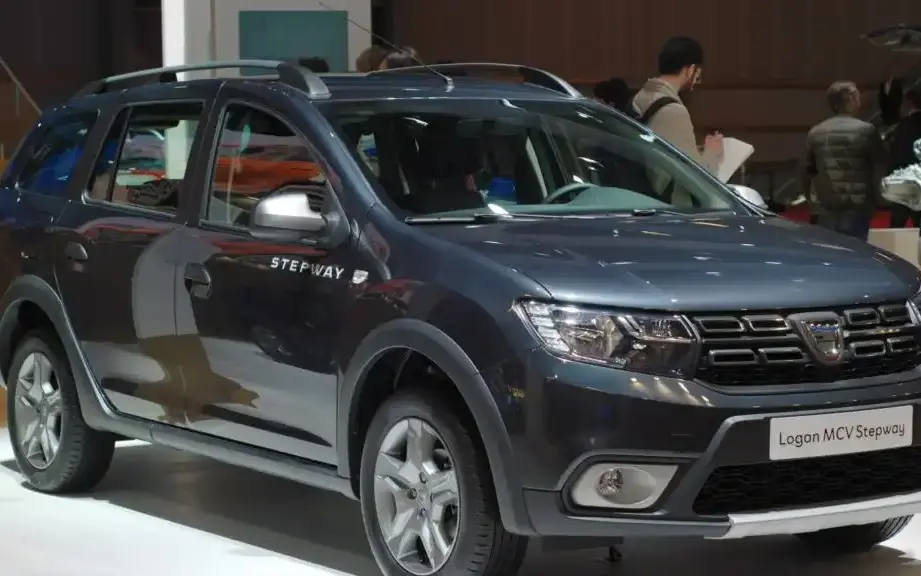
The Dacia Logan II MCV Stepway 1.0 TCe (101 hp) represents a specific variant within the second generation of Dacia’s popular Logan MCV (Multi-Capacity Vehicle) estate car line. Introduced with the 2017 facelift and produced from 2019 until September 2020, this version combined the practicality of the MCV body style with a downsized, turbocharged petrol engine. Positioned as a mid-range offering, it aimed to provide a balance between affordability, fuel efficiency, and acceptable performance for family use. The Stepway designation denotes a slightly more rugged appearance and increased ground clearance compared to the standard Logan MCV.
Technical Specifications
| Brand | Dacia |
| Model | Logan |
| Generation | Logan II MCV Stepway (facelift 2017) |
| Type (Engine) | 1.0 TCe (101 Hp) |
| Start of production | 2019 |
| End of production | September, 2020 |
| Powertrain Architecture | Internal Combustion engine |
| Body type | Station wagon (estate) |
| Seats | 5 |
| Doors | 5 |
| Fuel consumption (combined NEDC) | 5 l/100 km (47 US mpg, 56.5 UK mpg, 20 km/l) |
| CO2 emissions (NEDC) | 114 g/km |
| Fuel Type | Petrol (Gasoline) |
| Emission standard | Euro 6d-TEMP |
| Power | 101 Hp @ 5000 rpm |
| Power per litre | 101.1 Hp/l |
| Torque | 160 Nm @ 2000 rpm (118.01 lb.-ft. @ 2000 rpm) |
| Engine layout | Front, Transverse |
| Engine Model/Code | H4Dt |
| Engine displacement | 999 cm3 (60.96 cu. in.) |
| Number of cylinders | 3 |
| Engine configuration | Inline |
| Number of valves per cylinder | 4 |
| Fuel injection system | Multi-port manifold injection |
| Engine aspiration | Turbocharger, Intercooler |
| Engine oil capacity | 4.1 l (4.33 US qt | 3.61 UK qt) |
| Coolant capacity | 4.5 l (4.76 US qt | 3.96 UK qt) |
| Trunk (boot) space – minimum | 573 l (20.24 cu. ft.) |
| Trunk (boot) space – maximum | 1518 l (53.61 cu. ft.) |
| Fuel tank capacity | 50 l (13.21 US gal | 11 UK gal) |
| Length | 4528 mm (178.27 in.) |
| Width | 1761 mm (69.33 in.) |
| Width including mirrors | 1994 mm (78.5 in.) |
| Height | 1590 mm (62.6 in.) |
| Wheelbase | 2635 mm (103.74 in.) |
| Front track | 1491 mm (58.7 in.) |
| Rear track | 1481 mm (58.31 in.) |
| Front overhang | 846 mm (33.31 in.) |
| Rear overhang | 1047 mm (41.22 in.) |
| Ride height (ground clearance) | 174 mm (6.85 in.) |
| Minimum turning circle | 10.7 m (35.1 ft.) |
| Drivetrain Architecture | Front wheel drive |
| Number of gears and type of gearbox | 5 gears, manual transmission |
| Front brakes | Ventilated discs, 258×22 mm |
| Rear brakes | Drum |
Powertrain & Engine Architecture
The heart of this Logan MCV Stepway variant is the Renault-Nissan Alliance’s H4Dt 1.0 TCe three-cylinder petrol engine. This engine, part of the ‘Energy’ family, was designed for fuel efficiency and reduced emissions. It features a single-scroll turbocharger with an intercooler, coupled with multi-point fuel injection. The engine’s aluminum block and cylinder head contribute to its relatively lightweight construction. The 101 hp output is achieved at 5000 rpm, while peak torque of 160 Nm (118 lb-ft) is delivered at a more accessible 2000 rpm. This engine is known for its responsiveness at lower engine speeds, thanks to the turbocharger. The engine is paired with a five-speed manual transmission, which was the only gearbox option available for this configuration. The transmission is a conventional setup, prioritizing simplicity and cost-effectiveness.
Driving Characteristics
The 1.0 TCe engine, while providing adequate performance for everyday driving, isn’t particularly sporty. Acceleration is modest, and overtaking requires careful planning. The five-speed gearbox is well-matched to the engine’s characteristics, offering reasonable ratios for both urban and highway driving. Compared to the more powerful 0.9 TCe 90 hp version, the 101 hp variant offers a slight improvement in overall performance, particularly noticeable during highway cruising. However, it still falls short of the responsiveness of larger-displacement engines available in the Logan range. The Stepway’s increased ride height, while improving ground clearance, does introduce a slightly more noticeable body roll in corners.
Equipment & Trim Levels
The Stepway trim level, even in its base form, added a degree of visual appeal and practicality to the Logan MCV. Standard equipment typically included features such as air conditioning, power steering, electric front windows, a basic audio system with USB connectivity, and ABS brakes. The Stepway also featured distinctive plastic body cladding, roof rails, and raised suspension. Optional extras could include alloy wheels, a more advanced infotainment system with touchscreen display, rear parking sensors, and cruise control. Interior upholstery was typically cloth, with a functional and durable design. The dashboard layout was straightforward and user-friendly, prioritizing practicality over luxury.
Chassis & Braking
The Logan MCV Stepway utilizes a MacPherson strut front suspension and a torsion beam rear axle. This setup provides a comfortable ride quality, particularly on uneven road surfaces. The Stepway’s increased ride height contributes to improved ground clearance, making it more suitable for navigating rough roads or slightly off-road conditions. The braking system consists of ventilated discs on the front wheels and drum brakes on the rear. ABS (Anti-lock Braking System) is standard, providing enhanced braking performance and stability. The steering is hydraulic, offering a reasonably direct feel without being overly heavy.
Market Reception & Comparison
The Dacia Logan II MCV Stepway 1.0 TCe was generally well-received by critics as a practical and affordable family car. Its fuel efficiency and low running costs were particularly praised. However, some reviewers noted the engine’s lack of outright power and the somewhat basic interior. Compared to other Logan MCV variants, the 1.0 TCe offered a good balance between performance and economy. It was more affordable than the diesel options, while providing slightly better performance than the naturally aspirated petrol engines. In terms of reliability, the 1.0 TCe engine has proven to be generally dependable, although regular maintenance is essential to ensure long-term durability.
Legacy
The Dacia Logan II MCV Stepway 1.0 TCe represents a significant step in Dacia’s evolution as a mainstream automotive brand. It demonstrated the company’s ability to offer a practical, affordable, and relatively efficient estate car to a wide range of customers. While no longer in production, these models remain relatively common on the used car market. They are often sought after by buyers looking for a budget-friendly and spacious vehicle. The 1.0 TCe engine, despite its modest power output, has proven to be a reliable and economical powerplant, making this variant a sensible choice for those prioritizing practicality and value.