Technical Specifications
| Brand | Dacia |
| Model | Sandero |
| Generation | Sandero I |
| Type (Engine) | 1.6 8V (84 Hp) |
| Start of production | 2010 |
| End of production | 2012 |
| Powertrain Architecture | Internal Combustion engine |
| Body type | Hatchback |
| Seats | 5 |
| Doors | 5 |
| Fuel consumption (urban) | 9.3 l/100 km (25.3 US mpg) |
| Fuel consumption (extra urban) | 5.4 l/100 km (43.6 US mpg) |
| Fuel consumption (combined) | 6.7 l/100 km (35.1 US mpg) |
| CO2 emissions | 155 g/km |
| Fuel Type | Petrol (Gasoline) |
| Acceleration 0 – 100 km/h | 12.9 sec |
| Acceleration 0 – 62 mph | 12.9 sec |
| Acceleration 0 – 60 mph | 12.3 sec |
| Maximum speed | 169 km/h (105.01 mph) |
| Emission standard | Euro 5 |
| Weight-to-power ratio | 12.3 kg/Hp |
| Weight-to-torque ratio | 7.7 kg/Nm |
| Power | 84 Hp @ 5250 rpm |
| Torque | 135 Nm @ 3000 rpm (99.57 lb.-ft. @ 3000 rpm) |
| Engine layout | Front, Transverse |
| Engine Model/Code | K7M 800 |
| Engine displacement | 1598 cm3 (97.52 cu. in.) |
| Number of cylinders | 4 |
| Engine configuration | Inline |
| Cylinder Bore | 79.5 mm (3.13 in.) |
| Piston Stroke | 80.5 mm (3.17 in.) |
| Number of valves per cylinder | 2 |
| Fuel injection system | Multi-port manifold injection |
| Engine aspiration | Naturally aspirated |
| Valvetrain | SOHC |
| Engine oil capacity | 3.3 l (3.49 US qt | 2.9 UK qt) |
| Coolant capacity | 4.5 l (4.76 US qt | 3.96 UK qt) |
| Kerb Weight | 1036 kg (2283.99 lbs.) |
| Max. weight | 1536 kg (3386.3 lbs.) |
| Max load | 500 kg (1102.31 lbs.) |
| Trunk (boot) space – minimum | 320 l (11.3 cu. ft.) |
| Trunk (boot) space – maximum | 1200 l (42.38 cu. ft.) |
| Fuel tank capacity | 50 l (13.21 US gal | 11 UK gal) |
| Max. roof load | 80 kg (176.37 lbs.) |
| Permitted trailer load (braked) | 1100 kg (2425.08 lbs.) |
| Permitted trailer load (unbraked) | 555 kg (1223.57 lbs.) |
| Permitted towbar download | 75 kg (165.35 lbs.) |
| Length | 4020 mm (158.27 in.) |
| Width | 1746 mm (68.74 in.) |
| Width including mirrors | 1997 mm (78.62 in.) |
| Height | 1534 mm (60.39 in.) |
| Wheelbase | 2588 mm (101.89 in.) |
| Front track | 1480 mm (58.27 in.) |
| Rear track | 1470 mm (57.87 in.) |
| Front overhang | 781 mm (30.75 in.) |
| Rear overhang | 651 mm (25.63 in.) |
| Ride height (ground clearance) | 155 mm (6.1 in.) |
| Minimum turning circle | 10.5 m (34.45 ft.) |
| Drivetrain | Front wheel drive |
| Number of gears | 5 |
| Gearbox type | Manual transmission |
| Front suspension | Independent type McPherson, Transverse stabilizer |
| Rear suspension | Coil spring, Torsion |
| Front brakes | Ventilated discs, 259 mm |
| Rear brakes | Drum, 203 mm |
| Assisting systems | ABS (Anti-lock braking system) |
| Steering type | Steering rack and pinion |
| Power steering | Hydraulic |
| Tires size | 185/65 R15 |
| Wheel rims size | 6J x 15 |
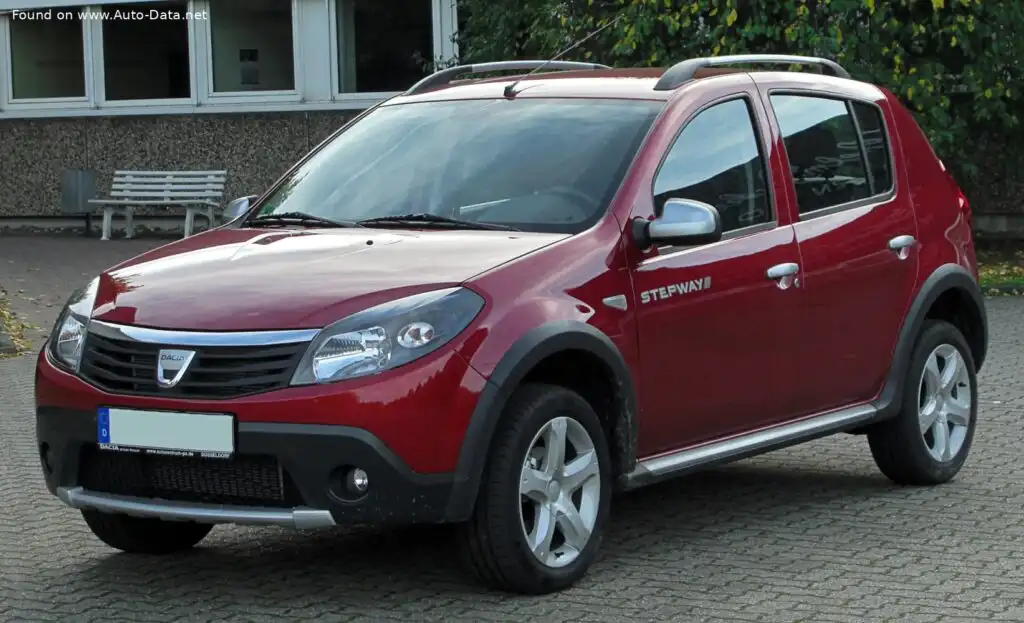
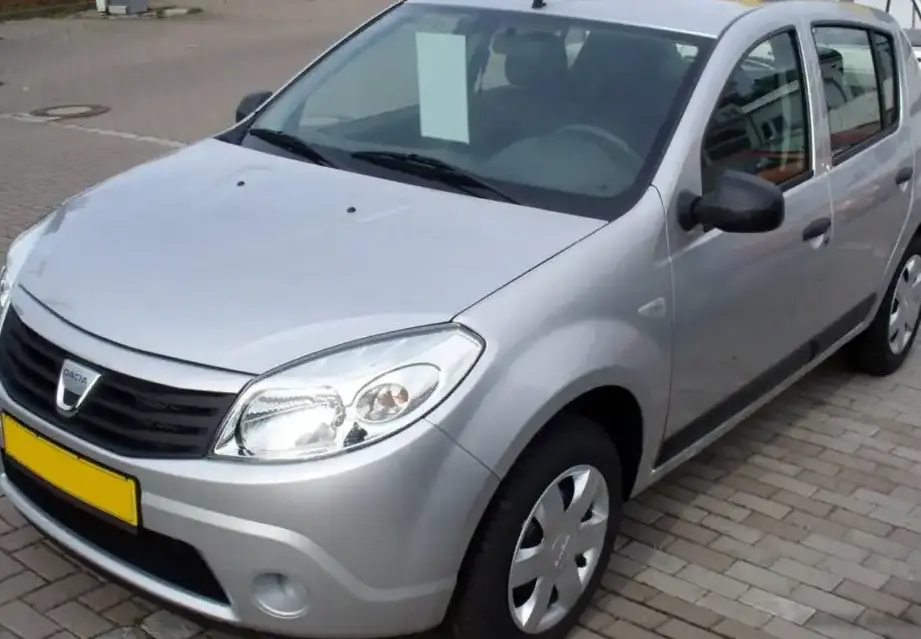
The Dacia Sandero I 1.6 8V (84 hp) was introduced in 2010 as a core component of the Sandero lineup. Built on the Renault/Nissan B platform, it shared underpinnings with models like the Renault Clio III and Nissan Micra. This platform choice allowed Dacia to leverage existing engineering and manufacturing processes, keeping costs down. The 1.6 8V engine, designated K7M 800, was a well-established unit within the Renault group, known for its simplicity and durability. This variant served as the entry point to the Sandero range, offering a balance between affordability and practicality for buyers in Europe and other emerging markets.
Powertrain & Engine Architecture
The heart of this Sandero variant is the K7M 800 1.6-liter inline-four cylinder engine. This engine is a naturally aspirated, eight-valve (two valves per cylinder) unit employing a single overhead camshaft (SOHC) valvetrain. Fuel delivery is managed by a multi-point fuel injection system. The K7M engine is known for its robust construction and relative simplicity, contributing to its reliability. The engine produces 84 horsepower at 5250 rpm and 135 Nm (99.57 lb-ft) of torque at 3000 rpm. The engine is transversely mounted at the front of the vehicle. Paired with the engine is a five-speed manual transmission, chosen for its cost-effectiveness and efficiency. This transmission features standard gear ratios optimized for fuel economy and everyday driving rather than sporty performance.
Driving Characteristics
The Sandero 1.6 8V with a manual transmission delivers modest performance. Acceleration from 0 to 100 km/h (0-62 mph) takes approximately 12.9 seconds, and the top speed is around 169 km/h (105 mph). The power delivery is linear but not particularly strong, requiring drivers to utilize the engine’s rev range to achieve optimal acceleration. The five-speed gearbox is adequately spaced, but the lack of a sixth gear means engine speeds can be relatively high at highway speeds. Compared to higher-output versions of the Sandero, such as those equipped with the 0.9 TCe turbocharged engine, this 1.6 8V feels noticeably less responsive. However, it offers a more predictable and forgiving driving experience, making it suitable for novice drivers or those prioritizing ease of use.
Equipment & Trim Levels
The 1.6 8V Sandero typically came with a basic level of equipment, reflecting its position as the entry-level model. Standard features generally included power steering, central locking, front electric windows, and an immobilizer. Interior upholstery was typically cloth, and the dashboard featured a simple, functional design. Optional extras, depending on the market, could include air conditioning, a radio/CD player, and alloy wheels. Higher trim levels, such as the Ambiance and Laureate, added features like body-colored bumpers, electric rear windows, and a more comprehensive audio system. The base trim focused on providing essential functionality at the lowest possible price point.
Chassis & Braking
The Sandero I utilizes a McPherson strut front suspension and a torsion beam rear suspension. This setup provides a comfortable ride quality, although it’s not particularly sporty. The front brakes are ventilated discs, while the rear brakes are drums. This configuration was common for vehicles in this price segment at the time. Anti-lock Braking System (ABS) was standard, enhancing safety. The steering is a hydraulic power steering system, offering reasonable assistance without feeling overly light or disconnected. The suspension tuning prioritizes comfort and stability over handling precision.
Market Reception & Comparison
The Dacia Sandero I 1.6 8V was generally well-received by critics as an exceptionally affordable and practical hatchback. It was praised for its low purchase price, fuel efficiency, and reliability. However, it was also criticized for its basic interior, modest performance, and lack of advanced features. Compared to other trims in the Sandero lineup, the 1.6 8V offered the lowest running costs but also the least exciting driving experience. The 1.5 dCi diesel variant, for example, provided superior fuel economy, while the higher-powered petrol engines offered more responsive performance. Despite these drawbacks, the 1.6 8V remained a popular choice for budget-conscious buyers.
Legacy
The K7M engine, used in the Sandero 1.6 8V, has a reputation for being a durable and reliable unit. While not known for its cutting-edge technology, its simplicity contributes to its longevity. In the used car market, Sandero I 1.6 8V models are often available at very low prices, making them attractive to first-time car buyers or those seeking a cheap and dependable runabout. Maintenance costs are generally low, and parts are readily available. However, potential buyers should be aware of the engine’s age and potential for wear and tear. Overall, the Sandero I 1.6 8V represents a significant milestone in Dacia’s history, demonstrating the brand’s commitment to providing affordable and practical transportation.