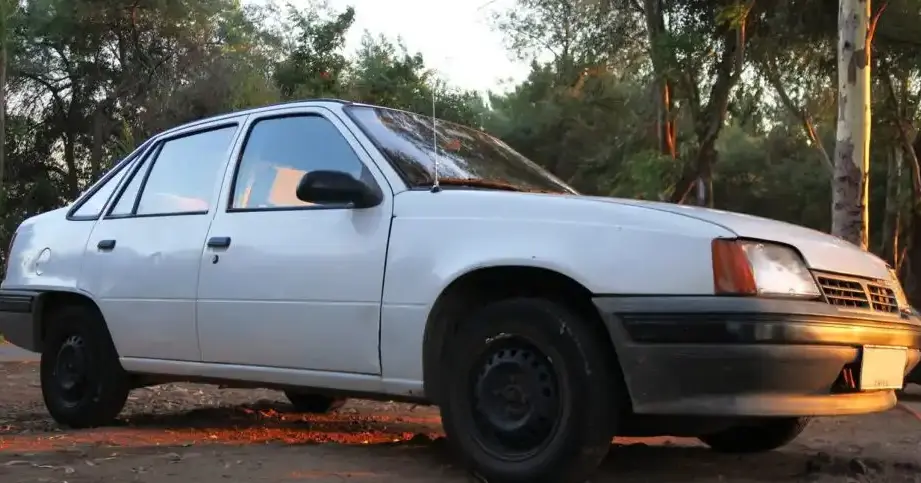
The Daewoo Racer, specifically the 1.6i variant with an automatic transmission, represents a significant entry in the compact hatchback market of the late 1980s and early 1990s. Produced from 1986 to 1995, the Racer was Daewoo’s initial foray into independent vehicle design and manufacturing, moving away from primarily assembling licensed models. This 3-door hatchback, positioned as an affordable and practical transportation option, played a crucial role in establishing the Daewoo brand, particularly in South Korea and export markets. The 1.6i Automatic trim occupied a middle ground in the Racer lineup, offering a balance between economy and convenience, appealing to buyers seeking an easy-to-drive city car.
Technical Specifications
| Brand | Daewoo |
| Model | Racer |
| Generation | Racer Hatchback |
| Type (Engine) | 1.6i (75 Hp) Automatic |
| Start of production | 1986 |
| End of production | 1995 |
| Powertrain Architecture | Internal Combustion engine |
| Body type | Hatchback |
| Seats | 5 |
| Doors | 3 |
| Fuel Type | Petrol (Gasoline) |
| Weight-to-power ratio | 13.2 kg/Hp, 75.8 Hp/tonne |
| Weight-to-torque ratio | 8.1 kg/Nm, 123.2 Nm/tonne |
| Power | 75 Hp @ 5600 rpm |
| Power per litre | 46.9 Hp/l |
| Torque | 122 Nm @ 2800 rpm (89.98 lb.-ft. @ 2800 rpm) |
| Engine layout | Front, Transverse |
| Engine displacement | 1598 cm3 (97.52 cu. in.) |
| Number of cylinders | 4 |
| Engine configuration | Inline |
| Cylinder Bore | 79 mm (3.11 in.) |
| Piston Stroke | 81.5 mm (3.21 in.) |
| Compression ratio | 8.6:1 |
| Number of valves per cylinder | 2 |
| Fuel injection system | Single-point injection |
| Engine aspiration | Naturally aspirated engine |
| Valvetrain | OHC |
| Kerb Weight | 990 kg (2182.58 lbs.) |
| Fuel tank capacity | 50 l (13.21 US gal | 11 UK gal) |
| Length | 4158 mm (163.7 in.) |
| Width | 1663 mm (65.47 in.) |
| Height | 1360 mm (53.54 in.) |
| Wheelbase | 2520 mm (99.21 in.) |
| Front track | 1400 mm (55.12 in.) |
| Rear (Back) track | 1406 mm (55.35 in.) |
| Drivetrain Architecture | The Internal combustion engine (ICE) drives the front wheels of the vehicle. |
| Drive wheel | Front wheel drive |
| Number of gears and type of gearbox | 3 gears, automatic transmission |
| Front suspension | Wishbone |
| Rear suspension | Coil spring |
| Front brakes | Disc |
| Rear brakes | Drum |
| Assisting systems | ABS (Anti-lock braking system) |
| Steering type | Steering rack and pinion |
| Tires size | 175/70 R13 |
Powertrain & Engine Architecture
The heart of the Racer 1.6i Automatic is a 1.6-liter inline four-cylinder engine. Designated with various codes depending on the market, this engine utilized a single-point fuel injection system, a common feature for vehicles of this era aiming for a balance between cost and efficiency. The engine’s overhead camshaft (OHC) valvetrain operated two valves per cylinder, contributing to reasonable power output for its displacement. The 75 horsepower peak arrived at 5600 rpm, while 122 Nm (89.98 lb-ft) of torque was available at 2800 rpm. This engine was known for its relative simplicity and ease of maintenance. The automatic transmission was a 3-speed unit, designed for smooth, if not particularly sporty, gear changes. It was a typical automatic of the period, prioritizing comfort over performance.
Driving Characteristics
The Racer 1.6i Automatic offered a comfortable, albeit uninspiring, driving experience. The automatic transmission, while convenient, noticeably dulled the engine’s performance compared to the available 5-speed manual version. Acceleration was adequate for city driving and highway merging, but passing maneuvers required careful planning. The 3-speed automatic’s gear ratios were spaced to prioritize fuel economy and smooth cruising, rather than rapid acceleration. The weight-to-power ratio of 13.2 kg/Hp meant that the car felt somewhat sluggish, especially when fully loaded. Steering was light and easy, making it maneuverable in urban environments, but lacked the precision found in more performance-oriented hatchbacks.
Equipment & Trim Levels
The 1.6i Automatic trim level generally included features considered standard for the time. These typically included cloth upholstery, a basic instrument cluster, and manual windows and door locks. Air conditioning was often an optional extra, as were features like a radio/cassette player. The interior design was functional and straightforward, prioritizing practicality over luxury. The dashboard layout was simple, with easily accessible controls. Higher trim levels, if available in certain markets, might have added features like upgraded upholstery, a sunroof, or power steering, but the 1.6i Automatic was generally positioned as a value-oriented offering.
Chassis & Braking
The Racer’s chassis featured a front wishbone suspension and a rear coil spring setup. This configuration provided a reasonably comfortable ride, absorbing bumps and imperfections in the road surface effectively. However, the suspension was not particularly sophisticated, and the car exhibited noticeable body roll during cornering. The braking system consisted of front disc brakes and rear drum brakes. While adequate for normal driving conditions, the drum brakes on the rear limited overall braking performance. An Anti-lock Braking System (ABS) was available as an option, enhancing safety by preventing wheel lockup during hard braking.
Market Reception & Comparison
The Daewoo Racer 1.6i Automatic was generally well-received as an affordable and reliable hatchback. Critics praised its practicality, fuel efficiency, and ease of driving. However, it was often criticized for its lack of performance and somewhat bland styling. Compared to other hatchbacks in its class, such as the Ford Escort or Volkswagen Golf, the Racer offered a lower price point but lacked the refinement and driving dynamics of its European competitors. The automatic transmission, while convenient, further diminished its performance advantage. Fuel economy was a strong point, making it an attractive option for budget-conscious buyers.
Legacy
The Daewoo Racer, and particularly the 1.6i Automatic variant, holds a modest but important place in automotive history. It represented Daewoo’s first significant step towards becoming a global automotive manufacturer. The powertrain, while not groundbreaking, proved to be relatively durable and reliable. Today, well-maintained examples are becoming increasingly rare, appealing to collectors and enthusiasts interested in 1980s and 1990s Korean automotive history. The 1.6-liter engine’s simplicity makes it relatively easy to repair and maintain, contributing to its longevity. While not a performance icon, the Racer 1.6i Automatic remains a testament to Daewoo’s early ambitions and its commitment to providing affordable transportation.