Technical Specifications
| Brand | Dodge |
| Model | RAM |
| Generation | Ram 3500 Regular Cab Long Bed (BR/BE) |
| Type (Engine) | DRW 5.9 Cummins TD (175 Hp) 4×4 |
| Start of production | 1994 |
| End of production | 1998 |
| Powertrain Architecture | Internal Combustion engine |
| Body type | Pick-up |
| Seats | 3 |
| Doors | 2 |
| Fuel Type | Diesel |
| Power | 175 Hp @ 2500 rpm |
| Power per litre | 29.7 Hp/l |
| Torque | 583 Nm @ 1600 rpm |
| Torque (lb-ft) | 430 lb.-ft. @ 1600 rpm |
| Engine layout | Front, Longitudinal |
| Engine displacement | 5883 cm3 |
| Engine displacement (cu. in.) | 359 cu. in. |
| Number of cylinders | 6 |
| Engine configuration | Inline |
| Cylinder Bore | 102 mm (4.02 in) |
| Piston Stroke | 120 mm (4.72 in) |
| Compression ratio | 17.5:1 |
| Number of valves per cylinder | 2 |
| Fuel injection system | Direct injection |
| Engine aspiration | Turbocharger, Intercooler |
| Engine oil capacity | 10.4 l (10.99 US qt | 9.15 UK qt) |
| Coolant capacity | 24.5 l (25.89 US qt | 21.56 UK qt) |
| Max. weight | 4581 kg (10099.38 lbs) |
| Permitted trailer load with brakes (12%) | 4173 kg (9199.89 lbs) |
| Length | 5692 mm (224.09 in) |
| Width including mirrors | 2383 mm (93.82 in) |
| Height | 1966 mm (77.4 in) |
| Wheelbase | 3429 mm (135 in) |
| Approach angle | 33.3° |
| Departure angle | 24.7° |
| Ramp-over (brakeover) angle | 23.5° |
| Drivetrain Architecture | All wheel drive (4×4). ICE drives rear wheels, front wheels engaged via clutch. |
| Number of gears and type of gearbox | 5 gears, manual transmission |
| Front suspension | Dependent spring suspension with anti-roll bar |
| Rear suspension | Rigid axle suspension, Leaf spring |
| Front brakes | Disc |
| Rear brakes | Drum |
| Assisting systems | ABS (Anti-lock braking system) |
| Steering type | Steering rack and pinion |
| Power steering | Hydraulic Steering |
| Tires size | 215/85 R16 |
| Wheel rims size | 6J x 16 |
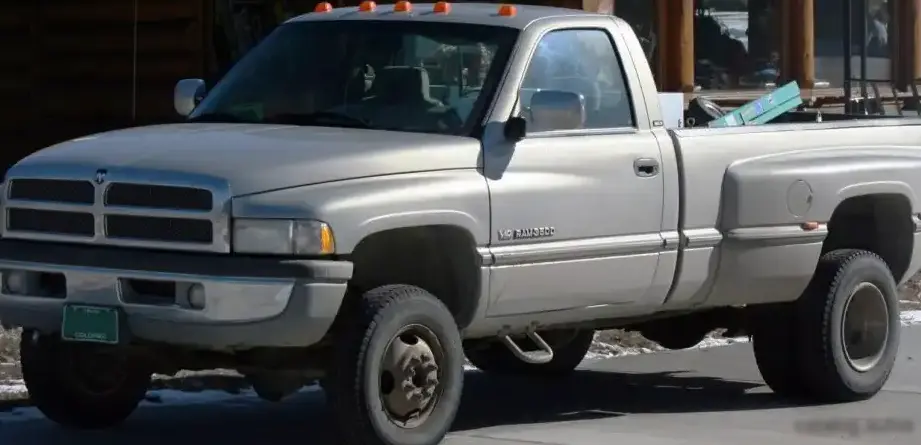
The Dodge Ram 3500 Regular Cab Long Bed (BR/BE) DRW 5.9 Cummins TD, produced from 1994 to 1998, represents a significant iteration of Dodge’s heavy-duty pickup truck lineage. This particular variant, equipped with the 5.9-liter Cummins turbodiesel engine and a four-wheel-drive system, was positioned as a workhorse for demanding tasks, catering to owners needing substantial towing and payload capacity. The “DRW” designation signifies a Dual Rear Wheel configuration, further enhancing its capabilities. It was part of the second generation of Ram trucks, known for its more aerodynamic styling and improved interior compared to its predecessors.
Powertrain & Engine Architecture
The heart of this Ram 3500 is the 5.9-liter (359 cubic inch) Cummins B-series inline-six diesel engine. This engine, designated with various codes depending on specific calibration (though commonly associated with the BE code in this era), was renowned for its durability and torque output. The 175 horsepower rating at 2500 rpm, while modest by modern standards, was paired with a substantial 430 lb-ft of torque available at a low 1600 rpm. This torque curve made it exceptionally well-suited for heavy hauling and towing. The engine utilized a direct injection system, a hallmark of Cummins diesels, which contributed to its efficiency and power. A turbocharger with an intercooler further enhanced performance by forcing more air into the cylinders. The five-speed manual transmission was the standard offering, chosen for its robustness and driver control, and was geared to maximize the engine’s torque for work applications.
Driving Characteristics
Behind the wheel, the 1994-1998 Ram 3500 with the 5.9L Cummins and manual transmission prioritized capability over outright speed. Acceleration was deliberate, but the engine’s abundant low-end torque allowed for confident towing and hauling, even when fully loaded. The manual transmission provided precise control, allowing drivers to select the optimal gear for the task at hand. Compared to later, higher-horsepower Cummins variants, this 175 hp version felt less refined but offered a more direct connection to the engine. The dual rear wheels provided enhanced stability when carrying heavy loads, and the four-wheel-drive system ensured traction in challenging conditions. The ride quality, typical of a heavy-duty truck, was firm, but the suspension was designed to absorb the impacts of rough terrain and heavy payloads.
Equipment & Trim Levels
The Ram 3500 Regular Cab Long Bed (BR/BE) DRW was generally offered in basic work-truck trim levels. Standard features typically included a vinyl interior, manual windows and locks, and a basic AM/FM radio. Air conditioning was often an optional extra, as were power windows and locks. The emphasis was on functionality and durability rather than luxury. The interior was designed to withstand the rigors of daily work use. The long bed configuration provided ample cargo space, and the dual rear wheels increased the truck’s payload capacity. Options like a trailer towing package, heavy-duty suspension upgrades, and various auxiliary lighting packages were available to further enhance the truck’s capabilities.
Chassis & Braking
The Ram 3500’s chassis was built for strength and durability. It featured a robust ladder frame construction, designed to withstand the stresses of heavy loads and demanding work conditions. The front suspension utilized a dependent spring setup with an anti-roll bar, while the rear suspension employed a rigid axle with leaf springs. This configuration provided a stable and predictable ride, even when carrying heavy payloads. The braking system consisted of disc brakes on the front axle and drum brakes on the rear. An Anti-lock Braking System (ABS) was included as a standard safety feature, improving braking performance and control, especially in slippery conditions. The tires, typically 215/85 R16 size, were chosen for their durability and load-carrying capacity.
Market Reception & Comparison
The Dodge Ram 3500 DRW 5.9 Cummins TD was well-received by buyers who needed a capable and reliable heavy-duty truck. Critics praised the Cummins engine’s durability and torque output, as well as the truck’s overall build quality. Compared to other heavy-duty trucks of the era, such as the Ford F-350 and Chevrolet K3500, the Ram 3500 offered a competitive combination of performance, capability, and value. While the 175 hp output was lower than some competing engines, the Cummins’ torque advantage made it a strong performer in real-world work applications. Fuel economy, while not a primary concern for heavy-duty truck buyers, was generally considered to be acceptable for a diesel engine of this size.
Legacy
The 1994-1998 Dodge Ram 3500 DRW 5.9 Cummins TD has earned a reputation as a durable and reliable work truck. The Cummins engine, in particular, is highly regarded for its longevity and ability to withstand high mileage. Today, these trucks are still found in use, often with well over 200,000 miles on the odometer. The availability of parts and the relatively simple mechanical design make them relatively easy to maintain and repair. In the used car market, well-maintained examples command a premium price, reflecting their enduring reputation for reliability and capability. This generation of Ram 3500 cemented the Cummins engine’s place as a benchmark for heavy-duty diesel performance and durability.