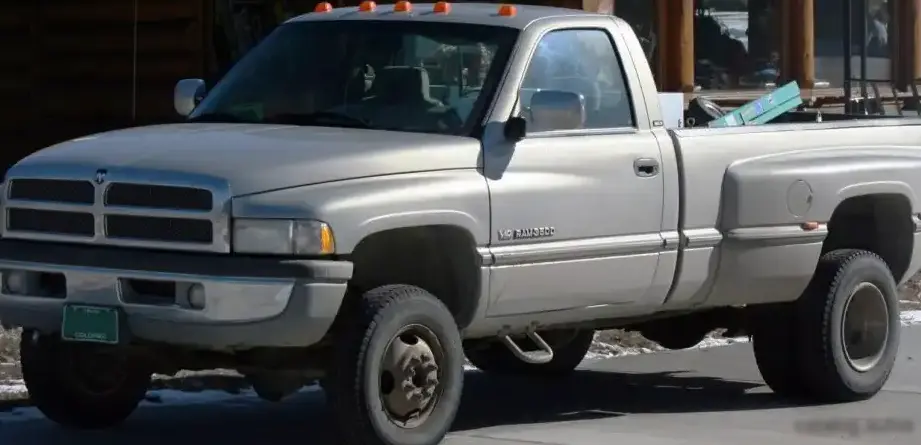
The Dodge Ram 3500 Regular Cab Long Bed (BR/BE) DRW, equipped with the 5.9 V8 engine producing 230 horsepower, represents a significant workhorse offering from Dodge during the 1994-1998 model years. This particular configuration, a dual rear wheel (DRW) pickup with four-wheel drive, was aimed at buyers needing substantial towing and hauling capacity. It occupied a position within the Ram 3500 lineup as a robust, gasoline-powered option, positioned below the Cummins diesel variants but offering a more affordable entry point for heavy-duty tasks. The BR/BE designation refers to the chassis codes used during this generation.
Technical Specifications
| Brand | Dodge |
| Model | RAM |
| Generation | Ram 3500 Regular Cab Long Bed (BR/BE) |
| Type (Engine) | DRW 5.9 V8 (230 Hp) 4×4 |
| Start of production | 1994 |
| End of production | 1998 |
| Powertrain Architecture | Internal Combustion engine |
| Body type | Pick-up |
| Seats | 3 |
| Doors | 2 |
| Fuel Type | Petrol (Gasoline) |
| Power | 230 Hp @ 4000 rpm |
| Power per litre | 39 Hp/l |
| Torque | 447 Nm @ 2800 rpm |
| Torque (lb-ft) | 329.69 lb.-ft. @ 2800 rpm |
| Engine layout | Front, Longitudinal |
| Engine Model/Code | 360 Magnum |
| Engine displacement | 5899 cm3 |
| Engine displacement (cu. in.) | 359.98 cu. in. |
| Number of cylinders | 8 |
| Engine configuration | V-engine |
| Fuel injection system | Multi-port manifold injection |
| Engine aspiration | Naturally aspirated engine |
| Engine oil capacity | 4.7 l |
| Engine oil capacity (US qt) | 4.97 US qt |
| Engine oil capacity (UK qt) | 4.14 UK qt |
| Coolant | 19 l |
| Coolant (US qt) | 20.08 US qt |
| Coolant (UK qt) | 16.72 UK qt |
| Max. weight | 3992 kg |
| Max. weight (lbs) | 8800.85 lbs |
| Permitted trailer load with brakes (12%) | 5987 kg |
| Permitted trailer load with brakes (lbs) | 13199.08 lbs |
| Length | 5692 mm |
| Length (in) | 224.09 in |
| Width including mirrors | 2383 mm |
| Width including mirrors (in) | 93.82 in |
| Height | 1966 mm |
| Height (in) | 77.4 in |
| Wheelbase | 3429 mm |
| Wheelbase (in) | 135 in |
| Approach angle | 33.3° |
| Departure angle | 29.1° |
| Ramp-over (brakeover) angle | 19.4° |
| Drivetrain Architecture | The Internal combustion engine (ICE) drives the rear wheels permanently, and the front wheels are driven through an electrically or mechanically operated clutch if necessary. |
| Drive wheel | All wheel drive (4×4) |
| Number of gears | 5 |
| Type of gearbox | manual transmission |
| Front suspension | Dependent spring suspension with anti-roll bar |
| Rear suspension | Rigid axle suspension, Leaf spring |
| Front brakes | Disc |
| Rear brakes | Drum |
| Assisting systems | ABS (Anti-lock braking system) |
| Steering type | Steering rack and pinion |
| Power steering | Hydraulic Steering |
| Tires size | 215/85 R16 |
| Wheel rims size | 6J x 16 |
Powertrain & Engine Architecture
The heart of this Ram 3500 variant is the 360 Magnum 5.9-liter V8 engine. This engine, a member of the LA engine family, is a pushrod design featuring a cast iron block and aluminum cylinder heads. It utilizes a multi-port fuel injection system, delivering fuel directly to each cylinder for improved efficiency and power delivery. The 360 Magnum was known for its relatively simple design and robust construction. The engine produced 230 horsepower at 4000 rpm and 447 Nm (329.69 lb-ft) of torque at 2800 rpm. The five-speed manual transmission was the standard offering, providing a direct connection to the engine’s power. This transmission was chosen for its durability and suitability for heavy-duty applications.
Driving Characteristics
The 5.9L V8 and five-speed manual combination in the Ram 3500 offered a balance between usability and capability. While not as quick as lighter-duty pickups, the engine provided ample torque for hauling heavy loads and navigating challenging terrain. The manual transmission allowed for precise control, particularly useful when towing or off-roading. Compared to the Cummins diesel options, this gasoline engine was noticeably less fuel-efficient, but it offered a lower initial purchase price and a simpler maintenance profile. The DRW configuration significantly enhanced stability when towing, distributing the load weight over a wider footprint. The gearing in the five-speed manual was optimized for towing, with lower gears providing strong pulling power and higher gears for efficient highway cruising.
Equipment & Trim Levels
The Ram 3500 Regular Cab Long Bed (BR/BE) DRW 5.9 V8 4×4 was typically offered with a fairly basic level of equipment, reflecting its work-oriented nature. Standard features generally included a vinyl bench seat, basic instrumentation, and a heavy-duty suspension. Air conditioning and an upgraded sound system were common optional extras. The interior was functional and durable, designed to withstand the rigors of daily use. Trim levels were relatively limited, with most customization options revolving around adding features like power windows, power locks, and a tilt steering wheel. The focus was on providing a reliable and capable truck rather than luxurious amenities.
Chassis & Braking
The Ram 3500’s chassis was built for durability and heavy-duty use. It featured a robust ladder frame construction, designed to withstand significant stress. The front suspension utilized a dependent spring setup with an anti-roll bar, while the rear suspension employed a rigid axle with leaf springs. This configuration provided a comfortable ride, even when carrying heavy loads. The braking system consisted of disc brakes on the front axle and drum brakes on the rear. An Anti-lock Braking System (ABS) was included as a standard safety feature. The DRW configuration, with its dual rear wheels, provided increased stability and load-carrying capacity. The tires, typically 215/85 R16, were chosen for their durability and ability to handle heavy loads.
Market Reception & Comparison
The Dodge Ram 3500 with the 5.9 V8 engine was generally well-received by buyers who needed a capable and affordable heavy-duty truck. Critics acknowledged its strong towing capacity and robust construction, but also noted its lower fuel economy compared to diesel alternatives. Compared to the Cummins diesel-powered Ram 3500s, the 5.9 V8 offered a lower purchase price and simpler maintenance, making it an attractive option for those who didn’t require the ultimate in towing power or fuel efficiency. The manual transmission was praised for its durability and control, but some drivers preferred the convenience of an automatic transmission. Overall, this variant represented a solid value proposition for buyers seeking a reliable and capable work truck.
Legacy
The 360 Magnum engine, while eventually superseded by more modern powertrains, remains a relatively reliable and straightforward engine to maintain. Parts availability is generally good, and the engine’s simple design makes it relatively easy to diagnose and repair. Today, these Ram 3500s are often found in the hands of enthusiasts and those who continue to use them for work. The DRW configuration, in particular, is highly sought after by those who need maximum towing capacity. While not as collectible as some other classic trucks, the Ram 3500 with the 5.9 V8 engine represents a significant chapter in Dodge’s history of building durable and capable work trucks. The used market values these trucks for their simplicity, robustness, and affordability.