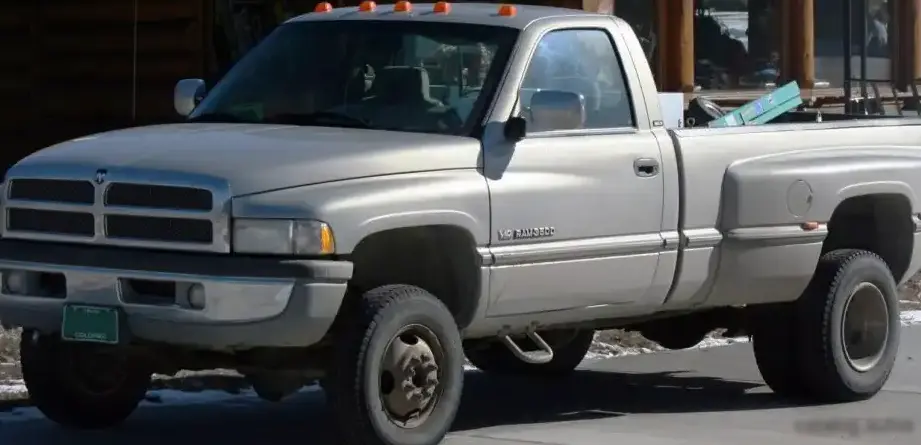
The Dodge Ram 3500 Regular Cab Long Bed (BR/BE) DRW 8.0 V10 4×4 Automatic, produced from 1994 to 1998, represented a significant offering in the heavy-duty pickup truck segment. This variant, characterized by its dual rear wheel (DRW) configuration and substantial 8.0-liter V10 engine, was aimed at buyers requiring serious towing and hauling capabilities. It occupied a premium position within the Ram 3500 lineup, positioned above the Cummins diesel and smaller gasoline engine options. The BR/BE generation marked a substantial redesign for the Ram series, moving away from the previous generation’s more utilitarian aesthetic towards a more modern and aerodynamic design.
Technical Specifications
| Brand | Dodge |
| Model | RAM |
| Generation | Ram 3500 Regular Cab Long Bed (BR/BE) |
| Type (Engine) | DRW 8.0 V10 (300 Hp) 4×4 Automatic |
| Start of production | 1994 |
| End of production | 1998 |
| Powertrain Architecture | Internal Combustion engine |
| Body type | Pick-up |
| Seats | 3 |
| Doors | 2 |
| Fuel Type | Petrol (Gasoline) |
| Power | 300 Hp @ 4000 rpm |
| Power per litre | 37.5 Hp/l |
| Torque | 610 Nm @ 2400 rpm / 449.91 lb.-ft. @ 2400 rpm |
| Engine layout | Front, Longitudinal |
| Engine Model/Code | 488 Magnum |
| Engine displacement | 7997 cm3 / 488.01 cu. in. |
| Number of cylinders | 10 |
| Engine configuration | V-engine |
| Fuel injection system | Multi-port manifold injection |
| Engine oil capacity | 6.6 l / 6.97 US qt | 5.81 UK qt |
| Coolant | 22.7 l / 23.99 US qt | 19.97 UK qt |
| Max. weight | 4763 kg / 10500.62 lbs |
| Permitted trailer load with brakes (12%) | 5806 kg / 12800.04 lbs |
| Length | 5692 mm / 224.09 in |
| Width including mirrors | 2383 mm / 93.82 in |
| Height | 1966 mm / 77.4 in |
| Wheelbase | 3429 mm / 135 in |
| Approach angle | 33.3° |
| Departure angle | 29.1° |
| Ramp-over (brakeover) angle | 23.5° |
| Drivetrain Architecture | All wheel drive (4×4). ICE drives rear wheels, front wheels engaged via clutch. |
| Number of gears and type of gearbox | 4 gears, automatic transmission |
| Front suspension | Dependent spring suspension with anti-roll bar |
| Rear suspension | Rigid axle suspension, Leaf spring |
| Front brakes | Disc |
| Rear brakes | Drum |
| Assisting systems | ABS (Anti-lock braking system) |
| Steering type | Steering rack and pinion |
| Power steering | Hydraulic Steering |
| Tires size | 215/85 R16 |
| Wheel rims size | 6J x 16 |
Powertrain & Engine Architecture
The heart of this Ram 3500 variant was the 488 Magnum V10 engine. Displacing 8.0 liters (488 cubic inches), this engine was a naturally aspirated, 300 horsepower powerplant. It utilized a multi-port fuel injection system to deliver fuel to the cylinders, and featured a robust cast iron block and aluminum cylinder heads. The engine’s 90-degree V configuration contributed to its relatively smooth operation for its size. The automatic transmission paired with the V10 was a 4-speed unit, designed to handle the engine’s substantial torque output. While not as fuel-efficient as smaller engines or diesel alternatives, the V10 provided a distinctive sound and ample power for demanding tasks.
Driving Characteristics
The 8.0L V10 and 4-speed automatic combination delivered a unique driving experience. Acceleration, while not blistering, was strong, particularly when unladen. The automatic transmission’s gear ratios were optimized for towing and hauling, prioritizing low-end torque over outright speed. Compared to the Cummins diesel options, the V10 offered quicker throttle response and a less agricultural feel. However, it lacked the diesel’s superior fuel economy and ultimate towing capacity. The dual rear wheels provided enhanced stability when carrying heavy loads, and the 4×4 system offered improved traction in challenging conditions. The overall driving experience was characterized by a sense of substantiality and capability.
Equipment & Trim Levels
The Ram 3500 BR/BE offered a range of trim levels, with the V10 4×4 typically found in higher-spec configurations. Standard features included air conditioning, a basic audio system, and cloth upholstery. Power windows and locks were often included, as was a tilt steering wheel. Optional extras included leather upholstery, upgraded audio systems, and various towing packages. The interior design, while functional, was relatively basic compared to some contemporary trucks, focusing on durability and ease of use. The long bed configuration provided ample cargo space, making it ideal for hauling large items.
Chassis & Braking
The Ram 3500’s chassis was built for heavy-duty work. It featured a robust frame and a heavy-duty suspension system. The front suspension utilized a dependent spring setup with an anti-roll bar, while the rear suspension employed a rigid axle with leaf springs. This configuration provided a comfortable ride, even when carrying heavy loads. Braking duties were handled by disc brakes at the front and drum brakes at the rear. An Anti-lock Braking System (ABS) was included as standard, enhancing safety during emergency braking situations. The DRW configuration significantly increased the truck’s stability and load-carrying capacity.
Market Reception & Comparison
The Dodge Ram 3500 with the 8.0L V10 engine received mixed reviews. Critics praised its power and towing capabilities, but noted its relatively poor fuel economy compared to diesel alternatives. The V10 was often seen as a niche engine, appealing to buyers who prioritized gasoline power and a distinctive driving experience. Compared to the Cummins diesel, the V10 was less popular among commercial users who valued fuel efficiency and long-term durability. However, it found favor among recreational users and those who preferred the sound and feel of a gasoline engine.
Legacy
The 488 Magnum V10 engine, while not as ubiquitous as the Cummins diesel, has developed a loyal following among enthusiasts. The BR/BE generation Ram 3500 is now considered a classic truck, and well-maintained examples are increasingly sought after by collectors. The V10 powertrain, while known for its thirst for fuel, is generally considered reliable if properly maintained. Common issues include oil leaks and sensor failures, but these are typically straightforward to address. Today, these trucks represent a unique chapter in American truck history, offering a blend of power, capability, and a distinctive driving experience.