
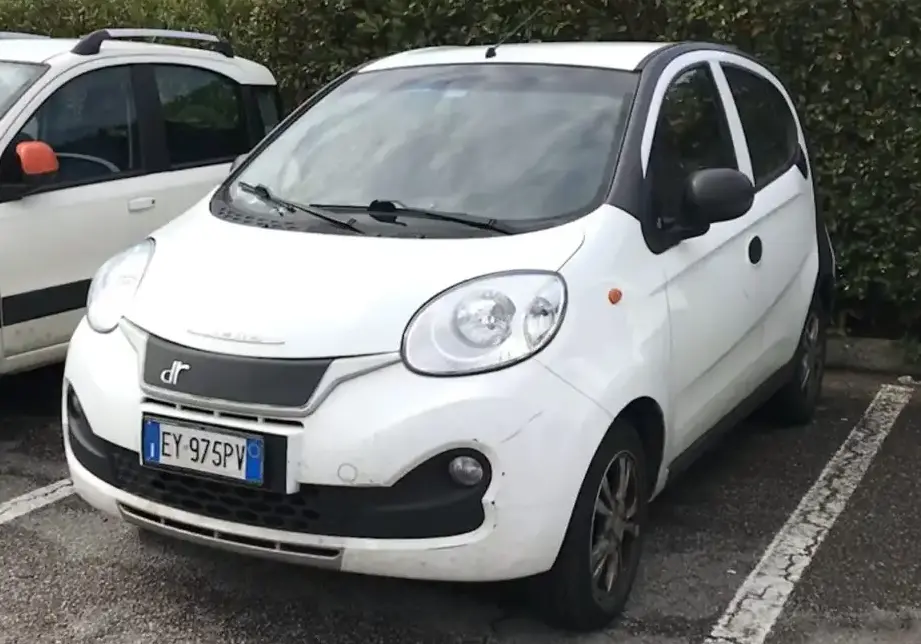
The DR Zero 1.0 Bifuel (67 hp) LPG was a city car produced by the Italian manufacturer DR Motor Company between 2015 and 2019. Based heavily on the Chery Riich G3, itself a rebadged version of the SEAT Ibiza Mk4, the Zero represented DR’s entry into the small hatchback segment, primarily targeting the Italian market. The Bifuel designation indicates the vehicle’s capability to run on both gasoline and Liquefied Petroleum Gas (LPG), offering owners a degree of fuel flexibility and potential cost savings. This particular variant, with its 1.0-liter engine and 67 horsepower output, served as the entry-level model in the Zero lineup.
Technical Specifications
| Brand | DR |
| Model | Zero |
| Generation | Zero |
| Type (Engine) | 1.0 Bifuel (67 Hp) LPG |
| Start of production | 2015 |
| End of production | 2019 |
| Powertrain Architecture | Internal Combustion engine |
| Body type | Hatchback |
| Seats | 4 |
| Doors | 5 |
| Fuel consumption (economy) – urban | 7.6 l/100 km (30.9 US mpg, 37.2 UK mpg, 13.2 km/l) |
| Fuel consumption (economy) – urban (LPG) | 10.8 l/100 km |
| Fuel consumption (economy) – extra urban | 5.3 l/100 km (44.4 US mpg, 53.3 UK mpg, 18.9 km/l) |
| Fuel consumption (economy) – extra urban (LPG) | 7.1 l/100 km |
| Fuel consumption (economy) – combined | 6.1 l/100 km (38.6 US mpg, 46.3 UK mpg, 16.4 km/l) |
| Fuel consumption (economy) – combined (LPG) | 8.5 l/100 km |
| CO2 emissions | 142 g/km |
| CO2 emissions (LPG) | 137 g/km |
| Fuel Type | Petrol / LPG |
| Acceleration 0 – 100 km/h | 13.5 sec |
| Acceleration 0 – 62 mph | 13.5 sec |
| Acceleration 0 – 60 mph | 12.8 sec |
| Maximum speed | 150 km/h (93.21 mph) |
| Emission standard | Euro 6 |
| Weight-to-power ratio | 14.6 kg/Hp, 68.7 Hp/tonne |
| Weight-to-torque ratio | 10.5 kg/Nm, 95.4 Nm/tonne |
| Power | 67 Hp |
| Power per litre | 67.1 Hp/l |
| Torque | 93 Nm @ 3500-4500 rpm (68.59 lb.-ft. @ 3500-4500 rpm) |
| Engine layout | Front, Transverse |
| Engine displacement | 998 cm3 (60.9 cu. in.) |
| Number of cylinders | 3 |
| Engine configuration | Inline |
| Compression ratio | 11:1 |
| Number of valves per cylinder | 4 |
| Fuel injection system | Multi-port manifold injection |
| Engine aspiration | Naturally aspirated engine |
| Valvetrain | DOHC |
| Kerb Weight | 975 kg (2149.51 lbs.) |
| Max. weight | 1311 kg (2890.26 lbs.) |
| Max load | 336 kg (740.75 lbs.) |
| Trunk (boot) space – minimum | 180 l (6.36 cu. ft.) |
| Trunk (boot) space – maximum | 430 l (15.19 cu. ft.) |
| Fuel tank capacity | 35 l (9.25 US gal | 7.7 UK gal) |
| Fuel tank capacity (LPG) | 32 l |
| Length | 3560 mm (140.16 in.) |
| Width | 1600 mm (62.99 in.) |
| Height | 1520 mm (59.84 in.) |
| Wheelbase | 2340 mm (92.13 in.) |
| Front track | 1390 mm (54.72 in.) |
| Rear (Back) track | 1365 mm (53.74 in.) |
| Minimum turning circle | 9.5 m (31.17 ft.) |
| Drivetrain Architecture | The Internal combustion engine (ICE) drives the front wheels of the vehicle. |
| Drive wheel | Front wheel drive |
| Number of gears and type of gearbox | 5 gears, manual transmission |
| Front suspension | Independent, type McPherson with coil spring and anti-roll bar |
| Rear suspension | Semi-independent, coil spring |
| Front brakes | Disc |
| Rear brakes | Drum |
| Assisting systems | ABS (Anti-lock braking system) |
| Steering type | Steering rack and pinion |
| Tires size | 165/60 R14; 175/50 R15 |
| Wheel rims size | 5.5J x 14; 5.5J x 15 |
Powertrain & Engine Architecture
The DR Zero 1.0 Bifuel utilizes a 998cc inline three-cylinder engine, designated as a derivative of the Chery 1.0-liter unit. This engine features a double overhead camshaft (DOHC) valvetrain with four valves per cylinder, and a compression ratio of 11:1. Fuel delivery is managed by a multi-port fuel injection system. The LPG system is a dedicated conversion, allowing the engine to switch seamlessly between gasoline and LPG operation. The engine produces 67 horsepower and 93 Nm (68.59 lb-ft) of torque between 3500 and 4500 rpm. The engine is transversely mounted, driving the front wheels. The transmission is a standard five-speed manual gearbox, chosen for its simplicity and cost-effectiveness in this entry-level model.
Driving Characteristics
The 1.0-liter engine, paired with the five-speed manual transmission, provided adequate, though not exhilarating, performance. Acceleration from 0 to 100 km/h (0-62 mph) took approximately 13.5 seconds, and the top speed was limited to 150 km/h (93 mph). The gear ratios were tuned for fuel efficiency and urban driving, meaning the engine needed to be revved relatively high to achieve brisk acceleration. Compared to potential higher-output versions (had DR offered them), this variant prioritized economy over outright speed. The LPG system did slightly reduce power output when running on gas, but offered a lower cost per kilometer.
Equipment & Trim Levels
The DR Zero 1.0 Bifuel, as the base model, came equipped with a relatively basic set of features. Standard equipment typically included power steering, central locking, electric front windows, and an ABS anti-lock braking system. Interior upholstery was typically cloth, and the dashboard featured a simple, functional design. Optional extras, depending on the year and market, could include air conditioning, a radio/CD player, and alloy wheels. The focus was on providing a functional and affordable vehicle, rather than luxury or advanced technology.
Chassis & Braking
The Zero utilized a McPherson strut independent suspension setup at the front, providing a reasonable level of ride comfort. The rear suspension was a semi-independent coil spring arrangement. The front brakes were disc brakes, while the rear brakes were drum brakes – a cost-saving measure common in this segment. The steering was a rack and pinion system, offering acceptable precision for city driving. Tire sizes varied depending on the trim level, with 165/60 R14 and 175/50 R15 being common options.
Market Reception & Comparison
The DR Zero 1.0 Bifuel was primarily aimed at budget-conscious buyers in Italy, where LPG conversions are popular due to tax incentives and lower fuel costs. Critics generally acknowledged the vehicle’s affordability and fuel efficiency, particularly when running on LPG. However, the engine’s limited power and the somewhat basic interior were often cited as drawbacks. Compared to other city cars available in Europe at the time, such as the Fiat Panda or the Renault Twingo, the Zero offered a competitive price point but lacked the refinement and brand recognition of its rivals. The LPG capability was a key selling point, offering a tangible cost saving for drivers willing to utilize it.
Legacy
The DR Zero 1.0 Bifuel, while not a groundbreaking vehicle, served as an important stepping stone for DR Motor Company in establishing itself in the Italian automotive market. The 1.0-liter LPG powertrain proved to be relatively reliable, with common issues typically related to the LPG conversion components rather than the engine itself. On the used car market, these vehicles are now relatively affordable, appealing to buyers seeking a cheap and economical runabout. However, potential buyers should be aware of the need for regular maintenance of the LPG system to ensure optimal performance and safety.
