Technical Specifications
| Brand | DS |
| Model | 3 |
| Generation | 3 Cabrio |
| Type (Engine) | 1.6 BlueHDi (100 Hp) Stop&Start |
| Start of production | 2016 |
| End of production | 2018 |
| Powertrain Architecture | Internal Combustion engine |
| Body type | Cabriolet |
| Seats | 4 |
| Doors | 3 |
| Fuel consumption (urban) | 4 l/100 km (58.8 US mpg, 70.6 UK mpg, 25 km/l) |
| Fuel consumption (extra urban) | 3.3 l/100 km (71.3 US mpg, 85.6 UK mpg, 30.3 km/l) |
| Fuel consumption (combined) | 3.5 l/100 km (67.2 US mpg, 80.7 UK mpg, 28.6 km/l) |
| CO2 emissions | 92 g/km |
| Fuel Type | Diesel |
| Acceleration 0 – 100 km/h | 12.1 sec |
| Acceleration 0 – 62 mph | 12.1 sec |
| Acceleration 0 – 60 mph | 11.5 sec |
| Maximum speed | 182 km/h (113.09 mph) |
| Emission standard | Euro 6 |
| Weight-to-power ratio | 11.5 kg/Hp, 87.1 Hp/tonne |
| Weight-to-torque ratio | 4.5 kg/Nm, 221.3 Nm/tonne |
| Power | 100 Hp @ 3750 rpm |
| Power per litre | 64.1 Hp/l |
| Torque | 254 Nm @ 1750 rpm (187.34 lb.-ft. @ 1750 rpm) |
| Engine layout | Front, Transverse |
| Engine Model/Code | BHY DV6FD |
| Engine displacement | 1560 cm3 (95.2 cu. in.) |
| Number of cylinders | 4 |
| Engine configuration | Inline |
| Cylinder Bore | 75 mm (2.95 in.) |
| Piston Stroke | 88.3 mm (3.48 in.) |
| Fuel injection system | Diesel Commonrail |
| Engine aspiration | Turbocharger, Intercooler |
| Engine oil capacity | 3.8 l (4.02 US qt | 3.34 UK qt) |
| Kerb Weight | 1148-1220 kg (2530.91 – 2689.64 lbs.) |
| Max. weight | 1652 kg (3642.04 lbs.) |
| Max load | 432-504 kg (952.4 – 1111.13 lbs.) |
| Trunk (boot) space – minimum | 245 l (8.65 cu. ft.) |
| Fuel tank capacity | 46 l (12.15 US gal | 10.12 UK gal) |
| AdBlue tank | 17 l (4.49 US gal | 3.74 UK gal) |
| Permitted trailer load with brakes (12%) | 775 kg (1708.58 lbs.) |
| Permitted trailer load without brakes | 450 kg (992.08 lbs.) |
| Permitted towbar download | 46 kg (101.41 lbs.) |
| Length | 3954 mm (155.67 in.) |
| Width with mirrors folded | 1715 mm (67.52 in.) |
| Width including mirrors | 2004 mm (78.9 in.) |
| Height | 1458-1483 mm (57.4 – 58.39 in.) |
| Wheelbase | 2464 mm (97.01 in.) |
| Front track | 1465-1468 mm (57.68 – 57.8 in.) |
| Rear (Back) track | 1467-1471 mm (57.76 – 57.91 in.) |
| Front overhang | 830 mm (32.68 in.) |
| Rear overhang | 660 mm (25.98 in.) |
| Minimum turning circle (turning diameter) | 10.2 m (33.46 ft.) |
| Drivetrain Architecture | The Internal combustion engine (ICE) drives the front wheels of the vehicle. |
| Drive wheel | Front wheel drive |
| Number of gears and type of gearbox | 5 gears, manual transmission |
| Front suspension | Independent type McPherson |
| Rear suspension | Semi-independent, coil spring |
| Front brakes | Ventilated discs |
| Rear brakes | Disc |
| Assisting systems | ABS (Anti-lock braking system) |
| Steering type | Steering rack and pinion |
| Power steering | Electric Steering |
| Tires size | 195/55 R16; 205/45 R17 |
| Wheel rims size | 16; 17 |
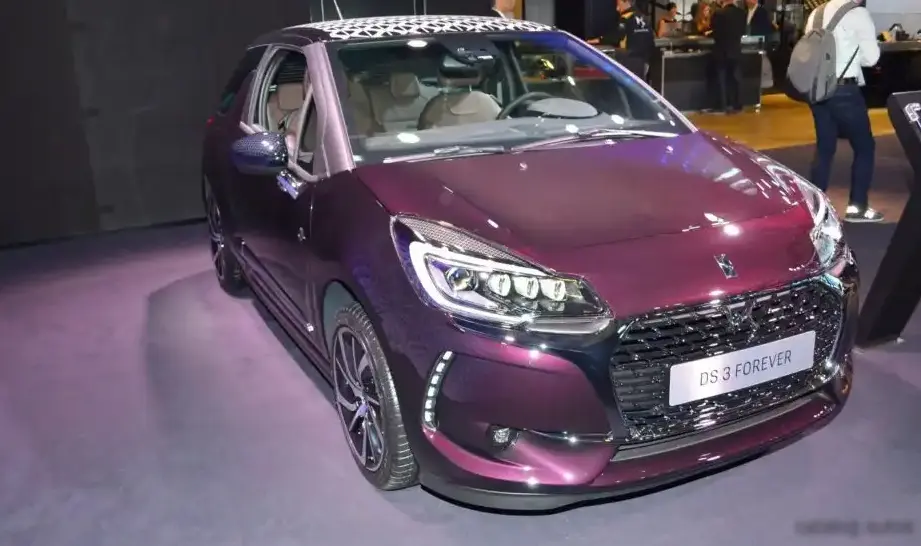
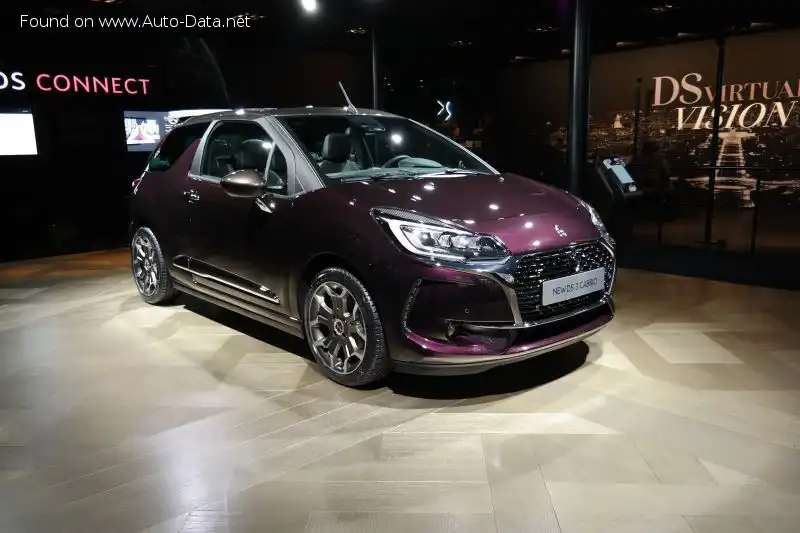
The DS 3 Cabrio 1.6 BlueHDi 100 Stop&Start was a front-wheel-drive, four-seater convertible produced between 2016 and 2018. Positioned as an entry-level offering within the DS 3 Cabrio range, it aimed to provide a stylish and economical open-top experience. This variant utilized a diesel engine paired with a manual transmission, catering to European markets prioritizing fuel efficiency and lower running costs. It was part of the broader DS 3 family, which itself was originally launched as a Citroën DS3 before becoming a standalone DS Automobiles model.
Powertrain & Engine Architecture
The DS 3 Cabrio 1.6 BlueHDi 100 Stop&Start was powered by the PSA Group’s DV6FD engine, specifically the BHY variant. This 1.6-liter, four-cylinder diesel engine utilized common-rail direct injection and a turbocharger with an intercooler to achieve a balance of power and efficiency. The engine code ‘BHY’ denotes a specific calibration for this application. The engine featured 16 valves (four per cylinder) and operated a single overhead camshaft. The Stop&Start system automatically shut off the engine when the vehicle came to a halt, reducing fuel consumption and emissions. The five-speed manual transmission was chosen for its affordability and contribution to fuel economy, although it wasn’t as quick-shifting as some contemporary gearboxes.
Driving Characteristics
The 100 horsepower and 254 Nm (187 lb-ft) of torque provided adequate, but not exhilarating, performance. Acceleration from 0-60 mph took around 11.5 seconds, and the top speed was 113 mph. The engine’s torque peak at 1750 rpm meant that it felt reasonably responsive in everyday driving situations, particularly for overtaking. However, compared to the more powerful petrol variants of the DS 3, or even the higher-output diesel versions, this model felt noticeably slower. The manual transmission’s gear ratios were geared towards economy, meaning that frequent downshifts were required for spirited driving. The Cabriolet body style added weight compared to the standard hatchback, further impacting performance.
Equipment & Trim Levels
The 1.6 BlueHDi 100 Stop&Start typically came with a reasonable level of standard equipment. This included air conditioning, electric front windows, a USB audio connection, and a basic infotainment system. Safety features such as ABS, ESP (Electronic Stability Program), and multiple airbags were standard. Higher trim levels, available as options, added features like alloy wheels, automatic headlights and wipers, parking sensors, and upgraded interior trim. Interior upholstery was typically cloth, with options for leather upgrades. The dashboard layout was generally functional and modern, though the materials used were not particularly luxurious.
Chassis & Braking
The DS 3 Cabrio utilized a McPherson strut front suspension and a semi-independent coil spring rear suspension. This setup provided a comfortable ride quality, although it wasn’t particularly sporty. The front brakes were ventilated discs, while the rear brakes were solid discs. The braking system was adequate for the vehicle’s weight and performance, but lacked the stopping power of higher-performance models. Stabilizer bars were fitted to both the front and rear axles to reduce body roll during cornering.
Market Reception & Comparison
The DS 3 Cabrio 1.6 BlueHDi 100 Stop&Start was generally well-received by critics for its fuel efficiency and affordability. It was seen as a practical choice for buyers looking for a stylish and economical open-top car. However, some reviewers criticized its lack of performance and the somewhat basic interior. Compared to the petrol-powered DS 3 models, the diesel offered significantly better fuel economy but less excitement. Against competitors like the Fiat 500C and MINI Convertible, the DS 3 Cabrio offered a more spacious interior and a more comfortable ride, but lacked the brand cachet of the MINI.
Legacy
The 1.6 BlueHDi engine proved to be a reliable unit, although, like all diesel engines, it is susceptible to issues with the diesel particulate filter (DPF) if not driven on longer journeys regularly. The manual transmission is also generally robust. In the used car market, the DS 3 Cabrio 1.6 BlueHDi 100 Stop&Start represents a relatively affordable entry point into the world of open-top motoring. Its fuel efficiency and low running costs continue to make it an attractive option for budget-conscious buyers. However, potential buyers should be aware of the potential for DPF issues and ensure that the vehicle has been properly maintained.