
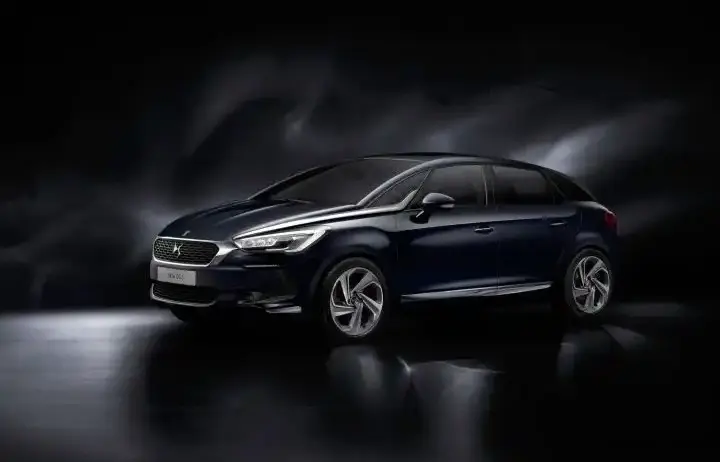
The DS 5 1.6 BlueHDi 120 Stop&Start Automatic was a front-wheel-drive compact hatchback produced by the French manufacturer DS Automobiles (formerly Citroën’s premium brand) between 2015 and 2018. Positioned as a mid-range offering within the DS 5 lineup, it aimed to provide a balance of fuel efficiency, comfort, and practicality. This variant was primarily marketed in Europe, where diesel engines and automatic transmissions were popular choices for long-distance commuting and family transport. It represented DS’s attempt to establish itself as a distinct luxury brand, offering a more sophisticated alternative to mainstream Citroën models.
Technical Specifications
| Brand | DS |
| Model | 5 |
| Generation | 5 |
| Type (Engine) | 1.6 BlueHDi (120 Hp) Stop&Start Automatic |
| Start of production | 2015 |
| End of production | 2018 |
| Powertrain Architecture | Internal Combustion engine |
| Body type | Hatchback |
| Seats | 5 |
| Doors | 5 |
| Fuel consumption (urban) | 4.8 l/100 km (49 US mpg, 58.9 UK mpg, 20.8 km/l) |
| Fuel consumption (extra urban) | 3.7 l/100 km (63.6 US mpg, 76.3 UK mpg, 27 km/l) |
| Fuel consumption (combined) | 4.1 l/100 km (57.4 US mpg, 68.9 UK mpg, 24.4 km/l) |
| CO2 emissions | 105-108 g/km |
| Fuel Type | Diesel |
| Acceleration 0 – 100 km/h | 11.9 sec |
| Acceleration 0 – 62 mph | 11.9 sec |
| Acceleration 0 – 60 mph | 11.3 sec |
| Maximum speed | 189 km/h (117.44 mph) |
| Emission standard | Euro 6 |
| Weight-to-power ratio | 12 kg/Hp, 83.7 Hp/tonne |
| Weight-to-torque ratio | 4.8 kg/Nm, 209.2 Nm/tonne |
| Power | 120 Hp @ 3500 rpm |
| Power per litre | 76.9 Hp/l |
| Torque | 300 Nm @ 1750 rpm (221.27 lb.-ft. @ 1750 rpm) |
| Engine layout | Front, Transverse |
| Engine Model/Code | BHZ DV6FC |
| Engine displacement | 1560 cm3 (95.2 cu. in.) |
| Number of cylinders | 4 |
| Engine configuration | Inline |
| Cylinder Bore | 75 mm (2.95 in.) |
| Piston Stroke | 88.3 mm (3.48 in.) |
| Number of valves per cylinder | 2 |
| Fuel injection system | Diesel Commonrail |
| Engine aspiration | Turbocharger, Intercooler |
| Engine oil capacity | 3.75 l (3.96 US qt | 3.3 UK qt) |
| Kerb Weight | 1434-1565 kg (3161.43 – 3450.23 lbs.) |
| Max. weight | 2025 kg (4464.36 lbs.) |
| Max load | 460-591 kg (1014.13 – 1302.93 lbs.) |
| Trunk (boot) space – minimum | 468 l (16.53 cu. ft.) |
| Trunk (boot) space – maximum | 1288 l (45.49 cu. ft.) |
| Fuel tank capacity | 60 l (15.85 US gal | 13.2 UK gal) |
| Permitted trailer load with brakes (12%) | 1050 kg (2314.85 lbs.) |
| Permitted trailer load without brakes | 745 kg (1642.44 lbs.) |
| Permitted towbar download | 75 kg (165.35 lbs.) |
| Length | 4530 mm (178.35 in.) |
| Width | 1871-2128 mm (73.66 – 83.78 in.) |
| Height | 1505-1539 mm (59.25 – 60.59 in.) |
| Wheelbase | 2727 mm (107.36 in.) |
| Front track | 1575-1582 mm (62.01 – 62.28 in.) |
| Rear (Back) track | 1599-1609 mm (62.95 – 63.35 in.) |
| Front overhang | 996 mm (39.21 in.) |
| Rear overhang | 807 mm (31.77 in.) |
| Minimum turning circle (turning diameter) | 11.2 m (36.75 ft.) |
| Drivetrain Architecture | The Internal combustion engine (ICE) drives the front wheels of the vehicle. |
| Drive wheel | Front wheel drive |
| Number of gears and type of gearbox | 6 gears, automatic transmission |
| Front suspension | Independent, type McPherson with coil spring and anti-roll bar |
| Rear suspension | Semi-independent, coil spring |
| Front brakes | Ventilated discs |
| Rear brakes | Disc |
| Assisting systems | ABS (Anti-lock braking system) |
| Steering type | Steering rack and pinion |
| Power steering | Electric Steering |
| Tires size | 215/60 R16; 215/55 R17 |
| Wheel rims size | 16; 17 |
Powertrain & Engine Architecture
The DS 5 1.6 BlueHDi 120 Automatic was powered by the PSA Group’s DV6FC engine, specifically the BHZ variant. This is a 1.6-liter, four-cylinder diesel engine utilizing common-rail direct injection and a turbocharger with intercooling. The engine produced 120 horsepower at 3500 rpm and 300 Nm (221 lb-ft) of torque at 1750 rpm. The engine featured a 16-valve configuration (two valves per cylinder) and a relatively high compression ratio typical of diesel engines. The BlueHDi technology incorporated a Selective Catalytic Reduction (SCR) system using AdBlue (Diesel Exhaust Fluid) to reduce nitrogen oxide (NOx) emissions, ensuring compliance with Euro 6 emission standards. The engine was transversely mounted in the front of the vehicle.
The automatic transmission was a six-speed torque converter automatic, chosen for its smoothness and ease of use, particularly in urban driving. While not as fuel-efficient as a manual transmission, it provided a more relaxed driving experience. The transmission control unit (TCU) was programmed to prioritize fuel economy, resulting in relatively early upshifts.
Driving Characteristics
The 1.6 BlueHDi 120 Automatic offered adequate performance for everyday driving. Acceleration from 0-60 mph took around 11.3 seconds, and the top speed was 117.44 mph. However, it wasn’t a particularly sporty variant. The engine felt somewhat strained at higher speeds, and overtaking required careful planning. The automatic transmission, while smooth, could sometimes feel hesitant when downshifting. Compared to the more powerful DS 5 variants, such as those equipped with the 2.0 BlueHDi engine, this version prioritized fuel economy and comfort over outright performance. The gear ratios were optimized for efficiency, resulting in a comfortable cruising experience but limiting acceleration.
Equipment & Trim Levels
The DS 5 1.6 BlueHDi 120 Automatic typically came equipped with a reasonable level of standard features. These included air conditioning, a touchscreen infotainment system, Bluetooth connectivity, cruise control, and automatic headlights and wipers. Interior upholstery was usually cloth, although leather options were available as upgrades. Higher trim levels added features such as leather seats, a panoramic sunroof, and advanced driver-assistance systems like blind-spot monitoring and lane departure warning. The DS 5 aimed for a premium feel, with attention paid to interior materials and design.
Chassis & Braking
The DS 5 featured a McPherson strut front suspension and a semi-independent coil spring rear suspension. This setup provided a comfortable ride, absorbing bumps and imperfections in the road surface effectively. The front brakes were ventilated discs, while the rear brakes were solid discs. Anti-lock Braking System (ABS) was standard. The suspension was tuned for comfort rather than sporty handling, resulting in a slight degree of body roll in corners. Stabilizer bars were fitted to both the front and rear axles to reduce body roll.
Market Reception & Comparison
The DS 5 1.6 BlueHDi 120 Automatic was generally well-received by critics for its fuel efficiency and comfortable ride. However, some reviewers found the engine to be underpowered, particularly when fully loaded or on steep inclines. Compared to other diesel hatchbacks in its class, such as the Volkswagen Golf and Ford Focus, the DS 5 offered a more distinctive and luxurious interior, but it wasn’t as dynamically engaging to drive. Fuel economy was a strong point, consistently achieving around 57.4 US mpg on the combined cycle. Reliability was generally good, although some owners reported minor issues with the infotainment system.
Legacy
The DS 5 1.6 BlueHDi 120 Automatic remains a relatively affordable and practical used car option. The DV6FC engine is known for its durability, provided it has been properly maintained. Regular servicing, including oil changes and filter replacements, is crucial for long-term reliability. The automatic transmission is also generally reliable, but it’s important to check for smooth gear changes during a test drive. While the DS 5 didn’t achieve the sales success of its mainstream rivals, it established DS Automobiles as a credible alternative in the premium compact segment, and the 1.6 BlueHDi engine proved to be a popular and efficient choice for many European drivers.
