
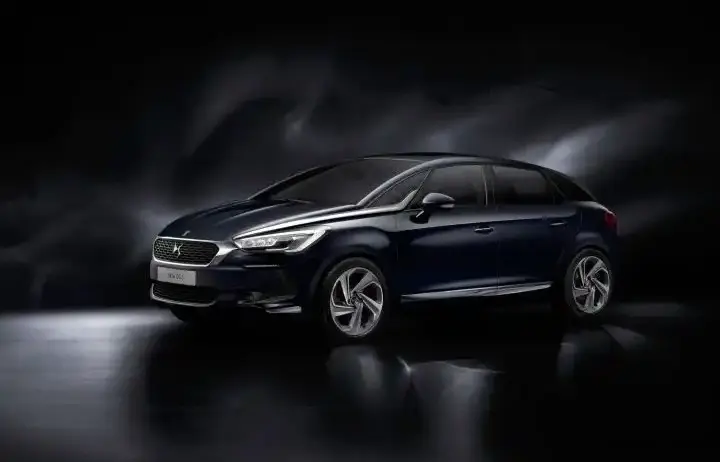
The DS 5 1.6 THP 210 Stop&Start was a premium compact hatchback produced by the French manufacturer DS Automobiles between 2015 and 2018. Positioned as a mid-to-high trim level within the DS 5 range, it offered a blend of performance, technology, and distinctive styling. The DS 5 itself was originally developed under Citroën, but with the creation of the DS brand as a separate entity, it became a flagship model representing a more upscale and sophisticated offering. This variant aimed to appeal to buyers seeking a more engaging driving experience than the diesel options, while still maintaining reasonable fuel efficiency.
Technical Specifications
| Brand | DS |
| Model | 5 |
| Generation | 5 |
| Type (Engine) | 1.6 THP (210 Hp) Stop&Start |
| Start of production | 2015 |
| End of production | 2018 |
| Powertrain Architecture | Internal Combustion engine |
| Body type | Hatchback |
| Seats | 5 |
| Doors | 5 |
| Fuel consumption (urban) | 8 l/100 km (29.4 US mpg, 35.3 UK mpg, 12.5 km/l) |
| Fuel consumption (extra urban) | 5.2 l/100 km (45.2 US mpg, 54.3 UK mpg, 19.2 km/l) |
| Fuel consumption (combined) | 6.2 l/100 km (37.9 US mpg, 45.6 UK mpg, 16.1 km/l) |
| CO2 emissions | 144 g/km |
| Fuel Type | Petrol (Gasoline) |
| Acceleration 0 – 100 km/h | 8.8 sec |
| Acceleration 0 – 62 mph | 8.8 sec |
| Acceleration 0 – 60 mph | 8.4 sec |
| Maximum speed | 235 km/h (146.02 mph) |
| Emission standard | Euro 6 |
| Weight-to-power ratio | 6.8 kg/Hp, 146.9 Hp/tonne |
| Weight-to-torque ratio | 5 kg/Nm, 199.3 Nm/tonne |
| Power | 210 Hp @ 6000 rpm |
| Power per litre | 131.4 Hp/l |
| Torque | 285 Nm @ 1750 rpm (210.21 lb.-ft. @ 1750 rpm) |
| Engine layout | Front, Transverse |
| Engine Model/Code | 5GM EP6FDTX |
| Engine displacement | 1598 cm3 (97.52 cu. in.) |
| Number of cylinders | 4 |
| Engine configuration | Inline |
| Cylinder Bore | 77 mm (3.03 in.) |
| Piston Stroke | 85.8 mm (3.38 in.) |
| Number of valves per cylinder | 4 |
| Fuel injection system | Direct injection |
| Engine aspiration | Turbocharger, Intercooler |
| Engine oil capacity | 4.25 l (4.49 US qt | 3.74 UK qt) |
| Kerb Weight | 1430-1560 kg (3152.61 – 3439.21 lbs.) |
| Max. weight | 2010 kg (4431.29 lbs.) |
| Max load | 450-580 kg (992.08 – 1278.68 lbs.) |
| Trunk (boot) space – minimum | 468 l (16.53 cu. ft.) |
| Trunk (boot) space – maximum | 1288 l (45.49 cu. ft.) |
| Fuel tank capacity | 60 l (15.85 US gal | 13.2 UK gal) |
| Permitted trailer load with brakes (12%) | 1050 kg (2314.85 lbs.) |
| Permitted trailer load without brakes | 750 kg (1653.47 lbs.) |
| Permitted towbar download | 75 kg (165.35 lbs.) |
| Length | 4530 mm (178.35 in.) |
| Width | 1871-2128 mm (73.66 – 83.78 in.) |
| Height | 1505-1539 mm (59.25 – 60.59 in.) |
| Wheelbase | 2727 mm (107.36 in.) |
| Front track | 1575-1582 mm (62.01 – 62.28 in.) |
| Rear (Back) track | 1599-1609 mm (62.95 – 63.35 in.) |
| Front overhang | 996 mm (39.21 in.) |
| Rear overhang | 807 mm (31.77 in.) |
| Minimum turning circle (turning diameter) | 11.2 m (36.75 ft.) |
| Drivetrain Architecture | The Internal combustion engine (ICE) drives the front wheels of the vehicle. |
| Drive wheel | Front wheel drive |
| Number of gears and type of gearbox | 6 gears, manual transmission |
| Front suspension | Independent, type McPherson with coil spring and anti-roll bar |
| Rear suspension | Semi-independent, coil spring |
| Front brakes | Ventilated discs |
| Rear brakes | Disc |
| Assisting systems | ABS (Anti-lock braking system) |
| Steering type | Steering rack and pinion |
| Power steering | Electric Steering |
| Tires size | 225/45 R18; 225/40 R19 |
| Wheel rims size | 17; 18; 19 |
Powertrain & Engine Architecture
The DS 5 1.6 THP 210 Stop&Start utilized the EP6FDTX engine, a 1.6-liter turbocharged inline-four cylinder petrol engine. This engine falls under the Prince engine family, jointly developed by PSA Peugeot Citroën and BMW. The ‘THP’ designation stands for Turbo High Pressure, indicating the use of a twin-scroll turbocharger and direct fuel injection. The engine code ‘5GM’ denotes specific calibration and emissions control features for the DS Automobiles brand. Direct injection, managed by Bosch, allowed for precise fuel delivery, contributing to both performance and efficiency. The engine featured a variable valve timing system on both intake and exhaust valves, optimizing engine breathing across the rev range. The Stop&Start system automatically shut off the engine when the vehicle came to a halt, further enhancing fuel economy in urban driving conditions. The engine was paired with a six-speed manual transmission, delivering power to the front wheels.
Driving Characteristics
The 210 horsepower and 285 Nm (210 lb-ft) of torque provided by the 1.6 THP engine gave the DS 5 a noticeably more spirited driving experience compared to the lower-powered diesel variants. Acceleration from 0-60 mph was achieved in approximately 8.4 seconds, and the car offered a respectable top speed of 146 mph. The turbocharger provided a noticeable boost in power from around 1750 rpm, offering good mid-range acceleration for overtaking and merging. The six-speed manual transmission was well-matched to the engine’s characteristics, allowing drivers to keep the engine in its optimal power band. While not a dedicated sports car, the DS 5 1.6 THP offered a good balance of performance and comfort, making it suitable for both daily commuting and longer journeys. The steering was precise, though perhaps lacking some feedback, and the suspension provided a comfortable ride without excessive body roll.
Equipment & Trim Levels
The DS 5 1.6 THP 210 Stop&Start typically came well-equipped as a mid-to-high trim level. Standard features often included leather upholstery, automatic climate control, a touchscreen infotainment system with navigation, rear parking sensors, and alloy wheels. Higher trim levels offered additional features such as a panoramic sunroof, premium audio system, and advanced driver-assistance systems like blind-spot monitoring and adaptive cruise control. The interior design was characterized by a unique ‘watch strap’ stitching pattern on the seats and dashboard, a signature design element of the DS brand. The overall ambiance was intended to be luxurious and sophisticated, setting it apart from more mainstream competitors.
Chassis & Braking
The DS 5 featured a McPherson strut front suspension and a semi-independent rear suspension with a torsion beam. This setup provided a good balance of ride comfort and handling. The car was equipped with ventilated disc brakes at the front and solid discs at the rear. ABS (Anti-lock Braking System) was standard, providing enhanced braking performance and stability. The steering was a rack-and-pinion system with electric power assistance, offering precise control and ease of maneuvering.
Market Reception & Comparison
The DS 5 1.6 THP 210 Stop&Start was generally well-received by automotive critics, who praised its stylish design, comfortable ride, and strong performance. However, some reviewers noted that the infotainment system could be complex to use and that the interior, while luxurious, felt somewhat cramped for rear passengers. Compared to the diesel variants, the 1.6 THP offered a more engaging driving experience but at the cost of slightly higher fuel consumption. Against competitors like the Audi A3, BMW 1 Series, and Volkswagen Golf, the DS 5 stood out with its distinctive styling and luxurious interior, but it often lacked the brand recognition and established reputation of its German rivals.
Legacy
The 1.6 THP engine, while generally reliable, has been known to exhibit issues with carbon buildup on the intake valves, particularly in vehicles that primarily see short trips. Regular servicing and the use of quality fuel are crucial to mitigating this risk. The DS 5 itself, while not a massive sales success, helped establish the DS brand as a separate entity and demonstrated its commitment to offering premium vehicles with distinctive styling and advanced technology. On the used car market, the DS 5 1.6 THP 210 Stop&Start represents a relatively affordable entry point into the world of French luxury, offering a unique and stylish alternative to more mainstream competitors.
