
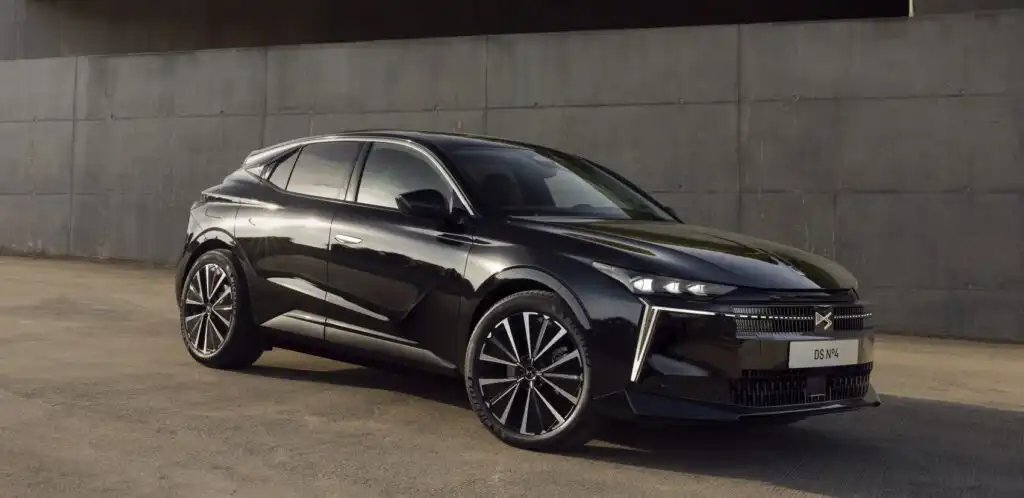
The DS N°4 II (facelift 2025) 1.2 (145 Hp) Hybrid eDCT represents a significant evolution in DS Automobiles’ compact crossover offering, launched in June 2025. Positioned as a mid-range option within the N°4 lineup, this variant blends a turbocharged three-cylinder gasoline engine with a 48-volt mild hybrid system, paired with a six-speed dual-clutch transmission (eDCT). It builds upon the foundation of the original N°4, which debuted as DS’s entry into the highly competitive C-segment crossover market, aiming to provide a balance of fuel efficiency, performance, and sophisticated styling. The facelifted model introduces updated aesthetics, enhanced technology, and refinements to the powertrain for improved real-world usability.
Technical Specifications
| Brand | DS |
| Model | N°4 |
| Generation | N°4 II (facelift 2025) |
| Type (Engine) | 1.2 (145 Hp) Hybrid eDCT |
| Start of production | June, 2025 |
| Powertrain Architecture | MHEV (Mild Hybrid Electric Vehicle) |
| Body type | Crossover |
| Seats | 5 |
| Doors | 5 |
| Fuel consumption at Low speed (WLTP) | 4.5 l/100 km (52.3 US mpg, 62.8 UK mpg, 22.2 km/l) |
| Fuel consumption at Medium speed (WLTP) | 4.8-4.9 l/100 km (49-48 US mpg, 58.9-57.6 UK mpg, 20.8-20.4 km/l) |
| Fuel consumption at high speed (WLTP) | 4.6 l/100 km (51.1 US mpg, 61.4 UK mpg, 21.7 km/l) |
| Fuel consumption at very high speed (WLTP) | 6.1 l/100 km (38.6 US mpg, 46.3 UK mpg, 16.4 km/l) |
| Combined fuel consumption (WLTP) | 5.2 l/100 km (45.2 US mpg, 54.3 UK mpg, 19.2 km/l) |
| CO2 emissions (WLTP) | 116-117 g/km |
| Fuel Type | Petrol (Gasoline) |
| Acceleration 0 – 100 km/h | 9.5 sec |
| Acceleration 0 – 62 mph | 9.5 sec |
| Acceleration 0 – 60 mph | 9 sec (Calculated) |
| Maximum speed | 203 km/h (126.14 mph) |
| Emission standard | Euro 6d-ISC-FCM |
| Weight-to-power ratio | 10.1 kg/Hp |
| Weight-to-torque ratio | 6.4 kg/Nm |
| Gross battery capacity | 0.88 kWh |
| Battery voltage | 48 V |
| Battery technology | Lithium-ion (Li-Ion) |
| Battery location | Below the floor, under the front seats |
| Electric motor power | 28 Hp |
| Electric motor Torque | 51 Nm (37.62 lb.-ft.) |
| Electric motor location | Integrated into the transmission |
| Electric motor type | Synchronous |
| System power | 145 Hp |
| Power | 136 Hp @ 5500 rpm |
| Torque | 230 Nm @ 1750 rpm (169.64 lb.-ft. @ 1750 rpm) |
| Engine layout | Front, Transverse |
| Engine Model/Code | HN09 |
| Engine displacement | 1199 cm3 (73.17 cu. in.) |
| Number of cylinders | 3 |
| Engine configuration | Inline |
| Number of valves per cylinder | 4 |
| Fuel injection system | Direct injection |
| Engine aspiration | Turbocharger, Intercooler |
| Engine oil capacity | 3.5 l (3.7 US qt, 3.08 UK qt) |
| Kerb Weight | 1463 kg (3225.36 lbs.) |
| Max. weight | 2005 kg (4420.27 lbs.) |
| Max load | 542 kg (1194.91 lbs.) |
| Trunk (boot) space – minimum | 430 l (15.19 cu. ft.) |
| Trunk (boot) space – maximum | 1240 l (43.79 cu. ft.) |
| Fuel tank capacity | 52 l (13.74 US gal, 11.44 UK gal) |
| Permitted trailer load with brakes (12%) | 1300 kg (2866.01 lbs.) |
| Permitted trailer load without brakes | 750 kg (1653.47 lbs.) |
| Length | 4400 mm (173.23 in.) |
| Width | 1830 mm (72.05 in.) |
| Width with mirrors folded | 1866 mm (73.46 in.) |
| Width including mirrors | 2061 mm (81.14 in.) |
| Height | 1490 mm (58.66 in.) |
| Wheelbase | 2675 mm (105.31 in.) |
| Front track | 1600 mm (62.99 in.) |
| Rear (Back) track | 1605 mm (63.19 in.) |
| Front overhang | 925 mm (36.42 in.) |
| Rear overhang | 800 mm (31.5 in.) |
| Ride height (ground clearance) | 189 mm (7.44 in.) |
| Drive wheel | Front wheel drive |
| Number of gears and type of gearbox | 6 gears, automatic transmission eDCT |
| Front brakes | Ventilated discs |
| Rear brakes | Disc |
| Tires size | 205/55 R19 |
| Wheel rims size | 19 |
Powertrain & Engine Architecture
At the heart of the DS N°4 II 1.2 Hybrid eDCT lies the HN09 engine, a 1.2-liter turbocharged three-cylinder gasoline engine. This engine produces 136 horsepower at 5500 rpm and 230 Nm (169.64 lb.-ft.) of torque at 1750 rpm. Direct fuel injection and a turbocharger with an intercooler contribute to its efficiency and responsiveness. The ‘Hybrid’ designation refers to a 48-volt mild hybrid system. This system incorporates a small electric motor (28 hp and 51 Nm of torque) integrated with the eDCT transmission, and a lithium-ion battery with a gross capacity of 0.88 kWh located under the front seats. The system allows for regenerative braking, providing a small boost during acceleration, and enabling a start/stop system for improved fuel economy. The six-speed eDCT (efficient Dual-Clutch Transmission) provides quick and smooth gear changes, enhancing the driving experience.
Driving Characteristics
The 145 hp combined output delivers adequate performance for everyday driving. Acceleration from 0 to 100 km/h (0-62 mph) takes 9.5 seconds. While not a performance-oriented variant, the eDCT transmission and the electric motor assist provide a noticeable improvement in responsiveness compared to a non-hybrid version. The mild hybrid system doesn’t offer full electric driving capability, but it does smooth out the engine’s operation and contributes to a more refined driving experience. The eDCT transmission is well-tuned for fuel efficiency, with gear ratios optimized for both city and highway driving. Compared to higher-output versions of the N°4, this variant prioritizes fuel economy and comfort over outright speed.
Equipment & Trim Levels
The 1.2 Hybrid eDCT trim typically includes standard features such as automatic climate control, a touchscreen infotainment system with Apple CarPlay and Android Auto compatibility, and a suite of driver-assistance systems including lane departure warning, automatic emergency braking, and traffic sign recognition. Interior upholstery is generally cloth, with options for leather upgrades. Available options include a panoramic sunroof, premium audio system, and advanced parking assist features. The overall interior design emphasizes a modern and upscale aesthetic, consistent with the DS Automobiles brand.
Chassis & Braking
The DS N°4 II utilizes a front-wheel-drive platform with a MacPherson strut front suspension and a torsion beam rear suspension. The braking system consists of ventilated discs at the front and solid discs at the rear. ABS (Anti-lock Braking System) is standard. The suspension is tuned for comfort, providing a relatively smooth ride quality. The steering is an electric power-assisted rack and pinion system, offering a balance of precision and ease of use.
Market Reception & Comparison
The DS N°4 II 1.2 Hybrid eDCT has been generally well-received by automotive critics for its fuel efficiency and comfortable ride. Compared to the more powerful gasoline and diesel variants, this trim offers a lower price point and improved fuel economy, making it an attractive option for budget-conscious buyers. However, some reviewers have noted that the performance is not as exhilarating as that of the higher-output models. The mild hybrid system provides a noticeable improvement in fuel economy compared to the non-hybrid versions, but it doesn’t offer the same level of electric driving range as a plug-in hybrid.
Legacy
The HN09 engine and eDCT transmission combination has proven to be relatively reliable in other PSA Group (now Stellantis) vehicles. The mild hybrid system, while relatively new, is expected to contribute to long-term durability. On the used car market, the DS N°4 II 1.2 Hybrid eDCT is likely to appeal to buyers seeking a stylish, fuel-efficient, and well-equipped crossover. Its combination of modern technology and comfortable driving characteristics should ensure its continued popularity in the years to come.
