
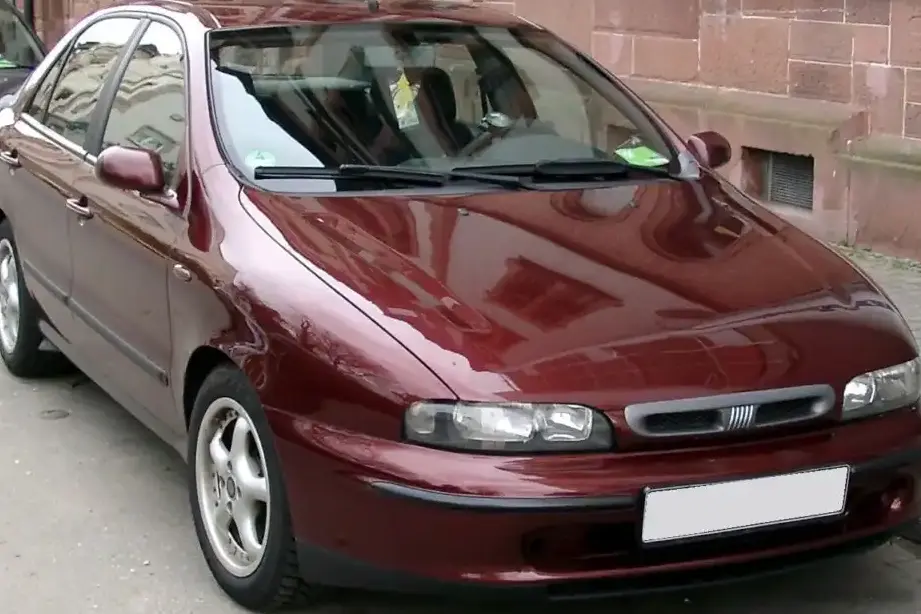
The Fiat Marea (185) 1.9 TD 75, produced between 1996 and 2000, represented a practical and economical offering within the Marea range. Positioned as an entry-level diesel variant, it aimed to provide fuel efficiency and reasonable performance for everyday commuting and long-distance travel. The Marea itself was Fiat’s replacement for the aging Tipo, offering a more modern and spacious package. This particular 75 horsepower turbodiesel version was primarily sold in European markets, where diesel engines enjoyed significant popularity due to favorable taxation and fuel costs. It served as a workhorse option, appealing to buyers prioritizing practicality over outright performance.
Technical Specifications
| Brand | Fiat |
| Model | Marea |
| Generation | Marea (185) |
| Type (Engine) | 1.9 TD 75 (75 Hp) |
| Start of production | 1996 |
| End of production | 2000 |
| Powertrain Architecture | Internal Combustion engine |
| Body type | Sedan |
| Seats | 5 |
| Doors | 4 |
| Fuel consumption (economy) – extra urban | 5.1 l/100 km (46.1 US mpg, 55.4 UK mpg, 19.6 km/l) |
| Fuel consumption (economy) – combined | 6.4 l/100 km (36.8 US mpg, 44.1 UK mpg, 15.6 km/l) |
| Fuel Type | Diesel |
| Acceleration 0 – 100 km/h | 15.4 sec |
| Acceleration 0 – 62 mph | 15.4 sec |
| Acceleration 0 – 60 mph | 14.6 sec |
| Maximum speed | 167 km/h (103.77 mph) |
| Emission standard | Euro 3 |
| Weight-to-power ratio | 15.8 kg/Hp, 63.3 Hp/tonne |
| Weight-to-torque ratio | 8.1 kg/Nm, 124.1 Nm/tonne |
| Power | 75 Hp @ 4200 rpm |
| Power per litre | 39.3 Hp/l |
| Torque | 147 Nm @ 2750 rpm (108.42 lb.-ft. @ 2750 rpm) |
| Engine layout | Front, Transverse |
| Engine Model/Code | 182A8000 |
| Engine displacement | 1910 cm3 (116.56 cu. in.) |
| Number of cylinders | 4 |
| Engine configuration | Inline |
| Cylinder Bore | 82 mm (3.23 in.) |
| Piston Stroke | 90.4 mm (3.56 in.) |
| Compression ratio | 20.7:1 |
| Number of valves per cylinder | 2 |
| Fuel injection system | Precombustion chamber injection |
| Engine aspiration | Turbocharger |
| Valvetrain | OHC |
| Engine oil capacity | 4.5 l (4.76 US qt | 3.96 UK qt) |
| Coolant | 6.6 l (6.97 US qt | 5.81 UK qt) |
| Kerb Weight | 1185 kg (2612.48 lbs.) |
| Max. weight | 1775 kg (3913.21 lbs.) |
| Max load | 590 kg (1300.73 lbs.) |
| Trunk (boot) space – minimum | 430 l (15.19 cu. ft.) |
| Fuel tank capacity | 63 l (16.64 US gal | 13.86 UK gal) |
| Length | 4390 mm (172.83 in.) |
| Width | 1740 mm (68.5 in.) |
| Height | 1420 mm (55.91 in.) |
| Wheelbase | 2540 mm (100 in.) |
| Front track | 1480 mm (58.27 in.) |
| Rear (Back) track | 1455 mm (57.28 in.) |
| Drivetrain Architecture | The Internal combustion engine (ICE) drives the front wheels of the vehicle. |
| Drive wheel | Front wheel drive |
| Number of gears and type of gearbox | 5 gears, manual transmission |
| Front suspension | Wishbone |
| Rear suspension | Coil spring |
| Front brakes | Disc |
| Rear brakes | Drum |
| Assisting systems | ABS (Anti-lock braking system) |
| Steering type | Steering rack and pinion |
| Power steering | Hydraulic Steering |
| Tires size | 175/70 R14 |
Powertrain & Engine Architecture
The heart of the Marea 1.9 TD 75 is the 182A8000 engine, a 1.9-liter inline-four cylinder diesel. This engine utilizes a precombustion chamber injection system, a common technology for diesel engines of the era. This system involves injecting fuel into a small precombustion chamber within the cylinder head, where it ignites and then ignites the main charge in the cylinder. This design aids in smoother combustion and reduced engine noise compared to direct injection systems. The engine is turbocharged, which significantly boosts power output for its displacement. The single overhead camshaft (OHC) valvetrain operates two valves per cylinder. The 5-speed manual transmission was the standard offering, chosen for its efficiency and cost-effectiveness. The engine’s relatively high compression ratio of 20.7:1 is typical for a turbocharged diesel, contributing to its thermal efficiency.
Driving Characteristics
The 1.9 TD 75 offered modest performance. Acceleration from 0-60 mph took around 14.6 seconds, and top speed was approximately 103.77 mph. While not sporty, the engine provided sufficient torque for comfortable cruising and overtaking on highways. The turbocharger provided a noticeable boost in power at higher RPMs, but the engine felt somewhat sluggish at lower speeds. The manual transmission’s gear ratios were geared towards fuel economy, meaning that frequent downshifts were necessary for spirited driving. Compared to the more powerful 2.0 16V petrol versions, the 1.9 TD 75 was significantly slower, but it offered substantially better fuel economy. The diesel’s torque delivery, however, made it more tractable in everyday driving situations than the higher-revving petrol engines.
Equipment & Trim Levels
The 1.9 TD 75 typically came with a fairly basic level of equipment. Standard features generally included power steering, central locking, and an anti-lock braking system (ABS). Interior upholstery was typically cloth, and the dashboard featured a functional, if somewhat utilitarian, design. Optional extras included air conditioning, electric windows, and a radio/cassette player. The trim level was generally considered the entry point to the Marea range, focusing on providing essential transportation at an affordable price.
Chassis & Braking
The Marea 1.9 TD 75 utilized a front-wheel-drive layout with a wishbone front suspension and a coil spring rear suspension. The front brakes were discs, providing adequate stopping power, while the rear brakes were drums, a cost-saving measure common in this class of vehicle. The suspension setup was tuned for comfort, providing a relatively smooth ride, although it wasn’t particularly sporty. The hydraulic power steering offered light and easy steering, making it easy to maneuver in urban environments.
Market Reception & Comparison
The Marea 1.9 TD 75 was generally well-received as a practical and economical family car. Critics praised its fuel efficiency and comfortable ride, but noted its lack of outright performance. Compared to other diesel options in the European market, such as the Volkswagen Golf TDI, the Marea offered a more spacious interior and a larger trunk. However, the Golf was often considered to have a more refined driving experience and a higher perceived quality. The Marea’s reliability was generally considered good, although some owners reported issues with the fuel injection system over time.
Legacy
The Fiat Marea 1.9 TD 75 remains a relatively common sight on European roads today, testament to its durability and practicality. The 182A8000 engine, while not known for being particularly high-tech, proved to be a robust and reliable unit when properly maintained. In the used car market, these models are often sought after by buyers looking for an affordable and fuel-efficient vehicle. Parts availability is generally good, although some specific components may be becoming increasingly difficult to find. The Marea, and particularly this diesel variant, represents a significant chapter in Fiat’s history, offering a practical and affordable option for families in a competitive market.
