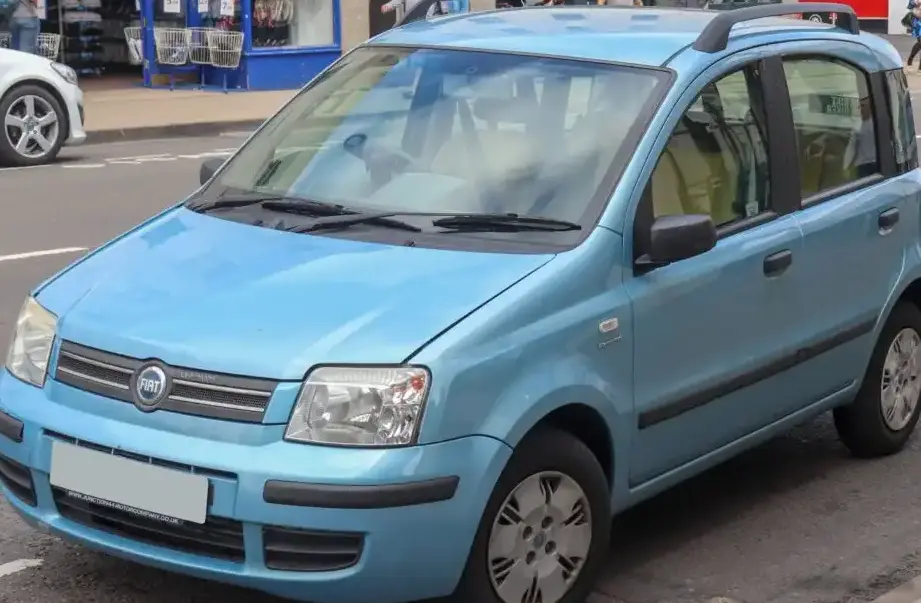
The Fiat Panda II (169) 1.3 16V Multijet, producing 70 horsepower, was a key variant in the second generation of Fiat’s iconic city car. Produced from 2003 to 2010, this model represented a significant step forward in efficiency and refinement for the Panda line. It was positioned as a practical and economical choice within the 169 series, appealing to buyers seeking low running costs and ease of use. The 169 Panda, launched in 2003, was a complete redesign of the original Panda, offering increased space, improved safety, and a more modern driving experience while retaining the core values of affordability and functionality.
Technical Specifications
| Brand | Fiat |
| Model | Panda |
| Generation | Panda II (169) |
| Type (Engine) | 1.3 16V Multijet (70 Hp) |
| Start of production | 2003 |
| End of production | 2010 |
| Powertrain Architecture | Internal Combustion engine |
| Body type | Hatchback |
| Seats | 5 |
| Doors | 5 |
| Fuel consumption (urban) | 5.4 l/100 km (43.6 US mpg, 52.3 UK mpg, 18.5 km/l) |
| Fuel consumption (extra urban) | 3.7 l/100 km (63.6 US mpg, 76.3 UK mpg, 27 km/l) |
| Fuel consumption (combined) | 4.3 l/100 km (54.7 US mpg, 65.7 UK mpg, 23.3 km/l) |
| Fuel Type | Diesel |
| Acceleration 0 – 100 km/h | 13 sec |
| Acceleration 0 – 62 mph | 13 sec |
| Acceleration 0 – 60 mph | 12.4 sec |
| Maximum speed | 160 km/h (99.42 mph) |
| Emission standard | Euro 4 |
| Weight-to-power ratio | 13.4 kg/Hp, 74.9 Hp/tonne |
| Weight-to-torque ratio | 5.2 kg/Nm, 192.5 Nm/tonne |
| Power | 70 Hp @ 4000 rpm |
| Power per litre | 56 Hp/l |
| Torque | 180 Nm @ 1750 rpm (132.76 lb.-ft. @ 1750 rpm) |
| Engine layout | Front, Transverse |
| Engine Model/Code | 188A8000 |
| Engine displacement | 1251 cm3 (76.34 cu. in.) |
| Number of cylinders | 4 |
| Engine configuration | Inline |
| Cylinder Bore | 69.6 mm (2.74 in.) |
| Piston Stroke | 82 mm (3.23 in.) |
| Compression ratio | 18:1 |
| Number of valves per cylinder | 4 |
| Fuel injection system | Diesel Commonrail |
| Engine aspiration | Turbocharger, Intercooler |
| Valvetrain | DOHC |
| Engine oil capacity | 2.8 l (2.96 US qt | 2.46 UK qt) |
| Coolant | 6.5 l (6.87 US qt | 5.72 UK qt) |
| Kerb Weight | 935 kg (2061.32 lbs.) |
| Max. weight | 1380 kg (3042.38 lbs.) |
| Max load | 445 kg (981.06 lbs.) |
| Trunk (boot) space – minimum | 206 l (7.27 cu. ft.) |
| Trunk (boot) space – maximum | 775 l (27.37 cu. ft.) |
| Fuel tank capacity | 35 l (9.25 US gal | 7.7 UK gal) |
| Length | 3538 mm (139.29 in.) |
| Width | 1578 mm (62.13 in.) |
| Height | 1540 mm (60.63 in.) |
| Wheelbase | 2299 mm (90.51 in.) |
| Front track | 1366 mm (53.78 in.) |
| Rear (Back) track | 1357 mm (53.43 in.) |
| Minimum turning circle | 9.1 m (29.86 ft.) |
| Drivetrain Architecture | Front wheel drive |
| Number of gears | 5 |
| Gearbox type | Manual transmission |
| Front suspension | Spring Strut |
| Rear suspension | Torsion |
| Front brakes | Ventilated discs |
| Rear brakes | Disc |
| Assisting systems | ABS (Anti-lock braking system) |
| Steering type | Steering rack and pinion |
| Tires size | 155/80 R13 |
| Wheel rims size | 5J x 13 |
Powertrain & Engine Architecture
The heart of this Panda variant is the 1.3 16V Multijet diesel engine, identified by the code 188A8000. This engine is a four-cylinder, inline configuration, displacing 1251 cubic centimeters. It utilizes a turbocharger with an intercooler to boost power and efficiency. The engine employs a common rail direct injection system, delivering fuel directly into the combustion chamber at extremely high pressure for optimized combustion. The double overhead camshaft (DOHC) valvetrain, with four valves per cylinder, further enhances breathing and performance. The 1.3 Multijet was a significant advancement for Fiat, known for its relatively quiet operation for a diesel and its impressive fuel economy. The five-speed manual transmission was the standard offering, chosen for its simplicity and contribution to fuel savings. The engine’s 18:1 compression ratio is typical for a diesel engine, contributing to its thermal efficiency.
Driving Characteristics
The 70 hp 1.3 Multijet engine, paired with the five-speed manual gearbox, provided adequate, though not exhilarating, performance. Acceleration from 0 to 60 mph took around 12.4 seconds, and top speed was approximately 99 mph. The engine’s 180 Nm (133 lb-ft) of torque, available from 1750 rpm, provided sufficient pulling power for everyday driving and urban commutes. Compared to higher-output versions of the Panda II, such as the 1.4-liter petrol engine, the Multijet offered significantly better fuel economy but lacked the same level of outright acceleration. The gear ratios were tuned for economy, meaning the engine needed to be revved to access its full potential. The driving experience was characterized by its light steering and nimble handling, making it easy to maneuver in tight city streets.
Equipment & Trim Levels
The 1.3 16V Multijet typically came with a modest level of standard equipment. Basic models featured power steering, central locking, and an adjustable steering column. Interior upholstery was typically cloth, and the dashboard featured a functional, if somewhat basic, design. Optional extras included air conditioning, electric windows, and a radio/CD player. Higher trim levels, such as the “Dynamic” or “Eleganza” variants, added features like alloy wheels, body-colored bumpers, and upgraded interior trim. Safety features included ABS brakes and a driver’s airbag, although passenger airbags were often optional.
Chassis & Braking
The Panda II utilized a simple yet effective chassis design. Front suspension consisted of MacPherson strut springs, while the rear employed a torsion beam setup. This configuration provided a comfortable ride quality, particularly on smoother roads. Braking was handled by ventilated discs on the front wheels and solid discs on the rear. The ABS anti-lock braking system was standard, enhancing safety during emergency stops. The relatively lightweight construction of the Panda, with a kerb weight of around 935 kg (2061 lbs), contributed to its nimble handling and braking performance.
Market Reception & Comparison
The Fiat Panda II 1.3 16V Multijet was generally well-received by automotive critics for its fuel efficiency, practicality, and affordability. It was praised as an ideal city car, offering low running costs and ease of parking. Compared to other small diesel cars of the time, such as the Renault Clio or Peugeot 206, the Panda offered a more affordable entry point, albeit with a less refined interior and driving experience. Its fuel economy of around 54.7 US mpg combined was a major selling point, particularly in Europe where diesel fuel was often cheaper than petrol. Reliability was generally good, although some owners reported issues with the turbocharger and fuel injection system over the long term.
Legacy
The 1.3 16V Multijet engine proved to be a durable and reliable powerplant, and many examples of the Panda II with this engine are still on the road today. In the used car market, these Pandas are valued for their low running costs and practicality. While not a performance car, the 1.3 Multijet variant remains a popular choice for those seeking an economical and dependable city car. The engine itself became a mainstay in several other Fiat and Alfa Romeo models, demonstrating its versatility and robustness. The Panda II, and particularly this 70 hp diesel variant, cemented the Panda’s reputation as a practical, affordable, and enduring automotive icon.