Technical Specifications
| Brand | Fiat |
| Model | Panda |
| Generation | Panda III (319) |
| Type (Engine) | 0.9 TwinAir (85 Hp) |
| Start of production | 2018 |
| End of production | 2020 |
| Powertrain Architecture | Internal Combustion engine |
| Body type | Hatchback |
| Seats | 4-5 |
| Doors | 5 |
| Fuel consumption (urban) | 6.8 l/100 km (34.6 US mpg) |
| Fuel consumption (extra urban) | 4.8 l/100 km (49 US mpg) |
| Fuel consumption (combined) | 5.5 l/100 km (42.8 US mpg) |
| CO2 emissions | 125 g/km |
| Fuel Type | Petrol (Gasoline) |
| Acceleration 0 – 100 km/h | 12.7 sec |
| Acceleration 0 – 62 mph | 12.7 sec |
| Acceleration 0 – 60 mph | 12.1 sec |
| Maximum speed | 170 km/h (105.63 mph) |
| Emission standard | Euro 6d – Temp |
| Weight-to-power ratio | 13.6 kg/Hp |
| Weight-to-torque ratio | 8 kg/Nm |
| Power | 85 Hp @ 5500 rpm |
| Torque | 145 Nm @ 1900 rpm (106.95 lb.-ft. @ 1900 rpm) |
| Engine layout | Front, Transverse |
| Engine Model/Code | 312A2000 |
| Engine displacement | 875 cm3 (53.4 cu. in.) |
| Number of cylinders | 2 |
| Engine configuration | Inline |
| Cylinder Bore | 80.5 mm (3.17 in.) |
| Piston Stroke | 86 mm (3.39 in.) |
| Compression ratio | 10:1 |
| Number of valves per cylinder | 4 |
| Engine aspiration | Turbocharger, Intercooler |
| Valvetrain | MultiAir |
| Engine oil capacity | 3.2 l (3.38 US qt | 2.82 UK qt) |
| Coolant capacity | 5.3 l (5.6 US qt | 4.66 UK qt) |
| Kerb Weight | 1155 kg (2546.34 lbs.) |
| Max. weight | 1540-1550 kg (3395.12 – 3417.17 lbs.) |
| Max load | 385-395 kg (848.78 – 870.83 lbs.) |
| Trunk (boot) space – minimum | 200 l (7.06 cu. ft.) |
| Fuel tank capacity | 35 l (9.25 US gal | 7.7 UK gal) |
| Length | 3653 mm (143.82 in.) |
| Width | 1643 mm (64.69 in.) |
| Height | 1605 mm (63.19 in.) |
| Wheelbase | 2300 mm (90.55 in.) |
| Front track | 1414 mm (55.67 in.) |
| Rear track | 1408 mm (55.43 in.) |
| Minimum turning circle | 9.7 m (31.82 ft.) |
| Drivetrain Architecture | Front wheel drive |
| Number of gears | 5 |
| Gearbox type | Manual transmission |
| Front suspension | Independent, McPherson with coil spring and anti-roll bar |
| Rear suspension | Torsion |
| Front brakes | Ventilated discs, 257 mm |
| Rear brakes | Drum, 203 mm |
| Assisting systems | ABS (Anti-lock braking system) |
| Steering type | Steering rack and pinion |
| Power steering | Electric |
| Wheel rims size | 14; 15 |
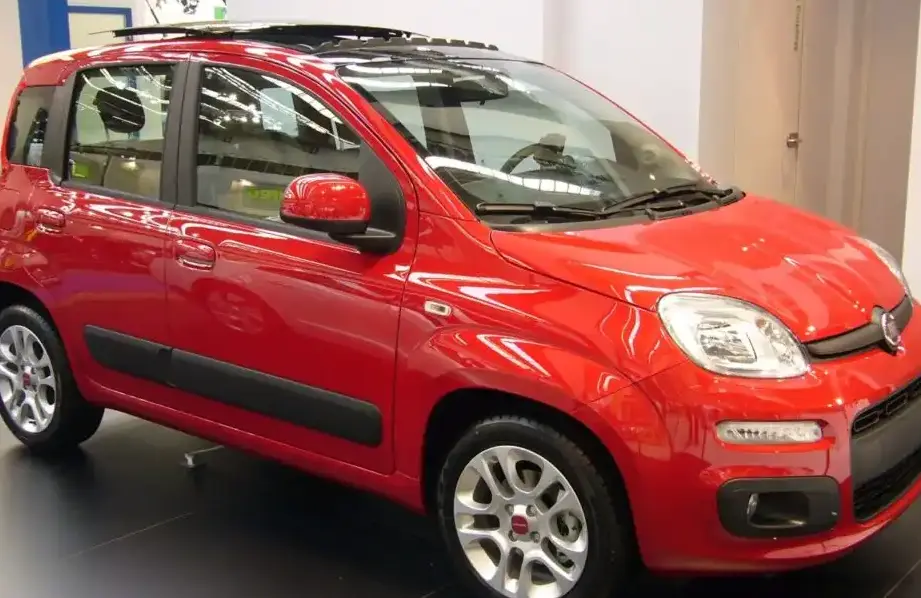
The Fiat Panda III (319) 0.9 TwinAir 85 Hp, produced from 2018 to 2020, represents a notable version of Fiat’s long-running and iconic city car. Positioned as a mid-range offering within the Panda III lineup, it aimed to strike a balance between fuel efficiency and acceptable performance for everyday driving. This variant was primarily marketed in Europe, where compact, economical vehicles are highly sought after, and it benefited from Fiat’s extensive experience in designing and building small cars. The 319 series Panda continued the tradition of its predecessors, offering a modern take on the practical and affordable city car concept. It shares its platform with the Fiat 500, internally known as the 319 project.
Powertrain & Engine Architecture
The core of the Panda III 0.9 TwinAir 85 Hp is the Fiat 312A2000 engine, a 0.9-liter turbocharged two-cylinder gasoline engine. This engine belongs to Fiat’s TwinAir family, celebrated for its small size and emphasis on efficiency. The 312A2000 incorporates Fiat’s MultiAir technology, a fully variable valve actuation system. MultiAir provides independent control over the intake and exhaust valve timing and lift, optimizing combustion for improved fuel economy and reduced emissions. A single-scroll turbocharger with an intercooler is employed to enhance power output. Fuel delivery is managed through multi-point sequential electronic injection. The engine is mounted transversely at the front of the vehicle. The 85 horsepower version delivers increased power compared to the base 65 Hp TwinAir, achieved through refined engine mapping and turbocharger settings. The engine is typically paired with a five-speed manual transmission, chosen for its simplicity and contribution to fuel efficiency. An automated manual transmission (Dualogic) was also offered as an option, though the standard manual was more prevalent.
Driving Characteristics
The 0.9 TwinAir 85 Hp Panda delivers a surprisingly spirited driving experience for a car of its size and displacement. While not designed for outright performance, the turbocharger provides a noticeable boost in acceleration, particularly in the mid-range. The engine feels responsive, and the five-speed gearbox is well-suited to the engine’s powerband. However, the two-cylinder configuration results in a unique engine note and some inherent vibrations, which are more noticeable than in engines with more cylinders. The gear ratios are optimized for fuel economy, which can make the engine feel somewhat strained at higher highway speeds. Compared to the 65 Hp version, the 85 Hp model offers significantly improved acceleration and feels more confident when overtaking. It also handles inclines with greater ease. Compared to higher-spec Panda trims with larger engines, the TwinAir 85 Hp prioritizes efficiency over raw performance.
Equipment & Trim Levels
The 0.9 TwinAir 85 Hp Panda generally came standard with features such as air conditioning, power steering, central locking, and an audio system with USB connectivity. Higher trim levels added features like alloy wheels, fog lights, a touchscreen infotainment system, and parking sensors. Interior upholstery was typically cloth, with a simple and functional design. Optional extras included a panoramic sunroof, heated seats, and a navigation system. The interior design prioritized practicality and durability, reflecting the Panda’s overall philosophy as an affordable and reliable city car.
Chassis & Braking
The Panda III utilizes a McPherson strut front suspension with a torsion beam rear suspension. This setup provides a comfortable ride quality, well-suited for urban driving conditions. The front brakes are ventilated discs, while the rear brakes are drums. ABS (Anti-lock Braking System) is standard equipment. The suspension is tuned for stability and ease of use, rather than sporty handling. The vehicle’s relatively light weight contributes to its nimble handling characteristics. Stabilizer bars were included to minimize body roll during cornering.
Market Reception & Comparison
The Fiat Panda III 0.9 TwinAir 85 Hp was generally well-received by automotive critics for its fuel efficiency and surprisingly enjoyable driving experience. It was praised for its practicality and affordability. However, some reviewers noted the engine’s unusual sound and vibrations. Compared to other Panda trims, the TwinAir 85 Hp offered a good compromise between performance and economy. It was more expensive than the base 65 Hp model but provided a noticeable improvement in performance. Compared to diesel-powered Panda variants, the TwinAir offered a smoother and quieter driving experience, although with slightly higher fuel consumption.
Legacy
The 0.9 TwinAir engine, while innovative, has faced some criticism regarding long-term reliability, with reports of issues related to the MultiAir system and turbocharger. However, with consistent and proper maintenance, the engine can prove to be durable. The Panda III 0.9 TwinAir 85 Hp remains a popular choice in the used car market, particularly for buyers seeking an economical and practical city car. Its compact size, low running costs, and surprisingly enjoyable driving experience continue to appeal to a broad range of drivers. The Panda’s enduring popularity is a testament to its clever design and its ability to meet the needs of urban commuters.