Technical Specifications
| Brand | Fiat |
| Model | Panda |
| Generation | Panda (ZAF 141, facelift 1991) |
| Type (Engine) | 1100 ie (55 Hp) |
| Start of production | October, 1995 |
| End of production | December, 1996 |
| Powertrain Architecture | Internal Combustion engine |
| Body type | Hatchback |
| Seats | 5 |
| Doors | 3 |
| Fuel consumption (combined) | 6.7 l/100 km (35.1 US mpg, 42.2 UK mpg, 14.9 km/l) |
| Fuel Type | Petrol (Gasoline) |
| Acceleration 0 – 100 km/h | 17.5 sec |
| Acceleration 0 – 62 mph | 17.5 sec |
| Acceleration 0 – 60 mph | 16.6 sec |
| Maximum speed | 140 km/h (86.99 mph) |
| Weight-to-power ratio | 13.5 kg/Hp (73.8 Hp/tonne) |
| Weight-to-torque ratio | 8.7 kg/Nm (115.4 Nm/tonne) |
| Power | 55 Hp @ 5500 rpm |
| Power per litre | 49.6 Hp/l |
| Torque | 86 Nm @ 3250 rpm (63.43 lb.-ft. @ 3250 rpm) |
| Engine layout | Front, Transverse |
| Engine Model/Code | 176 B2.000 |
| Engine displacement | 1108 cm3 (67.61 cu. in.) |
| Number of cylinders | 4 |
| Engine configuration | Inline |
| Cylinder Bore | 70 mm (2.76 in.) |
| Piston Stroke | 72 mm (2.83 in.) |
| Compression ratio | 9.6:1 |
| Number of valves per cylinder | 2 |
| Fuel injection system | Single-point injection |
| Engine aspiration | Naturally aspirated engine |
| Valvetrain | OHC |
| Engine oil capacity | 3.8 l (4.02 US qt | 3.34 UK qt) |
| Coolant | 5 l (5.28 US qt | 4.4 UK qt) |
| Kerb Weight | 745 kg (1642.44 lbs.) |
| Max. weight | 1150 kg (2535.32 lbs.) |
| Max load | 405 kg (892.87 lbs.) |
| Trunk (boot) space – minimum | 270 l (9.53 cu. ft.) |
| Trunk (boot) space – maximum | 630 l (22.25 cu. ft.) |
| Fuel tank capacity | 40 l (10.57 US gal | 8.8 UK gal) |
| Length | 3408 mm (134.17 in.) |
| Width | 1494 mm (58.82 in.) |
| Height | 1420 mm (55.91 in.) |
| Wheelbase | 2159 mm (85 in.) |
| Front track | 1263 mm (49.72 in.) |
| Rear (Back) track | 1265 mm (49.8 in.) |
| Minimum turning circle | 9.4 m (30.84 ft.) |
| Drivetrain Architecture | The Internal combustion engine (ICE) drives the front wheels of the vehicle. |
| Drive wheel | Front wheel drive |
| Front suspension | Coil spring |
| Rear suspension | Coil spring |
| Front brakes | Disc |
| Rear brakes | Drum |
| Assisting systems | ABS (Anti-lock braking system) |
| Tires size | 155/65 R13 S |
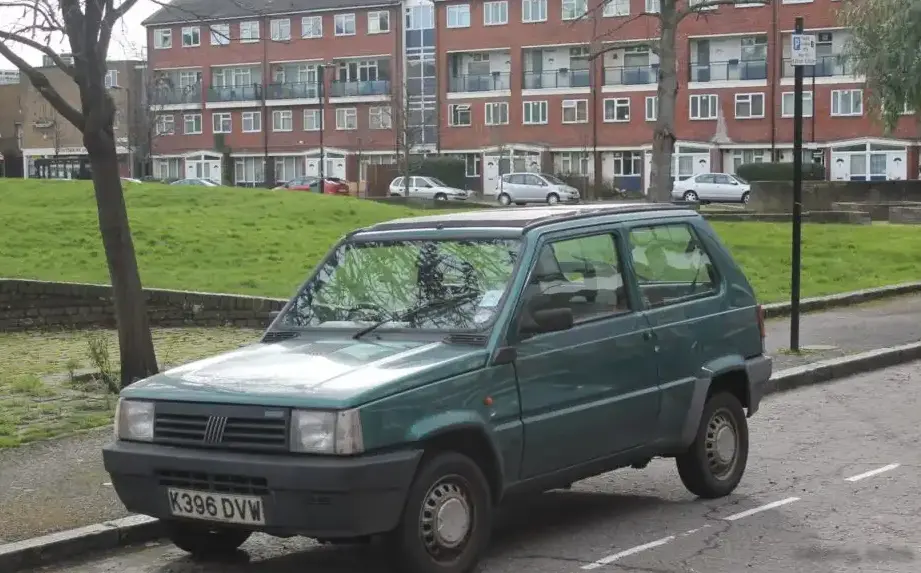
The Fiat Panda 1100 ie, produced between October 1995 and December 1996, represents a notable variant of the enduringly popular Fiat Panda city car. This version falls within the ZAF 141 series, which received a facelift in 1991, and occupied the entry-level position in the Panda lineup. Designed to provide affordable and practical transportation, the 1100 ie primarily targeted urban drivers and those seeking a simple, economical vehicle. The combination of a 1.1-liter engine and an automatic transmission was relatively uncommon for the Panda, aiming to offer a degree of convenience alongside the model’s inherent practicality.
Powertrain & Engine Architecture
The heart of the Panda 1100 ie is the 176 B2.000 engine, a 1.1-liter (1108 cc) inline-four cylinder unit. This engine featured a single overhead camshaft (OHC) valvetrain with two valves per cylinder. Fuel delivery was managed by a single-point injection system, a relatively basic setup compared to the multi-point injection systems becoming more common at the time. This system, while cost-effective, contributed to the engine’s modest power output. The engine produced 55 horsepower at 5500 rpm and 86 Nm (63.43 lb-ft) of torque at 3250 rpm. The automatic transmission used was a three-speed unit, chosen for its simplicity and ease of use, though it came at the expense of performance and fuel efficiency compared to the available five-speed manual gearbox.
Driving Characteristics
The 1100 ie automatic offered a relaxed, if unhurried, driving experience. Acceleration was noticeably slower than the manual transmission versions or those equipped with the larger 1.2-liter engine. The 0-60 mph time was around 16.6 seconds, and the top speed was 140 km/h (87 mph). The three-speed automatic transmission had relatively wide gear ratios, prioritizing fuel economy over spirited acceleration. The engine felt strained when attempting brisk acceleration, and the transmission would often hunt for the correct gear on inclines. However, for typical urban driving, the automatic provided a comfortable and convenient experience, eliminating the need for constant gear changes.
Equipment & Trim Levels
The Panda 1100 ie, as the entry-level automatic variant, was typically equipped with basic but functional features. Standard equipment included cloth upholstery, a simple dashboard layout, and manual windows and door locks. Power steering was not typically included as standard, though it could be added as an option. Optional extras included a radio, upgraded interior trim, and occasionally, a sunroof. The interior was designed for practicality and durability, with hard-wearing plastics and a focus on maximizing space within the small cabin. The trim level was generally consistent across the 1100 ie models, with limited customization options available.
Chassis & Braking
The Panda 1100 ie utilized a simple but effective chassis design. Front suspension consisted of coil springs, while the rear employed a coil spring setup. Braking was comprised of disc brakes on the front wheels and drum brakes on the rear. ABS (Anti-lock Braking System) was included as a standard safety feature, a notable inclusion for a vehicle in this price segment. The relatively lightweight construction of the Panda (745 kg / 1642 lbs) helped to mitigate the effects of the modest engine power and braking system. Stabilizer bars were not typically fitted to the standard 1100 ie, contributing to a slightly more pronounced body roll during cornering.
Market Reception & Comparison
The Panda 1100 ie automatic received mixed reviews. Critics acknowledged its affordability and practicality but often criticized its sluggish performance and relatively high fuel consumption compared to the manual versions. The automatic transmission, while convenient, was seen as detracting from the Panda’s overall driving experience. Compared to the 1.2-liter models, the 1100 ie offered significantly less power and acceleration. However, it was often praised for its ease of use and suitability for novice drivers or those primarily using the vehicle for short urban journeys. Fuel economy was rated at 6.7 l/100 km, which was acceptable for the time but less competitive than the manual transmission variants.
Legacy
The Fiat Panda 1100 ie automatic, while not the most popular version of the Panda, holds a place in automotive history as a testament to affordable and practical transportation. The 176 B2.000 engine, while simple, proved to be relatively reliable, and many examples remain on the road today. In the used car market, these Pandas are often sought after by enthusiasts looking for a classic city car or a project vehicle. The automatic transmission, while not known for its longevity, can be rebuilt with relative ease. The Panda 1100 ie represents a unique blend of simplicity, affordability, and Italian design, making it a fondly remembered vehicle for many.