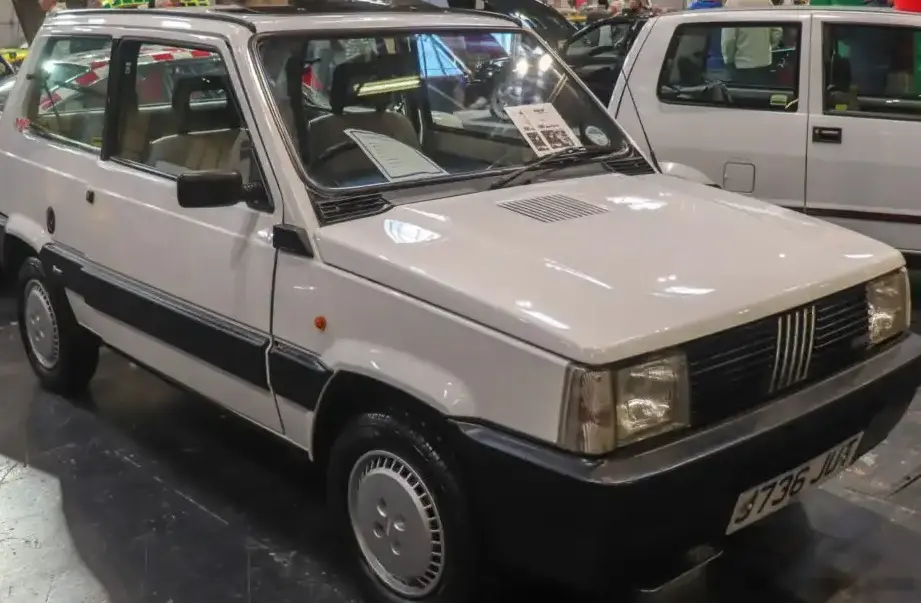
The Fiat Panda 750 L, produced from May 1986 to May 1991, represents a significant iteration of the iconic Italian city car. This variant, part of the ZAF 141 series and benefitting from the 1986 facelift, was positioned as the entry-level model within the Panda range. It offered affordable transportation and practicality, becoming a popular choice in Italy and other European markets. The 750 L’s appeal lay in its simplicity, fuel efficiency, and ease of use, making it a staple for urban commuters and first-time car buyers.
Technical Specifications
| Brand | Fiat |
| Model | Panda |
| Generation | Panda (ZAF 141, facelift 1986) |
| Type (Engine) | 750 L (34 Hp) |
| Start of production | May, 1986 |
| End of production | May, 1991 |
| Powertrain Architecture | Internal Combustion engine |
| Body type | Hatchback |
| Seats | 5 |
| Doors | 3 |
| Fuel consumption (urban) | 6.2 l/100 km (37.9 US mpg, 45.6 UK mpg, 16.1 km/l) |
| Fuel consumption (extra urban) | 5 l/100 km (47 US mpg, 56.5 UK mpg, 20 km/l) |
| Fuel Type | Petrol (Gasoline) |
| Acceleration 0 – 100 km/h | 23 sec |
| Acceleration 0 – 62 mph | 23 sec |
| Acceleration 0 – 60 mph | 21.9 sec |
| Maximum speed | 125 km/h (77.67 mph) |
| Weight-to-power ratio | 19.8 kg/Hp, 50.4 Hp/tonne |
| Weight-to-torque ratio | 11.8 kg/Nm, 84.6 Nm/tonne |
| Power | 34 Hp @ 5250 rpm |
| Power per litre | 44.2 Hp/l |
| Torque | 57 Nm @ 3000 rpm (42.04 lb.-ft. @ 3000 rpm) |
| Engine layout | Front, Transverse |
| Engine Model/Code | 156A4.000 |
| Engine displacement | 769 cm3 (46.93 cu. in.) |
| Number of cylinders | 4 |
| Engine configuration | Inline |
| Cylinder Bore | 65 mm (2.56 in.) |
| Piston Stroke | 58 mm (2.28 in.) |
| Compression ratio | 9.4:1 |
| Number of valves per cylinder | 2 |
| Fuel injection system | Carburettor |
| Engine aspiration | Naturally aspirated engine |
| Valvetrain | OHV |
| Engine oil capacity | 3.5 l (3.7 US qt | 3.08 UK qt) |
| Coolant | 5.6 l (5.92 US qt | 4.93 UK qt) |
| Kerb Weight | 674 kg (1485.92 lbs.) |
| Max. weight | 1150 kg (2535.32 lbs.) |
| Max load | 476 kg (1049.4 lbs.) |
| Trunk (boot) space – minimum | 272 l (9.61 cu. ft.) |
| Trunk (boot) space – maximum | 1088 l (38.42 cu. ft.) |
| Fuel tank capacity | 40 l (10.57 US gal | 8.8 UK gal) |
| Length | 3410 mm (134.25 in.) |
| Width | 1490 mm (58.66 in.) |
| Height | 1420 mm (55.91 in.) |
| Wheelbase | 2159 mm (85 in.) |
| Minimum turning circle | 9.45 m (31 ft.) |
| Drivetrain Architecture | The Internal combustion engine (ICE) drives the front wheels of the vehicle. |
| Drive wheel | Front wheel drive |
| Number of gears and type of gearbox | 4 gears, manual transmission |
| Front suspension | Independent type McPherson |
| Rear suspension | Semi-independent, coil spring |
| Front brakes | Disc, 227 mm |
| Rear brakes | Drum, 185 mm |
| Steering type | Steering rack and pinion |
INTRODUCTION
The Fiat Panda 750 L, launched in 1986, was a refreshed version of the original Panda (Mark I), which debuted in 1980. The facelift included minor cosmetic updates and improvements to the interior. The 750 L was designed to be a practical and economical vehicle for everyday use, particularly in congested urban environments. It was a key player in the Italian automotive market, offering a low-cost alternative to larger, more expensive cars. The Panda’s simple design and robust construction made it a popular choice for families and individuals seeking reliable transportation.
Powertrain & Engine Architecture
At the heart of the Panda 750 L lies the 156A4.000 engine, a 769cc inline-four cylinder petrol engine. This engine, producing 34 horsepower at 5250 rpm and 57 Nm (42.04 lb-ft) of torque at 3000 rpm, was known for its simplicity and durability. It utilized a single overhead valve (OHV) valvetrain and a carburetor fuel injection system – a common setup for vehicles of this era. The carburetor, while less efficient than modern fuel injection systems, contributed to the engine’s reliability and ease of maintenance. The engine was transversely mounted at the front of the vehicle, driving the front wheels. The 750 L was exclusively offered with a four-speed manual transmission, optimized for fuel economy and urban driving. The gear ratios were relatively tall, prioritizing efficiency over outright acceleration.
Driving Characteristics
The driving experience in the Panda 750 L was characterized by its light weight and nimble handling. While the 34 horsepower engine didn’t deliver exhilarating performance, it provided sufficient power for navigating city streets and country roads. Acceleration from 0 to 100 km/h (0-62 mph) took approximately 23 seconds, and the top speed was around 125 km/h (77.67 mph). Compared to higher-spec Panda models, such as the 1000 Fire, the 750 L felt noticeably slower. However, its compact size and responsive steering made it enjoyable to drive in tight spaces. The four-speed manual transmission required frequent shifting, but the light clutch pedal and precise gear changes made the process relatively effortless. The suspension, while basic, provided a comfortable ride on most road surfaces.
Equipment & Trim Levels
The Panda 750 L was a fairly basic vehicle, reflecting its position as the entry-level model. Standard equipment included cloth upholstery, vinyl floor covering, and a simple dashboard layout. The seats were manually adjustable, and the car featured basic instrumentation, including a speedometer, fuel gauge, and temperature gauge. Optional extras included a radio, heated rear window, and upgraded interior trim. The interior was designed for practicality and durability, with hard-wearing materials used throughout. The exterior featured steel wheels, black plastic bumpers, and minimal chrome trim.
Chassis & Braking
The Panda 750 L utilized a simple yet effective chassis design. The front suspension consisted of independent McPherson struts, while the rear suspension employed a semi-independent coil spring setup. This configuration provided a reasonable balance between ride comfort and handling. The brakes were disc brakes at the front and drum brakes at the rear. The braking system was adequate for the car’s weight and performance, but it lacked the sophistication of more modern braking systems. The steering was a rack and pinion system, providing precise and responsive steering feel.
Market Reception & Comparison
The Fiat Panda 750 L was generally well-received by critics and consumers alike. It was praised for its affordability, fuel efficiency, and practicality. However, some critics noted its lack of power and basic interior. Compared to other entry-level cars of the time, such as the Citroën 2CV and the Renault 5, the Panda 750 L offered a more modern design and a slightly more refined driving experience. The 1000 Fire variant, with its larger engine and improved performance, was a popular upgrade for those seeking more power. Fuel economy was a strong point, with the 750 L achieving around 6.2 l/100 km (37.9 US mpg) in urban driving and 5 l/100 km (47 US mpg) on the open road.
Legacy
The Fiat Panda 750 L remains a popular classic car among enthusiasts. Its simple design and robust construction have contributed to its longevity, and many examples are still on the road today. The 156A4.000 engine is known for its reliability, although regular maintenance is essential to keep it running smoothly. Parts availability can be a challenge, but many aftermarket suppliers offer replacement components. The Panda 750 L represents a significant chapter in Fiat’s history, and it continues to be cherished by those who appreciate its simplicity, practicality, and Italian charm. In the used car market, well-maintained examples command a modest but growing price, reflecting the car’s increasing popularity among collectors.