Technical Specifications
| Brand | Fiat |
| Model | Punto |
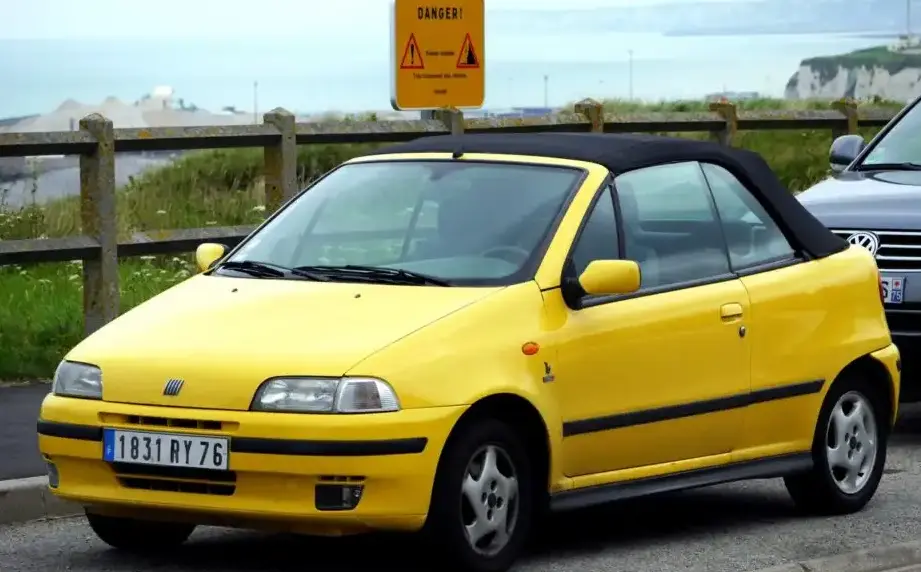
| Generation | Punto Cabrio (176C) |
| Type (Engine) | 1.2 (58 Hp) |
| Start of production | 1994 |
| End of production | 1995 |
| Powertrain Architecture | Internal Combustion engine |
| Body type | Cabriolet |
| Seats | 4 |
| Doors | 2 |
| Fuel consumption (urban) | 7.7 l/100 km (30.5 US mpg) |
| Fuel consumption (extra urban) | 5.1 l/100 km (46.1 US mpg) |
| Fuel consumption (combined) | 6.6 l/100 km (35.6 US mpg) |
| Fuel Type | Petrol (Gasoline) |
| Acceleration 0 – 100 km/h | 15.1 sec |
| Acceleration 0 – 62 mph | 15.1 sec |
| Acceleration 0 – 60 mph | 14.3 sec |
| Maximum speed | 150 km/h (93.21 mph) |
| Weight-to-power ratio | 16.6 kg/Hp |
| Weight-to-torque ratio | 10 kg/Nm |
| Power | 58 Hp @ 5500 rpm |
| Torque | 96 Nm @ 3000 rpm (70.81 lb.-ft. @ 3000 rpm) |
| Engine layout | Front, Transverse |
| Engine Model/Code | 176A7000 |
| Engine displacement | 1242 cm3 (75.79 cu. in.) |
| Number of cylinders | 4 |
| Engine configuration | Inline |
| Cylinder Bore | 70.8 mm (2.79 in.) |
| Piston Stroke | 78.9 mm (3.11 in.) |
| Compression ratio | 9.6:1 |
| Number of valves per cylinder | 2 |
| Fuel injection system | Single-point injection |
| Engine aspiration | Naturally aspirated |
| Valvetrain | OHC |
| Engine oil capacity | 3.8 l (4.02 US qt | 3.34 UK qt) |
| Coolant capacity | 4.5 l (4.76 US qt | 3.96 UK qt) |
| Kerb Weight | 960 kg (2116.44 lbs.) |
| Max. weight | 1320 kg (2910.1 lbs.) |
| Max load | 360 kg (793.66 lbs.) |
| Trunk (boot) space – minimum | 200 l (7.06 cu. ft.) |
| Fuel tank capacity | 47 l (12.42 US gal | 10.34 UK gal) |
| Length | 3760 mm (148.03 in.) |
| Width | 1625 mm (63.98 in.) |
| Height | 1447 mm (56.97 in.) |
| Wheelbase | 2450 mm (96.46 in.) |
| Front track | 1395 mm (54.92 in.) |
| Rear track | 1377 mm (54.21 in.) |
| Drag coefficient (Cd) | 0.38 |
| Minimum turning circle | 10.2 m (33.46 ft.) |
| Drivetrain Architecture | Front wheel drive |
| Number of gears | 5 |
| Gearbox type | Manual transmission |
| Front suspension | Spring Strut |
| Rear suspension | Coil spring |
| Front brakes | Disc |
| Rear brakes | Drum |
| Assisting systems | ABS (Anti-lock braking system) |
| Steering type | Steering rack and pinion |
| Tires size | 155/70 R13 S |
The Fiat Punto Cabrio (176C) 1.2, produced between 1994 and 1995, served as the entry point into the open-top Punto range. Based on the 176 series Punto, the Cabrio offered affordable open-air motoring and distinctive Italian styling in a compact package. It was primarily marketed in Europe, where small, economical convertibles were popular, providing a more accessible alternative to larger and more expensive drop-tops. This variant, equipped with the 1.2-liter engine and a five-speed manual transmission, occupied the base trim level, prioritizing affordability and fuel efficiency over outright performance.
Powertrain & Engine Architecture
The Punto Cabrio 1.2 utilized Fiat’s 176A7.000 engine, a naturally aspirated, inline-four cylinder powerplant displacing 1242cc. This engine featured a single overhead camshaft (OHC) operating two valves per cylinder. Fuel delivery was handled by a single-point fuel injection system, a relatively simple setup common in budget-oriented vehicles of the era. The 1.2-liter engine produced 58 horsepower at 5500 rpm and 96 Nm (70.81 lb-ft) of torque at 3000 rpm. The engine’s compression ratio was 9.6:1. The five-speed manual transmission was a standard Fiat unit, chosen for its affordability and relative simplicity. Gear ratios were geared towards economy rather than performance, with a taller final drive contributing to lower fuel consumption.
Driving Characteristics
The 1.2-liter Punto Cabrio, with its modest power output, wasn’t designed for spirited driving. Acceleration was leisurely, taking approximately 15.1 seconds to reach 62 mph. Top speed was around 93 mph. The engine felt strained at higher revs, and overtaking required careful planning. Compared to the more powerful 1.4-liter or even the diesel variants, the 1.2 felt noticeably slower. However, the light weight of the vehicle and the well-chosen gear ratios made it reasonably pleasant to drive around town. The manual transmission allowed for a degree of driver control, but the lack of power meant that frequent downshifts were necessary when encountering hills or needing to accelerate quickly. The steering was light and responsive, making it easy to maneuver in urban environments.
Equipment & Trim Levels
The base 1.2-liter Punto Cabrio was fairly sparsely equipped, reflecting its position as the entry-level model. Standard features typically included cloth upholstery, basic instrumentation, and a manually operated soft top. Power steering was often an optional extra. Interior trim was functional rather than luxurious, with hard plastics dominating the cabin. Optional extras could include upgraded audio systems, alloy wheels, and electric windows. The dashboard layout was typical of early 1990s Fiat designs, with a straightforward and user-friendly arrangement of controls.
Chassis & Braking
The Punto Cabrio utilized a relatively simple chassis design. Front suspension consisted of MacPherson struts, while the rear employed a coil spring setup. Brakes were discs on the front wheels and drums on the rear, a common configuration for vehicles in this price range. ABS (Anti-lock Braking System) was available as an option, enhancing safety. The suspension was tuned for comfort rather than handling, providing a reasonably smooth ride on most road surfaces. Stabilizer bars were relatively thin, contributing to a degree of body roll during cornering.
Market Reception & Comparison
The Punto Cabrio 1.2 was generally well-received as an affordable and stylish convertible. Critics praised its attractive design and relatively low price point. However, the engine’s lack of power was a common criticism. Compared to the 1.4-liter version, the 1.2 offered significantly lower performance but better fuel economy. The 1.4 was considered a more practical choice for those who frequently drove on motorways or carried passengers. Fuel economy figures for the 1.2 were respectable for the time, averaging around 35.6 US mpg on the combined cycle. Reliability was generally good, although the single-point fuel injection system could occasionally require maintenance.
Legacy
The Fiat Punto Cabrio 1.2, while not a performance icon, remains a popular choice among classic car enthusiasts seeking an affordable and charming convertible. The 176A7.000 engine is known for its durability, although regular maintenance is essential to prevent issues. Parts availability is generally good, although some specific trim pieces may be difficult to find. Today, these cars are often sought after as weekend cruisers or as a nostalgic reminder of 1990s Italian motoring. The 1.2-liter version, being the most affordable variant, represents a particularly accessible entry point into Punto Cabrio ownership.