
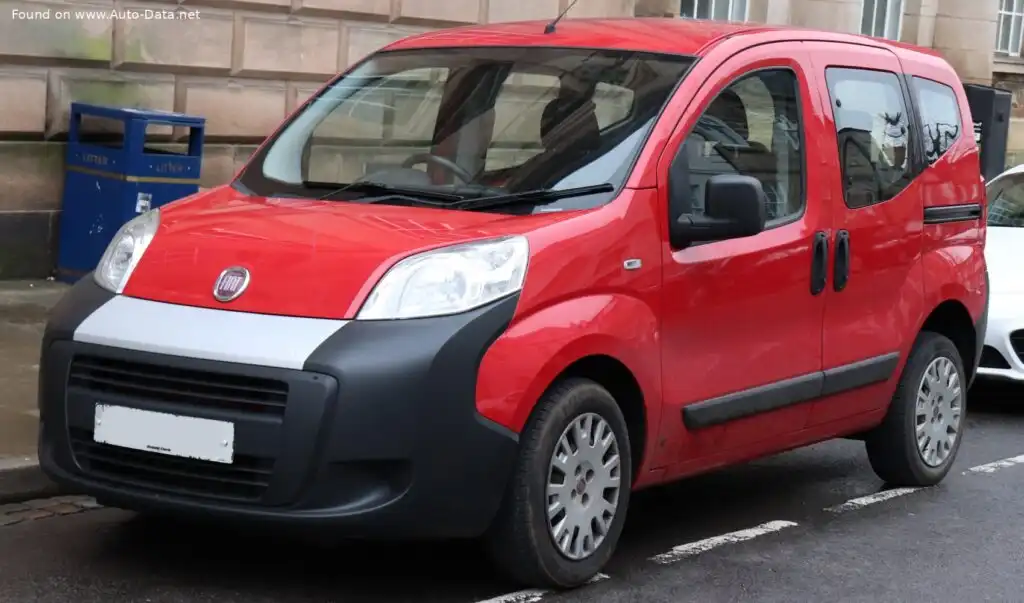
Technical Specifications
| Brand | Fiat |
| Model | Qubo |
| Generation | Qubo |
| Type (Engine) | 1.3 MultiJet (80 Hp) |
| Start of production | 2019 |
| End of production | 2019 |
| Powertrain Architecture | Internal Combustion engine |
| Body type | Minivan, MPV |
| Seats | 5 |
| Doors | 5 |
| Fuel consumption (urban) | 6.5 l/100 km (36.2 US mpg, 43.5 UK mpg, 15.4 km/l) |
| Fuel consumption (extra urban) | 4.4 l/100 km (53.5 US mpg, 64.2 UK mpg, 22.7 km/l) |
| Fuel consumption (combined) | 5.2 l/100 km (45.2 US mpg, 54.3 UK mpg, 19.2 km/l) |
| CO2 emissions | 126 g/km |
| Fuel Type | Diesel |
| Acceleration 0 – 100 km/h | 13.9 sec |
| Acceleration 0 – 62 mph | 13.9 sec |
| Acceleration 0 – 60 mph | 13.2 sec |
| Maximum speed | 161 km/h (100.04 mph) |
| Emission standard | Euro 6d-Temp |
| Weight-to-power ratio | 15.4 kg/Hp |
| Weight-to-torque ratio | 6.2 kg/Nm |
| Power | 80 Hp @ 3750 rpm |
| Power per litre | 64.1 Hp/l |
| Torque | 200 Nm @ 1500 rpm (147.51 lb.-ft. @ 1500 rpm) |
| Engine layout | Front, Transverse |
| Engine Model/Code | 225 A2.000 |
| Engine displacement | 1248 cm3 (76.16 cu. in.) |
| Number of cylinders | 4 |
| Engine configuration | Inline |
| Compression ratio | 16.8:1 |
| Fuel injection system | Diesel Commonrail |
| Engine aspiration | Turbocharger, Intercooler |
| Engine oil capacity | 3.9 l (4.12 US qt | 3.43 UK qt) |
| Coolant capacity | 6.5 l (6.87 US qt | 5.72 UK qt) |
| Kerb Weight | 1230 kg (2711.69 lbs.) |
| Max. weight | 1740 kg (3836.04 lbs.) |
| Max load | 510 kg (1124.36 lbs.) |
| Trunk (boot) space – minimum | 330 l (11.65 cu. ft.) |
| Trunk (boot) space – maximum | 2500 l (88.29 cu. ft.) |
| Fuel tank capacity | 45 l (11.89 US gal | 9.9 UK gal) |
| Permitted trailer load with brakes (12%) | 1000 kg (2204.62 lbs.) |
| Permitted trailer load without brakes | 600 kg (1322.77 lbs.) |
| Length | 3957-3971 mm (155.79 – 156.34 in.) |
| Width | 1716 mm (67.56 in.) |
| Height | 1735-1810 mm (68.31 – 71.26 in.) |
| Wheelbase | 2513 mm (98.94 in.) |
| Front track | 1462-1464 mm (57.56 – 57.64 in.) |
| Rear track | 1464-1465 mm (57.64 – 57.68 in.) |
| Minimum turning circle | 10.82 m (35.5 ft.) |
| Drivetrain | Front wheel drive |
| Number of gears | 5 |
| Gearbox type | Manual transmission |
| Front suspension | Independent type McPherson |
| Rear suspension | Torsion |
| Front brakes | Disc, 257 mm |
| Rear brakes | Disc, 228 mm |
| Assisting systems | ABS (Anti-lock braking system) |
| Steering type | Steering rack and pinion |
| Power steering | Hydraulic Steering |
| Wheel rims size | 15; 16 |
The Fiat Qubo 1.3 MultiJet (80 hp) represents a specific configuration within the second generation of the Qubo, a compact multi-purpose vehicle (MPV) produced by the Italian manufacturer Fiat. Introduced in 2019, this variant was primarily aimed at budget-conscious buyers seeking a practical and fuel-efficient vehicle for urban and family use. It falls within the broader Qubo range, sharing its platform and basic structure with the Citroën Nemo and Peugeot Bipper, a result of a collaborative venture between the PSA Group (now Stellantis) and Fiat. The 2019 model year represents a refresh of the original Qubo, bringing it into compliance with updated emissions standards and incorporating minor design changes.
Powertrain & Engine Architecture
The Qubo 1.3 MultiJet (80 hp) is powered by Fiat’s 225 A2.000 engine, a 1.3-liter inline-four cylinder diesel engine. This engine is a member of the MultiJet family, characterized by its common-rail direct injection system and a variable geometry turbocharger. The MultiJet technology allows for multiple injections per combustion cycle, optimizing fuel burn and reducing noise, vibration, and harshness (NVH). The engine produces 80 horsepower at 3750 rpm and 200 Nm (147.51 lb-ft) of torque at 1500 rpm. This torque output, available at relatively low engine speeds, is a key characteristic of diesel engines and contributes to the Qubo’s usability in everyday driving. The engine features a compression ratio of 16.8:1. The 5-speed manual transmission was the standard offering for this variant, chosen for its simplicity and cost-effectiveness.
Driving Characteristics
The 1.3 MultiJet 80 hp engine, paired with a manual transmission, provides adequate, though not exhilarating, performance. Acceleration from 0 to 100 km/h (0-62 mph) takes approximately 13.9 seconds, and the top speed is around 161 km/h (100 mph). The focus is on fuel efficiency and low-speed drivability rather than outright speed. The gear ratios are tuned for maximizing fuel economy, meaning the engine can feel strained when accelerating quickly or climbing hills. Compared to higher-powered versions of the Qubo, such as those equipped with the 1.4-liter petrol engine, the 1.3 MultiJet offers significantly better fuel economy but lacks the same level of responsiveness. The manual transmission allows for greater driver control and engagement compared to an automatic, but requires more effort in stop-and-go traffic.
Equipment & Trim Levels
The Qubo 1.3 MultiJet (80 hp) typically served as the entry-level trim in many markets. Standard equipment generally included power steering, ABS brakes, a driver’s airbag, and a basic audio system. Interior upholstery was typically cloth, and the dashboard featured a functional, if somewhat basic, design. Optional extras could include air conditioning, electric windows, central locking, and a passenger airbag. Higher trim levels offered additional features such as alloy wheels, upgraded audio systems, and more premium interior materials. The Qubo’s modular interior, with its folding rear seats, was a key selling point, offering a versatile cargo space ranging from 330 liters (11.65 cu. ft.) with all seats in place to 2500 liters (88.29 cu. ft.) with the rear seats folded down.
Chassis & Braking
The Qubo utilizes a McPherson strut front suspension and a torsion beam rear suspension. This setup provides a reasonable balance between ride comfort and handling. The front brakes are disc brakes, measuring 257 mm in diameter, while the rear brakes are also disc brakes, at 228 mm. ABS (Anti-lock Braking System) is standard. The Qubo’s relatively lightweight construction (kerb weight of 1230 kg / 2711.69 lbs.) helps to offset the modest power output of the 1.3 MultiJet engine. The steering is hydraulic, providing a reasonably direct feel.
Market Reception & Comparison
The Fiat Qubo 1.3 MultiJet (80 hp) was generally well-received as a practical and affordable MPV. Critics praised its fuel efficiency, spacious interior, and versatility. However, the engine’s limited power output was often cited as a drawback, particularly when the vehicle was fully loaded. Compared to other small MPVs on the market, such as the Renault Kangoo and the Volkswagen Caddy, the Qubo offered a competitive price point and a good level of standard equipment. Its fuel economy was comparable to other diesel-powered MPVs in its class.
Legacy
The 1.3 MultiJet engine has proven to be a relatively reliable unit, although regular maintenance is essential. Common issues include injector problems and turbocharger wear, particularly on higher-mileage examples. The Qubo, as a whole, has established a reputation as a durable and practical vehicle, making it a popular choice in the used car market. Its simple construction and readily available parts contribute to its affordability and ease of maintenance. While not a performance vehicle, the Qubo 1.3 MultiJet (80 hp) remains a viable option for buyers seeking a fuel-efficient and versatile MPV for everyday use.
