
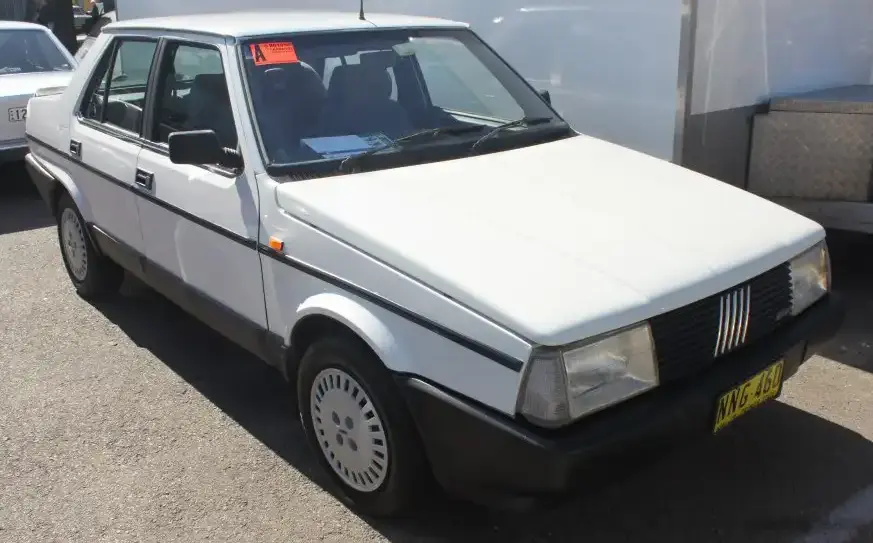
The Fiat Regata 100 1.6, produced between 1985 and 1990, was a mainstay of the Fiat lineup during that period. Part of the 138 project, the Regata represented a significant update to the aging Fiat 132, offering a more modern design and improved efficiency. The “100” designation indicated the trim level, and the 1.6 signified the engine displacement. This particular variant, with its 101 horsepower engine, occupied a middle ground in the Regata range, positioned as a practical and affordable option for families and commuters. It was primarily sold in European markets, where it competed with vehicles like the Ford Sierra and Opel Ascona.
Technical Specifications
| Brand | Fiat |
| Model | Regata |
| Generation | Regata (138) |
| Type (Engine) | 100 1.6 (101 Hp) |
| Start of production | 1985 |
| End of production | 1990 |
| Powertrain Architecture | Internal Combustion engine |
| Body type | Sedan |
| Seats | 5 |
| Doors | 4 |
| Fuel Type | Petrol (Gasoline) |
| Power | 101 Hp |
| Engine Model/Code | 149A2.000 |
| Engine aspiration | Naturally aspirated engine |
| Engine oil capacity | 4.2 l / 4.44 US qt / 3.7 UK qt |
| Coolant capacity | 7 l / 7.4 US qt / 6.16 UK qt |
| Trunk (boot) space – minimum | 513 l / 18.12 cu. ft. |
| Fuel tank capacity | 55 l / 14.53 US gal / 12.1 UK gal |
| Length | 4260 mm / 167.72 in. |
| Width | 1650 mm / 64.96 in. |
| Height | 1410 mm / 55.51 in. |
| Front overhang | 820 mm / 32.28 in. |
| Rear overhang | 992 mm / 39.06 in. |
Powertrain & Engine Architecture
The Fiat Regata 100 1.6 was powered by the 149A2.000 engine, a 1.6-liter inline-four cylinder gasoline engine. This engine was a naturally aspirated unit, meaning it did not utilize a turbocharger or supercharger. It featured a cast iron block and an aluminum cylinder head, a common configuration for engines of this era. Fuel delivery was managed by a Bosch mechanical fuel injection system, a step up from carburetors but less sophisticated than later electronic fuel injection systems. The engine employed a single overhead camshaft (SOHC) valvetrain, operating two valves per cylinder. The 101 horsepower output was achieved at approximately 5800 rpm, with peak torque of around 137 Nm (101 lb-ft) at 3600 rpm. The Regata 100 1.6 was typically paired with a three-speed automatic transmission, although a five-speed manual transmission was also available. The automatic transmission was a conventional hydraulic unit, known for its smooth operation but relatively slow shift times compared to modern automatics.
Driving Characteristics
The driving experience in the Regata 100 1.6 with the automatic transmission was geared towards comfort and ease of use rather than outright performance. Acceleration was adequate for everyday driving, but the 101 hp engine and three-speed automatic meant it wasn’t particularly quick. The automatic transmission’s gear ratios were optimized for fuel economy and smooth cruising, resulting in a noticeable delay during kickdown for overtaking maneuvers. Compared to the manual transmission version, the automatic Regata 1.6 felt noticeably slower. The suspension, while comfortable, wasn’t particularly sporty, prioritizing ride quality over handling precision. Steering was light and easy, making it well-suited for city driving. The overall driving experience was typical of European sedans of the 1980s – practical, reliable, and comfortable, but not exciting.
Equipment & Trim Levels
The Regata 100 1.6 offered a reasonable level of equipment for its price point. Standard features typically included cloth upholstery, a basic instrument cluster, and manual windows and door locks. The interior was functional and durable, though not particularly luxurious. Optional extras included a sunroof, upgraded stereo system, and power windows. The “100” trim level generally signified a mid-range offering, sitting above the base models but below the more luxurious versions like the Regata ES. The dashboard layout was straightforward, with clearly labeled controls. Air conditioning was often an optional extra, and its presence significantly increased the vehicle’s value.
Chassis & Braking
The Regata 100 1.6 utilized a relatively simple chassis design. It featured independent front suspension with MacPherson struts and a solid rear axle with leaf springs. This configuration provided a comfortable ride but limited handling capabilities. Braking was typically accomplished with disc brakes on the front wheels and drum brakes on the rear wheels. The braking system was adequate for normal driving conditions, but lacked the stopping power of more modern systems. A stabilizer bar was fitted to the front suspension to reduce body roll during cornering. The Regata’s weight, around 1150-1200 kg (2535-2645 lbs), contributed to its moderate handling characteristics.
Market Reception & Comparison
The Fiat Regata 100 1.6 was generally well-received by automotive critics as a practical and affordable family sedan. However, the automatic transmission version was often criticized for its sluggish performance compared to the manual transmission models. Fuel economy was considered reasonable for the time, averaging around 8-10 liters per 100 kilometers (23-28 mpg). Compared to other trims in the Regata lineup, the 1.6 offered a good balance between performance and fuel efficiency. The more powerful 1.8 and 2.0-liter engines provided more spirited performance, but at the cost of increased fuel consumption. The diesel-powered Regata models offered superior fuel economy but lacked the refinement of the gasoline engines. The Regata competed directly with vehicles like the Ford Sierra, Opel Ascona, and Renault 18, offering a similar level of practicality and affordability.
Legacy
The Fiat Regata, and specifically the 100 1.6 variant, has become a relatively sought-after classic car among enthusiasts. The 149A2.000 engine is known for its durability and relative simplicity, making it relatively easy to maintain. However, finding parts can be challenging as production ceased over three decades ago. The automatic transmission, while reliable, is prone to wear and tear with age. Today, well-maintained examples of the Regata 100 1.6 are increasingly rare and command a modest premium in the used car market. It represents a snapshot of 1980s European automotive design and engineering, offering a nostalgic driving experience for those seeking a classic Italian sedan.
