
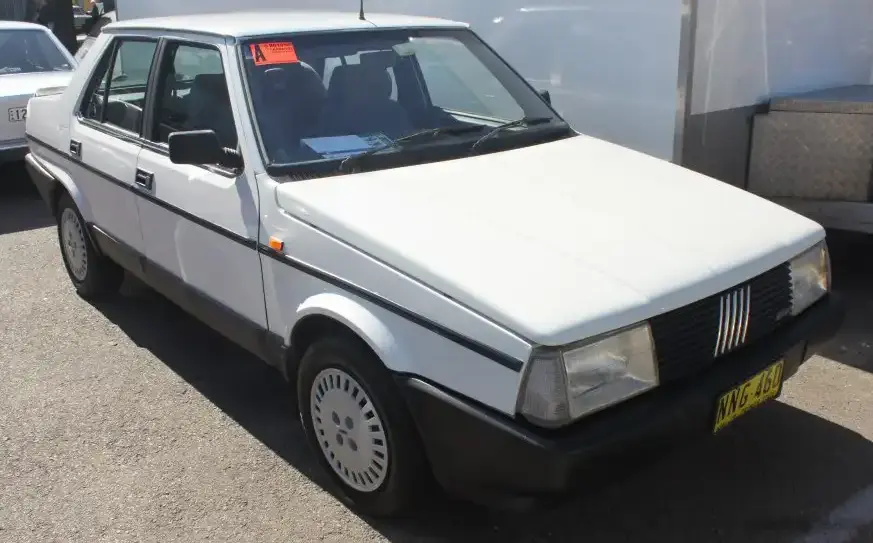
The Fiat Regata 100 Super 1.6, produced between 1983 and 1989, represented a mid-range offering within the Regata (Type 138) lineup. Positioned above the base models and below the more powerful and sporting versions, the 100 Super aimed to provide a balance of practicality, comfort, and reasonable performance for the average family car buyer in Europe. The Regata itself was designed as a replacement for the Fiat 132, offering a more modern and efficient package in the compact family sedan segment. It shared its platform and many components with the Alfa Romeo Arna, a result of Fiat’s ownership of Alfa Romeo at the time.
Technical Specifications
| Brand | Fiat |
| Model | Regata |
| Generation | Regata (138) |
| Type (Engine) | 100 Super 1.6 (95 Hp) |
| Start of production | 1983 |
| End of production | 1989 |
| Powertrain Architecture | Internal Combustion engine |
| Body type | Sedan |
| Seats | 5 |
| Doors | 4 |
| Fuel Type | Petrol (Gasoline) |
| Power | 95 Hp |
| Engine Model/Code | 149 C3.000 |
| Engine aspiration | Naturally aspirated engine |
| Engine oil capacity | 4.6 l (4.86 US qt | 4.05 UK qt) |
| Coolant capacity | 7 l (7.4 US qt | 6.16 UK qt) |
| Trunk (boot) space – minimum | 513 l (18.12 cu. ft.) |
| Fuel tank capacity | 55 l (14.53 US gal | 12.1 UK gal) |
| Length | 4260 mm (167.72 in.) |
| Width | 1650 mm (64.96 in.) |
| Height | 1410 mm (55.51 in.) |
| Front overhang | 820 mm (32.28 in.) |
| Rear overhang | 992 mm (39.06 in.) |
Powertrain & Engine Architecture
The heart of the Regata 100 Super 1.6 was the Fiat 149 C3.000 engine, a 1.6-liter inline-four cylinder gasoline engine. This engine featured a cast iron block and an aluminum cylinder head, a common configuration for the era. It employed a single overhead camshaft (SOHC) valvetrain operating two valves per cylinder. Fuel delivery was managed by a Bosch mechanical fuel injection system, a step up from carburetors but less sophisticated than later electronic fuel injection systems. This system aimed to improve fuel efficiency and reduce emissions compared to earlier Fiat engines. The engine produced 95 horsepower (HP) at 6000 rpm and approximately 99 lb-ft of torque at 4000 rpm. The engine was known for its relative simplicity and durability, though it wasn’t a particularly high-revving or powerful unit.
The 100 Super was typically equipped with a three-speed automatic transmission. This transmission, while providing convenience, was not known for its responsiveness or efficiency. It featured a torque converter and a relatively conservative gear ratio spread, prioritizing smooth operation over outright performance. Manual transmission options were available on other Regata models, offering a more engaging driving experience and slightly improved fuel economy.
Driving Characteristics
The Regata 100 Super 1.6 Automatic offered a comfortable, if uninspiring, driving experience. Acceleration was adequate for everyday driving, but the automatic transmission and the engine’s modest torque output meant that overtaking maneuvers required careful planning. The three-speed automatic’s gear changes were noticeable, and it lacked the smoothness of more modern automatic transmissions. The car’s suspension, consisting of MacPherson struts at the front and a twist-beam axle at the rear, provided a reasonably comfortable ride, absorbing bumps and imperfections in the road surface effectively. However, it wasn’t particularly sporty, with noticeable body roll during cornering. The steering was light and easy, making it maneuverable in urban environments, but lacked feedback.
Compared to the manual transmission versions of the Regata 1.6, the automatic suffered a slight performance penalty. The manual offered quicker acceleration and better fuel economy. The more powerful Regata 100 versions, equipped with larger engines, provided significantly more spirited performance, but at a higher price point.
Equipment & Trim Levels
The “Super” trim level of the Regata 1.6 offered a step up in terms of equipment compared to the base models. Standard features typically included cloth upholstery, a basic radio, and a more comprehensive instrument panel. The interior was functional and reasonably well-built, though the materials used were not particularly luxurious. Optional extras included a sunroof, upgraded audio systems, and power windows. The dashboard layout was typical of Italian cars of the era, with a focus on practicality and ease of use. The Regata 100 Super aimed to provide a comfortable and well-equipped interior for family use.
Chassis & Braking
The Regata 138 utilized a relatively conventional chassis design. The front suspension employed MacPherson struts, while the rear suspension featured a twist-beam axle. This setup provided a good balance of ride comfort and handling for a family sedan. Braking was typically accomplished with disc brakes at the front and drum brakes at the rear. The braking system was adequate for normal driving conditions, but lacked the stopping power of more modern braking systems. The car’s weight distribution was reasonably balanced, contributing to its predictable handling characteristics.
Market Reception & Comparison
The Fiat Regata 100 Super 1.6 was generally well-received by automotive critics as a practical and affordable family car. However, the automatic transmission was often criticized for its lack of responsiveness and efficiency. Compared to other cars in its class, such as the Ford Escort and Opel Kadett, the Regata offered a competitive level of equipment and comfort. Fuel economy was reasonable for the time, but not exceptional. Reliability was generally good, although the Bosch fuel injection system could occasionally require maintenance. The Regata’s styling was considered somewhat conservative, but it was a functional and appealing design.
Legacy
The Fiat Regata 1.6, particularly the 100 Super variant, has become a relatively sought-after classic car among enthusiasts. The engine’s simplicity and durability make it a relatively easy unit to maintain. While not a performance icon, the Regata 100 Super represents a well-built and practical family car from the 1980s. Good examples are becoming increasingly rare, and well-maintained cars can command a reasonable price on the used car market. The Regata’s legacy lies in its role as a comfortable and affordable family sedan that provided reliable transportation for many European drivers.
