
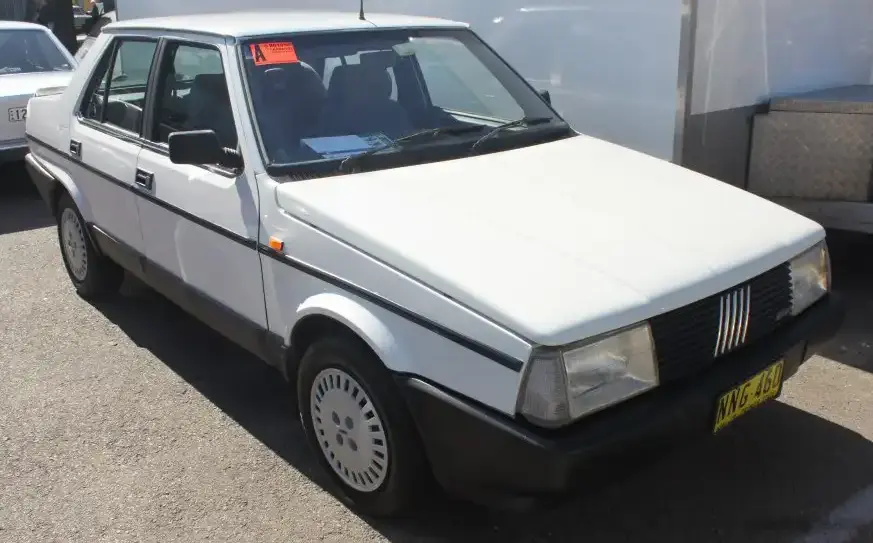
The Fiat Regata 70 1.3, producing 65 horsepower, was a mainstay of the Fiat Regata (Type 138) lineup from its introduction in 1983 until the model’s discontinuation in 1989. Positioned as the entry-level variant, it offered affordable transportation within the compact sedan segment, primarily targeting budget-conscious buyers in Europe and select international markets. The Regata itself was designed as a more modern and spacious replacement for the aging Fiat 132, utilizing a front-wheel-drive layout and offering a range of engines and trim levels. The 70 1.3 model, despite being the least powerful in the range, represented a significant portion of Regata sales due to its fuel efficiency and practicality.
Technical Specifications
| Brand | Fiat |
| Model | Regata |
| Generation | Regata (138) |
| Type (Engine) | 70 1.3 (65 Hp) |
| Start of production | 1983 |
| End of production | 1989 |
| Powertrain Architecture | Internal Combustion engine |
| Body type | Sedan |
| Seats | 5 |
| Doors | 4 |
| Fuel consumption (urban) | 8.5 l/100 km (27.7 US mpg) |
| Fuel consumption (extra urban) | 5.5 l/100 km (42.8 US mpg) |
| Fuel consumption (combined) | 7.1 l/100 km (33.1 US mpg) |
| Fuel Type | Petrol (Gasoline) |
| Acceleration 0 – 100 km/h | 13.5 sec |
| Acceleration 0 – 62 mph | 13.5 sec |
| Acceleration 0 – 60 mph | 12.8 sec |
| Maximum speed | 155 km/h (96.31 mph) |
| Weight-to-power ratio | 13.3 kg/Hp |
| Weight-to-torque ratio | 8.7 kg/Nm |
| Power | 65 Hp @ 5600 rpm |
| Power per litre | 50 Hp/l |
| Torque | 100 Nm @ 3000 rpm (73.76 lb.-ft. @ 3000 rpm) |
| Engine layout | Front, Transverse |
| Engine Model/Code | 138B2.000 |
| Engine displacement | 1301 cm3 (79.39 cu. in.) |
| Number of cylinders | 4 |
| Engine configuration | Inline |
| Number of valves per cylinder | 2 |
| Fuel injection system | Carburettor |
| Engine aspiration | Naturally aspirated |
| Engine oil capacity | 4.1 l (4.33 US qt | 3.61 UK qt) |
| Coolant capacity | 7 l (7.4 US qt | 6.16 UK qt) |
| Kerb Weight | 867 kg (1911.41 lbs) |
| Trunk (boot) space | 513 l (18.12 cu. ft.) |
| Fuel tank capacity | 55 l (14.53 US gal | 12.1 UK gal) |
| Permitted trailer load with brakes (12%) | 1000 kg (2204.62 lbs) |
| Length | 4260 mm (167.72 in) |
| Width | 1650 mm (64.96 in) |
| Height | 1410 mm (55.51 in) |
| Wheelbase | 2455 mm (96.65 in) |
| Front overhang | 820 mm (32.28 in) |
| Rear overhang | 992 mm (39.06 in) |
| Minimum turning circle | 10.3 m (33.79 ft) |
| Drivetrain Architecture | Front wheel drive |
| Number of gears | 4 |
| Gearbox type | Manual transmission |
| Front suspension | Independent, McPherson with coil spring and anti-roll bar |
| Rear suspension | Leaf spring |
| Front brakes | Disc |
| Rear brakes | Drum |
| Steering type | Steering rack and pinion |
| Tires size | 165/65 R14 |
Powertrain & Engine Architecture
The heart of the Regata 70 1.3 was the Fiat 138B2.000 engine, a 1301cc inline-four cylinder unit. This engine, a descendant of the earlier Fiat 128 engine family, featured a single overhead camshaft (SOHC) valvetrain with two valves per cylinder. Crucially, this variant utilized a carburetor for fuel delivery, a cost-saving measure compared to the fuel injection systems found in higher-spec Regata models. The carburetor, while simpler and cheaper, resulted in slightly lower performance and increased emissions. The engine produced 65 horsepower at 5600 rpm and 100 Nm (73.76 lb-ft) of torque at 3000 rpm. The engine was transversely mounted, driving the front wheels through a four-speed manual transmission. This configuration was typical for European front-wheel-drive cars of the era, maximizing interior space and improving traction in adverse conditions.
Driving Characteristics
The Regata 70 1.3 offered modest performance. Acceleration from 0-60 mph took around 12.8 seconds, and the top speed was approximately 96 mph. Compared to the more powerful Regata 100 (with a 1.6-liter engine) or the diesel variants, the 1.3 felt noticeably underpowered, particularly when fully loaded or tackling inclines. The four-speed gearbox, while adequate, lacked the versatility of a five-speed unit, requiring more frequent gear changes to maintain optimal engine speed. However, the light weight of the vehicle (approximately 1911 lbs) helped to mitigate the lack of horsepower. The steering was light and responsive, making it easy to maneuver in urban environments. The ride quality, while not luxurious, was generally comfortable, thanks to the McPherson strut front suspension.
Equipment & Trim Levels
The Regata 70 1.3 was the base model, and as such, came with a relatively sparse equipment list. Standard features typically included cloth upholstery, basic instrumentation (speedometer, fuel gauge, temperature gauge), and a simple two-speaker radio. Power steering and central locking were generally not standard, but were often available as optional extras. Interior trim was functional rather than luxurious, with hard-wearing plastics dominating the cabin. Optional extras could include upgraded upholstery, a sunroof, and alloy wheels, allowing buyers to personalize their vehicles to some extent.
Chassis & Braking
The Regata featured an independent McPherson strut suspension at the front, providing reasonable handling and ride comfort. The rear suspension utilized a leaf spring setup, a cost-effective solution that prioritized simplicity and durability over sophisticated handling. Braking was accomplished via disc brakes at the front and drum brakes at the rear. While adequate for normal driving conditions, the braking system lacked the stopping power of more modern setups. The Regata’s tires were typically 165/65 R14, providing a balance between comfort and grip.
Market Reception & Comparison
The Regata 70 1.3 was generally well-received as an affordable and practical family car. Critics praised its spacious interior, fuel efficiency, and ease of driving. However, the engine’s lack of power was a common criticism. Compared to the Regata 100, the 1.3 offered significantly lower performance but also lower running costs. The diesel variants, while slower still, provided even better fuel economy. The Regata competed with other compact sedans such as the Volkswagen Jetta, Ford Escort, and Opel Kadett, offering a compelling value proposition in its segment.
Legacy
The Fiat Regata 70 1.3, while not a performance icon, remains a fondly remembered car for many owners. The 138B2.000 engine, despite its carburetor-based fuel system, proved to be relatively reliable and durable. Today, well-maintained examples are becoming increasingly sought after by classic car enthusiasts. Parts availability can be a challenge, but the engine’s simplicity makes it relatively easy to repair. The Regata 70 1.3 represents a significant chapter in Fiat’s history, embodying the company’s commitment to providing affordable and practical transportation to a wide range of customers.
