
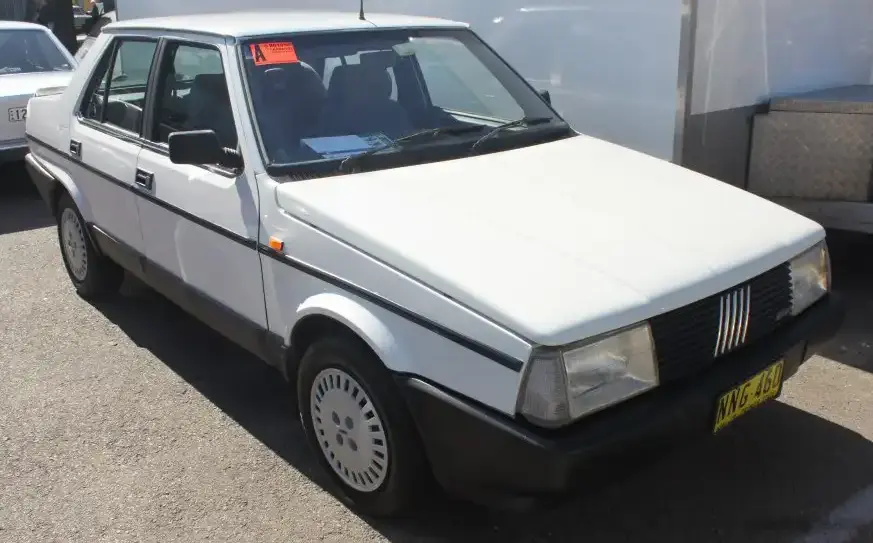
The Fiat Regata 70 1.3, produced between 1983 and 1986, was an entry-level variant of the Fiat Regata (Type 138) sedan. Positioned as the most affordable option in the Regata lineup, it aimed to provide economical transportation for families and commuters. The Regata itself was designed as a modern replacement for the aging Fiat 132, offering improved fuel efficiency, handling, and a more contemporary design. This 70 1.3 model, with its modest 68 horsepower, served as the foundation for the range, offering a balance between price and practicality in the European market.
Technical Specifications
| Brand | Fiat |
| Model | Regata |
| Generation | Regata (138) |
| Type (Engine) | 70 1.3 (68 Hp) |
| Start of production | 1983 |
| End of production | 1986 |
| Powertrain Architecture | Internal Combustion engine |
| Body type | Sedan |
| Seats | 5 |
| Doors | 4 |
| Fuel Type | Petrol (Gasoline) |
| Power | 68 Hp |
| Engine Model/Code | 138 B2.000 |
| Engine aspiration | Naturally aspirated engine |
| Engine oil capacity | 4.1 l (4.33 US qt | 3.61 UK qt) |
| Coolant capacity | 7 l (7.4 US qt | 6.16 UK qt) |
| Trunk (boot) space – minimum | 513 l (18.12 cu. ft.) |
| Fuel tank capacity | 55 l (14.53 US gal | 12.1 UK gal) |
| Length | 4260 mm (167.72 in.) |
| Width | 1650 mm (64.96 in.) |
| Height | 1410 mm (55.51 in.) |
| Front overhang | 820 mm (32.28 in.) |
| Rear overhang | 992 mm (39.06 in.) |
Powertrain & Engine Architecture
The Fiat Regata 70 1.3 was powered by the 138 B2.000 engine, a 1301cc inline-four cylinder petrol engine. This engine was a relatively simple design, featuring a single overhead camshaft (SOHC) operating two valves per cylinder. Fuel delivery was managed by a Weber 32 ADFA carburetor, a common setup for European cars of this era aiming for affordability and ease of maintenance. The engine produced 68 horsepower at 6000 rpm and approximately 84 lb-ft of torque at 3600 rpm. The engine block was cast iron, while the cylinder head was aluminum, contributing to a reasonable weight for its size. The Regata 70 1.3 was exclusively offered with a four-speed manual transmission, designed to maximize fuel economy rather than performance. This transmission was known for its relatively long gearing, further emphasizing the car’s focus on efficiency.
Driving Characteristics
The driving experience in the Regata 70 1.3 was characterized by its modest performance. Acceleration was leisurely, with a 0-60 mph time estimated around 14-15 seconds. The long gearing of the four-speed manual transmission meant that the engine often felt strained when attempting to accelerate quickly, particularly when fully loaded. However, in steady-state cruising, the engine was relatively relaxed and fuel-efficient. The suspension, consisting of MacPherson struts at the front and a twist-beam axle at the rear, provided a comfortable ride, although handling was not particularly sharp. Steering was light and easy, making it well-suited for city driving. Compared to the more powerful Regata 100 models (equipped with larger engines), the 70 1.3 felt significantly slower and less refined, but it offered a more economical and accessible entry point into the Regata range.
Equipment & Trim Levels
The Regata 70 1.3 was the base model, and as such, it came with a fairly basic level of equipment. Standard features included cloth upholstery, vinyl floor covering, and a simple dashboard layout. The instrumentation consisted of a speedometer, fuel gauge, and temperature gauge. Power steering and central locking were not typically included as standard equipment, although they could be added as optional extras. The exterior trim was minimal, with black plastic bumpers and steel wheels with hubcaps. Optional extras included a radio, upgraded upholstery, and tinted glass. The interior was designed for practicality and durability rather than luxury, reflecting the car’s target market.
Chassis & Braking
The Regata 70 1.3 utilized a relatively conventional chassis design. The front suspension featured MacPherson struts with an anti-roll bar, while the rear suspension employed a twist-beam axle. Braking was provided by disc brakes at the front and drum brakes at the rear. The braking system was adequate for the car’s weight and performance, but it lacked the stopping power of more modern vehicles. The steering was a rack-and-pinion system, providing reasonably precise control. The overall chassis setup was geared towards comfort and stability rather than sporty handling.
Market Reception & Comparison
The Fiat Regata 70 1.3 was generally well-received as an affordable and practical family car. Critics praised its fuel efficiency and comfortable ride, but noted its lack of performance. Compared to other cars in its class, such as the Ford Escort and Opel Kadett, the Regata 70 1.3 offered a competitive price point and a reasonable level of equipment. However, it lagged behind in terms of performance and refinement. The more powerful Regata 100 models, with their larger engines and improved trim levels, were often preferred by buyers who were willing to spend a little more. The 70 1.3’s main advantage was its low running costs, making it a popular choice for budget-conscious buyers.
Legacy
The Fiat Regata 70 1.3, while not a particularly exciting car, played an important role in providing affordable transportation for many European families during the 1980s. The 138 B2.000 engine proved to be relatively reliable, and many examples are still on the road today. However, due to its age and basic specification, finding well-maintained examples can be challenging. In the used car market, the Regata 70 1.3 is typically valued as a classic car, appealing to enthusiasts who appreciate its simplicity and affordability. Parts availability can be limited, but many components are still available through specialist suppliers. The Regata 70 1.3 represents a snapshot of automotive engineering from a bygone era, offering a glimpse into the priorities of car manufacturers in the 1980s.
