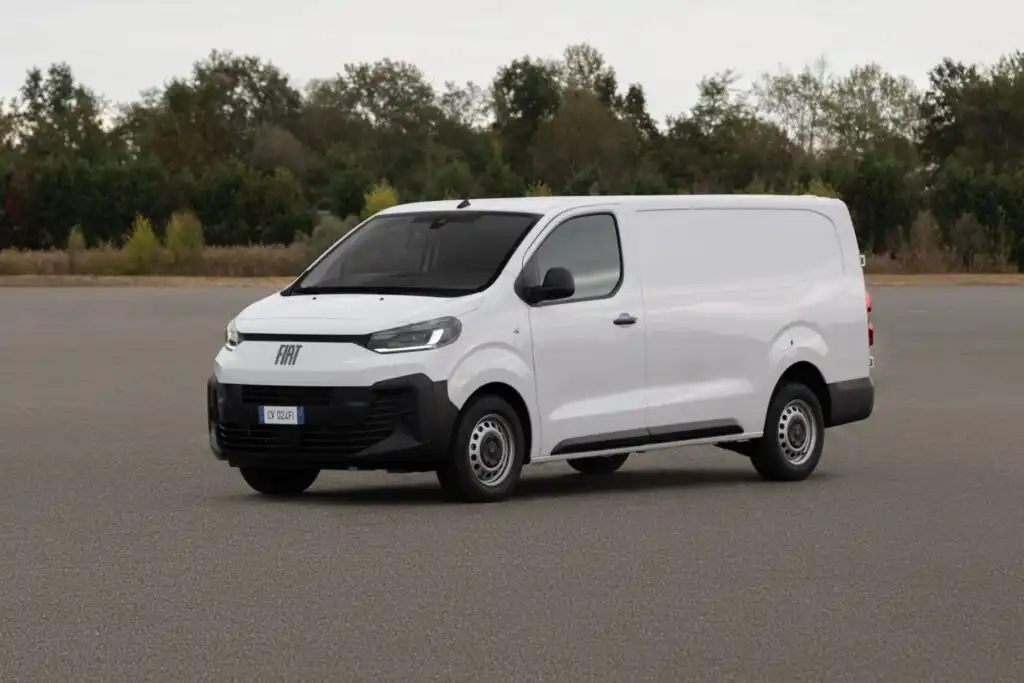
Technical Specifications
| Brand | Fiat |
| Model | Scudo |
| Generation | Scudo III Panel Van |
| Type (Engine) | 2.0 Multijet (145 Hp) L3 |
| Start of production | December, 2021 |
| End of production | October, 2023 |
| Powertrain Architecture | Internal Combustion engine |
| Body type | Van |
| Seats | 2-3 |
| Doors | 4-5 |
| Combined fuel consumption (WLTP) | 6.9-8 l/100 km (34.1 – 29.4 US mpg, 40.9 – 35.3 UK mpg, 14.5 – 12.5 km/l) |
| CO2 emissions (WLTP) | 182-210 g/km |
| Fuel Type | Diesel |
| Acceleration 0 – 100 km/h | 12.4 sec |
| Acceleration 0 – 62 mph | 12.4 sec |
| Acceleration 0 – 60 mph | 11.8 sec |
| Maximum speed | 170 km/h (105.63 mph) |
| Emission standard | Euro 6d-ISC-FCM |
| Weight-to-power ratio | 11.8 kg/Hp, 84.9 Hp/tonne |
| Weight-to-torque ratio | 5 kg/Nm, 199.2 Nm/tonne |
| Power | 145 Hp @ 3750 rpm |
| Power per litre | 72.6 Hp/l |
| Torque | 340 Nm @ 2000 rpm (250.77 lb.-ft. @ 2000 rpm) |
| Engine layout | Front, Transverse |
| Engine Model/Code | DW10FDDU |
| Engine displacement | 1997 cm3 (121.86 cu. in.) |
| Number of cylinders | 4 |
| Engine configuration | Inline |
| Cylinder Bore | 85 mm (3.35 in.) |
| Piston Stroke | 88 mm (3.46 in.) |
| Number of valves per cylinder | 4 |
| Fuel injection system | Diesel Commonrail |
| Engine aspiration | Turbocharger, Intercooler |
| Valvetrain | DOHC |
| Engine oil capacity | 6 l (6.34 US qt | 5.28 UK qt) |
| Kerb Weight | 1707 kg (3763.29 lbs.) |
| Max. weight | 3100 kg (6834.33 lbs.) |
| Max load | 1393 kg (3071.04 lbs.) |
| Trunk (boot) space – minimum | 6100 l (215.42 cu. ft.) |
| Trunk (boot) space – maximum | 6800 l (240.14 cu. ft.) |
| Fuel tank capacity | 69 l (18.23 US gal | 15.18 UK gal) |
| AdBlue tank | 22.5 l (5.94 US gal | 4.95 UK gal) |
| Max. roof load | 170 kg (374.79 lbs.) |
| Permitted trailer load with brakes (12%) | 2500 kg (5511.56 lbs.) |
| Length | 5309 mm (209.02 in.) |
| Width | 1920 mm (75.59 in.) |
| Width with mirrors folded | 2010 mm (79.13 in.) |
| Width including mirrors | 2204 mm (86.77 in.) |
| Height | 1935 mm (76.18 in.) |
| Wheelbase | 3275 mm (128.94 in.) |
| Front track | 1630 mm (64.17 in.) |
| Rear (Back) track | 1618 mm (63.7 in.) |
| Front overhang | 881 mm (34.69 in.) |
| Rear overhang | 1153 mm (45.39 in.) |
| Ride height (ground clearance) | 150 mm (5.91 in.) |
| Minimum turning circle (turning diameter) | 12.4 m (40.68 ft.) |
| Drivetrain Architecture | Front wheel drive |
| Number of gears and type of gearbox | 6 gears, manual transmission |
| Front suspension | Independent, type McPherson with coil spring and anti-roll bar |
| Rear suspension | Trailing arm |
| Front brakes | Ventilated discs, 304×28 mm |
| Rear brakes | Disc, 294×22 mm |
| Assisting systems | ABS (Anti-lock braking system) |
| Steering type | Steering rack and pinion |
| Power steering | Electric Steering |
| Tires size | 215/65 R16; 225/55 R17 |
| Wheel rims size | 16; 17 |
The Fiat Scudo III Panel Van 2.0 Multijet (145 Hp) L3, introduced in December 2021 and produced through October 2023, represents a key variant within Fiat’s commercial vehicle range. This model is built on a platform jointly developed with Peugeot and Citroën – a collaboration stemming from the PSA Group era. The “L3” designation signifies the extended wheelbase configuration, providing a larger cargo area. Positioned as a mid-range offering in the Scudo panel van series, it aimed to strike a balance between performance, fuel efficiency, and practicality for businesses needing a versatile and dependable work vehicle. Its primary market was Europe, where it competed directly with popular vans such as the Ford Transit Custom, Volkswagen Transporter, and Mercedes-Benz Vito.
Powertrain & Engine Architecture
The Scudo III 2.0 Multijet is powered by the DW10FDDU engine, a 1.997-liter inline-four cylinder diesel. This engine is a product of the PSA Group’s (now Stellantis) diesel engine family, renowned for its durability and efficiency. It utilizes a common rail direct injection system, injecting fuel at very high pressure for optimized combustion. A turbocharger with an intercooler further enhances power output and minimizes turbo lag. The engine features a DOHC (Double Overhead Camshaft) valvetrain with four valves per cylinder, contributing to efficient airflow and improved performance. A 6-speed manual transmission is standard, chosen for its robustness and driver control. While an automatic transmission was available on other Scudo models, the 145 hp version was predominantly offered with the manual gearbox.
Driving Characteristics
The 145 hp 2.0 Multijet engine, coupled with the 6-speed manual transmission, delivers adequate performance for typical commercial van applications. Acceleration isn’t a highlight, with a 0-60 mph time around 11.8 seconds, but it provides sufficient torque (340 Nm / 250.77 lb.-ft.) for hauling loads and navigating various terrains. The gear ratios are optimized for practicality, prioritizing fuel economy and drivability over outright speed. Compared to higher-output Scudo variants or those equipped with the larger 2.2-liter engine, this version feels less responsive, especially when heavily loaded. However, the manual transmission provides greater driver control and the ability to maintain optimal engine speed for efficient operation. The extended L3 wheelbase does slightly impact handling, making it feel less agile than the shorter wheelbase versions.
Equipment & Trim Levels
The Scudo III Panel Van 2.0 Multijet (145 Hp) L3 typically featured a functional, work-focused interior. Standard equipment included a driver’s airbag, ABS brakes, a basic audio system with USB connectivity, and manual air conditioning. The cabin generally had durable plastic trim and cloth upholstery. Optional extras included a passenger airbag, rear parking sensors, a touchscreen infotainment system with navigation, and cruise control. Higher trim levels offered upgrades like improved seating, additional storage compartments, and enhanced security features. The emphasis was on providing a practical and reliable workspace for drivers and tradespeople.
Chassis & Braking
The Scudo III employs a front-wheel-drive layout, contributing to its relatively low load floor and efficient packaging. The front suspension utilizes an independent McPherson strut design with coil springs and an anti-roll bar, providing a comfortable ride and reasonable handling. The rear suspension uses a trailing arm setup, optimized for load-carrying capacity. Braking is handled by ventilated discs at the front and solid discs at the rear. ABS (Anti-lock Braking System) is standard, enhancing safety during emergency braking. The steering is rack and pinion with electric power assistance, offering a good balance of precision and ease of use.
Market Reception & Comparison
The Fiat Scudo III 2.0 Multijet (145 Hp) L3 was generally well-received by critics as a practical and economical work van. Its fuel economy, ranging from 6.9 to 8 liters per 100 km, was a significant selling point. Compared to the more powerful Scudo variants, this version offered a lower purchase price and potentially lower running costs, appealing to budget-conscious buyers. Some reviewers noted that the engine could feel strained when carrying heavy loads or driving uphill. Compared to competitors like the Ford Transit Custom and Volkswagen Transporter, the Scudo offered a competitive level of practicality and value, although it often lacked the brand prestige of its rivals.
Legacy
The DW10FDDU engine, found in the Scudo III, has proven to be a relatively reliable powertrain when properly maintained. Common issues include diesel particulate filter (DPF) clogging, particularly with frequent short trips, and occasional injector problems. However, these issues are generally manageable with regular servicing and preventative maintenance. On the used car market, the Scudo III 2.0 Multijet (145 Hp) L3 represents a good value for businesses seeking a dependable and affordable van. Its extended wheelbase provides ample cargo space, and its relatively simple mechanicals make it easier and less expensive to repair than some of its more technologically advanced competitors.