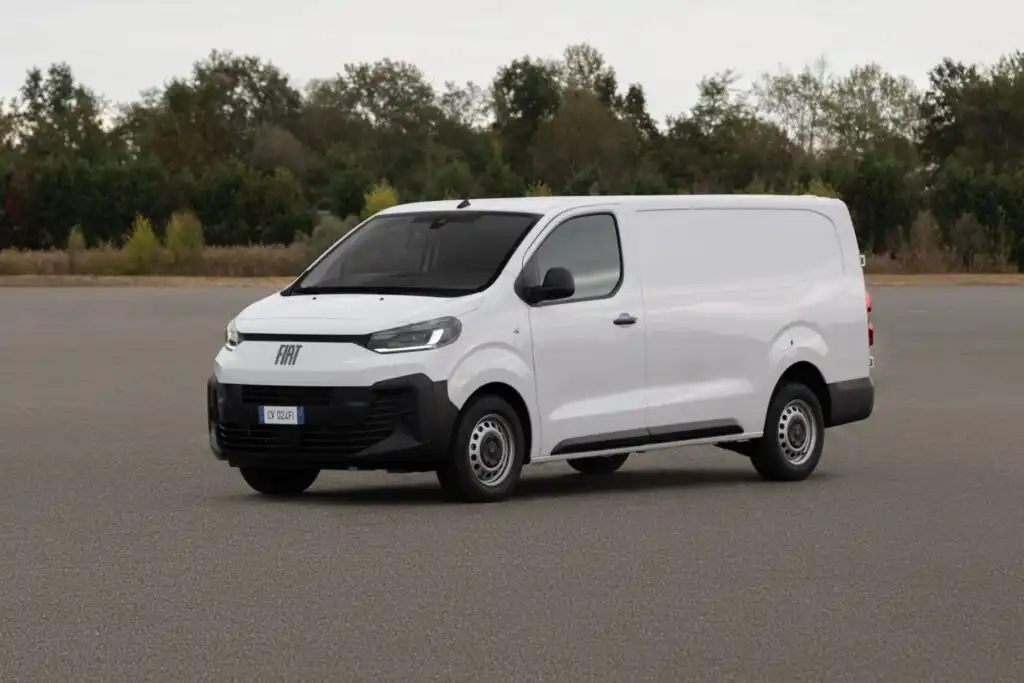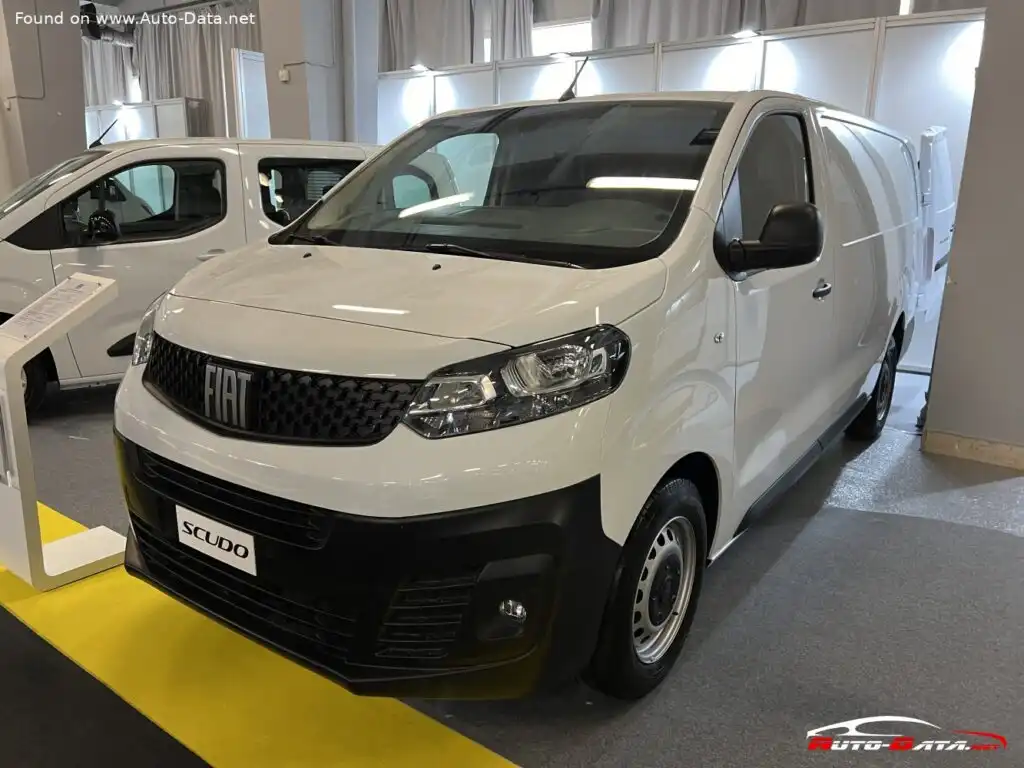
The Fiat Scudo III Panel Van 2.0 Multijet (177 Hp) Automatic L3 represents a significant iteration in Fiat’s commercial vehicle lineup, introduced in December 2021 and continuing through October 2023. This variant is part of the Scudo III generation, built upon the collaborative platform shared with the Peugeot Expert and Citroën Jumpy, known internally as the P84 platform. Positioned as a mid-range offering within the Scudo III range, the 2.0 Multijet Automatic L3 aimed to balance performance, fuel efficiency, and practicality for commercial users requiring a sizable cargo capacity and the convenience of an automatic transmission. The “L3” designation indicates the vehicle’s extended wheelbase, providing a larger cargo area compared to the standard L2 version.
Technical Specifications
| Brand | Fiat |
| Model | Scudo |
| Generation | Scudo III Panel Van |
| Type (Engine) | 2.0 Multijet (177 Hp) Automatic L3 |
| Start of production | December, 2021 |
| End of production | October, 2023 |
| Powertrain Architecture | Internal Combustion engine |
| Body type | Van |
| Seats | 2-3 |
| Doors | 4-5 |
| Combined fuel consumption (WLTP) | 6.8-7.8 l/100 km (34.6 – 30.2 US mpg, 41.5 – 36.2 UK mpg, 14.7 – 12.8 km/l) |
| CO2 emissions (WLTP) | 179-206 g/km |
| Fuel Type | Diesel |
| Acceleration 0 – 100 km/h | 10.9 sec |
| Acceleration 0 – 62 mph | 10.9 sec |
| Acceleration 0 – 60 mph | 10.4 sec |
| Maximum speed | 170 km/h (105.63 mph) |
| Emission standard | Euro 6d-ISC-FCM |
| Weight-to-power ratio | 9.7 kg/Hp, 102.8 Hp/tonne |
| Weight-to-torque ratio | 4.3 kg/Nm, 232.4 Nm/tonne |
| Power | 177 Hp @ 3750 rpm |
| Power per litre | 88.6 Hp/l |
| Torque | 400 Nm @ 2000 rpm (295.02 lb.-ft. @ 2000 rpm) |
| Engine layout | Front, Transverse |
| Engine Model/Code | DW10FDCU |
| Engine displacement | 1997 cm3 (121.86 cu. in.) |
| Number of cylinders | 4 |
| Engine configuration | Inline |
| Cylinder Bore | 85 mm (3.35 in.) |
| Piston Stroke | 88 mm (3.46 in.) |
| Number of valves per cylinder | 4 |
| Fuel injection system | Diesel Commonrail |
| Engine aspiration | Turbocharger, Intercooler |
| Valvetrain | DOHC |
| Engine oil capacity | 5 l (5.28 US qt | 4.4 UK qt) |
| Kerb Weight | 1721 kg (3794.16 lbs.) |
| Max. weight | 3100 kg (6834.33 lbs.) |
| Max load | 1379 kg (3040.17 lbs.) |
| Trunk (boot) space – minimum | 6100 l (215.42 cu. ft.) |
| Trunk (boot) space – maximum | 6800 l (240.14 cu. ft.) |
| Fuel tank capacity | 69 l (18.23 US gal | 15.18 UK gal) |
| AdBlue tank | 22.5 l (5.94 US gal | 4.95 UK gal) |
| Max. roof load | 170 kg (374.79 lbs.) |
| Permitted trailer load with brakes (12%) | 2500 kg (5511.56 lbs.) |
| Length | 5309 mm (209.02 in.) |
| Width | 1920 mm (75.59 in.) |
| Width with mirrors folded | 2010 mm (79.13 in.) |
| Width including mirrors | 2204 mm (86.77 in.) |
| Height | 1935 mm (76.18 in.) |
| Wheelbase | 3275 mm (128.94 in.) |
| Front track | 1630 mm (64.17 in.) |
| Rear (Back) track | 1618 mm (63.7 in.) |
| Front overhang | 881 mm (34.69 in.) |
| Rear overhang | 1153 mm (45.39 in.) |
| Ride height (ground clearance) | 150 mm (5.91 in.) |
| Minimum turning circle (turning diameter) | 12.4 m (40.68 ft.) |
| Drivetrain Architecture | The Internal combustion engine (ICE) drives the front wheels of the vehicle. |
| Drive wheel | Front wheel drive |
| Number of gears and type of gearbox | 8 gears, automatic transmission |
| Front suspension | Independent, type McPherson with coil spring and anti-roll bar |
| Rear suspension | Trailing arm |
| Front brakes | Ventilated discs, 304×28 mm |
| Rear brakes | Disc, 294×22 mm |
| Assisting systems | ABS (Anti-lock braking system) |
| Steering type | Steering rack and pinion |
| Power steering | Electric Steering |
| Tires size | 215/65 R16; 225/55 R17 |
| Wheel rims size | 16; 17 |
Powertrain & Engine Architecture
The heart of the Scudo III 2.0 Multijet Automatic L3 is the DW10FDCU engine, a 2.0-liter inline four-cylinder diesel engine. This engine is a product of PSA Group (now Stellantis) and has been widely used across various Peugeot, Citroën, and Fiat models. The DW10FDCU utilizes a common rail direct injection system, delivering fuel at extremely high pressure for optimized combustion. A turbocharger with an intercooler further enhances performance by forcing more air into the cylinders. The engine features a Double Overhead Camshaft (DOHC) valvetrain, contributing to efficient valve control and improved engine breathing. The 8-speed automatic transmission, sourced from Aisin, provides smooth and efficient gear changes, enhancing drivability, particularly in urban environments and when carrying heavy loads. This transmission was chosen for its reliability and ability to handle the engine’s torque output.
Driving Characteristics
The 177 horsepower and 400 Nm (295 lb-ft) of torque offered by the 2.0 Multijet engine, coupled with the 8-speed automatic transmission, provide a reasonable balance of performance and efficiency. Acceleration from 0-100 km/h (0-62 mph) takes approximately 10.9 seconds, which is adequate for a commercial van of this size. The automatic transmission is well-programmed, offering smooth shifts and responsive performance. Compared to the manual transmission versions, the automatic provides greater convenience, especially in stop-and-go traffic. However, it does slightly diminish fuel economy and offers less direct driver control. Compared to higher-output versions of the 2.0 Multijet (available in some Scudo III trims), this 177 hp variant offers a more economical driving experience, albeit with reduced outright performance. The gear ratios are optimized for hauling and towing, providing ample low-end torque for navigating inclines and carrying heavy loads.
Equipment & Trim Levels
The Scudo III Panel Van 2.0 Multijet Automatic L3 typically came equipped with a range of standard features geared towards commercial use. These included a driver’s airbag, ABS brakes, power windows, central locking, and a basic audio system. Interior upholstery was typically durable and practical, often featuring hard-wearing cloth. Optional extras included air conditioning, a touchscreen infotainment system with navigation, rear parking sensors, cruise control, and upgraded seating. The L3 variant, with its extended wheelbase, offered a significantly larger cargo area than the L2 version, making it ideal for businesses requiring maximum load space. Trim levels varied depending on the market, but generally offered progressively more comfort and convenience features as you moved up the range.
Chassis & Braking
The Scudo III utilizes a front-wheel-drive layout, contributing to a lower load floor and improved space utilization. The front suspension employs an independent McPherson strut setup with coil springs and an anti-roll bar, providing a comfortable ride and stable handling. The rear suspension utilizes a trailing arm configuration, optimized for load-carrying capacity. Braking duties are handled by ventilated discs at the front and solid discs at the rear. ABS (Anti-lock Braking System) is standard, enhancing safety during emergency braking situations. The steering is rack and pinion with electric power assistance, providing precise and responsive steering feel.
Market Reception & Comparison
The Fiat Scudo III Panel Van 2.0 Multijet Automatic L3 was generally well-received by critics and commercial vehicle operators. It was praised for its spacious interior, comfortable ride, and the convenience of the automatic transmission. Fuel economy was considered competitive within its segment, although slightly lower than the manual transmission versions. Compared to rivals like the Ford Transit Custom and Volkswagen Transporter, the Scudo offered a compelling combination of value, practicality, and reliability. The 2.0 Multijet engine, while not the most powerful in its class, provided ample performance for most commercial applications.
Legacy
The DW10FDCU engine has proven to be a robust and reliable powerplant, with many examples still in service today. The 8-speed Aisin automatic transmission is also known for its durability. The Scudo III, and specifically this 2.0 Multijet Automatic L3 variant, remains a popular choice in the used commercial vehicle market, offering a practical and affordable solution for businesses requiring a versatile and reliable van. Regular maintenance, including timely oil changes and filter replacements, is crucial for ensuring the long-term reliability of this powertrain. The Scudo III’s collaborative platform with Peugeot and Citroën has also contributed to its widespread availability of parts and service support.