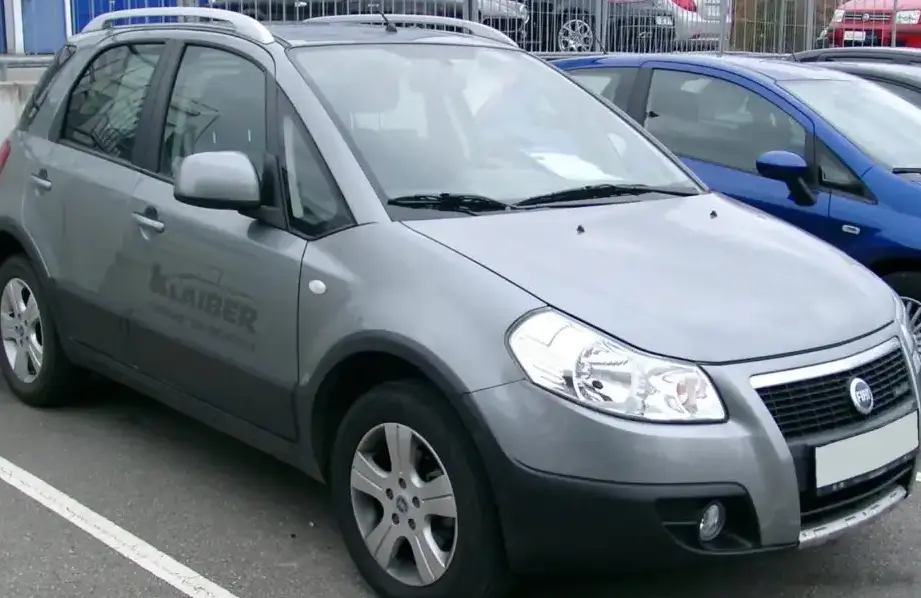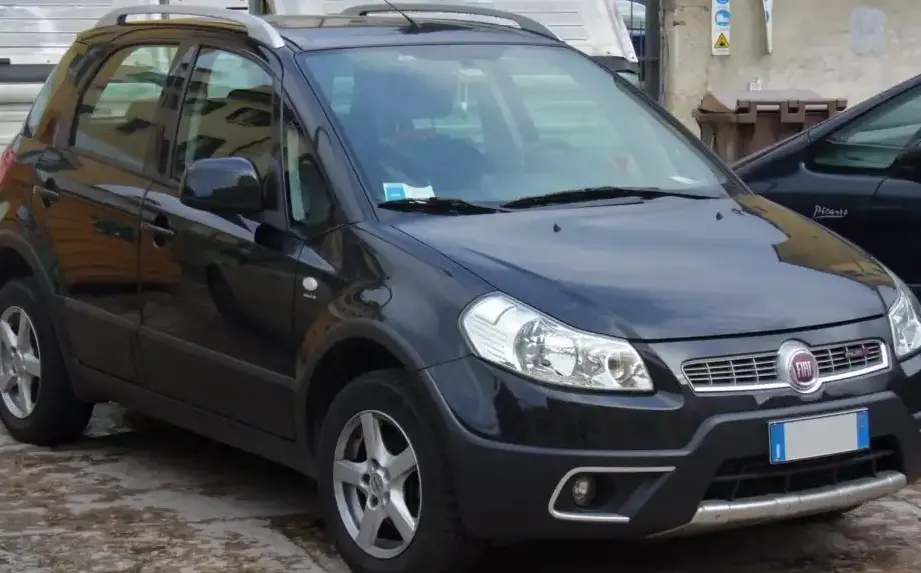
The Fiat Sedici, particularly the facelifted version introduced in 2009, represented Fiat’s entry into the burgeoning small SUV segment. Produced from 2009 to 2014, the 1.6 16V 4×4 variant, boasting 120 horsepower, occupied a middle ground within the Sedici lineup, offering a balance between affordability, practicality, and all-wheel-drive capability. This model was a collaborative effort with Suzuki, sharing its platform and many components with the Suzuki SX4. The Sedici aimed to appeal to European buyers seeking a compact, versatile vehicle suitable for both urban driving and occasional off-road excursions.
Technical Specifications
| Brand | Fiat |
| Model | Sedici |
| Generation | Sedici (facelift 2009) |
| Type (Engine) | 1.6 16V (120 Hp) 4×4 |
| Start of production | 2009 |
| End of production | 2014 |
| Powertrain Architecture | Internal Combustion engine |
| Body type | SUV |
| Seats | 5 |
| Doors | 5 |
| Fuel consumption (urban) | 8.2 l/100 km (28.7 US mpg) |
| Fuel consumption (extra urban) | 5.5 l/100 km (42.8 US mpg) |
| Fuel consumption (combined) | 6.5 l/100 km (36.2 US mpg) |
| Fuel Type | Petrol (Gasoline) |
| Acceleration 0 – 100 km/h | 11.5 sec |
| Acceleration 0 – 62 mph | 11.5 sec |
| Acceleration 0 – 60 mph | 10.9 sec |
| Maximum speed | 175 km/h (108.74 mph) |
| Emission standard | Euro 5 |
| Weight-to-power ratio | 10.4 kg/Hp |
| Weight-to-torque ratio | 8 kg/Nm |
| Power | 120 Hp @ 6000 rpm |
| Torque | 156 Nm @ 4400 rpm (115.06 lb.-ft. @ 4400 rpm) |
| Engine layout | Front, Transverse |
| Engine Model/Code | M16A |
| Engine displacement | 1598 cm3 (97.52 cu. in.) |
| Number of cylinders | 4 |
| Engine configuration | Inline |
| Number of valves per cylinder | 4 |
| Fuel injection system | Multi-port manifold injection |
| Engine aspiration | Naturally aspirated engine |
| Valvetrain | DOHC |
| Engine oil capacity | 3.9 l (4.12 US qt | 3.43 UK qt) |
| Coolant capacity | 7.7 l (8.14 US qt | 6.78 UK qt) |
| Kerb Weight | 1250 kg (2755.78 lbs.) |
| Max. weight | 1750 kg (3858.09 lbs.) |
| Max load | 500 kg (1102.31 lbs.) |
| Trunk (boot) space – minimum | 270 l (9.53 cu. ft.) |
| Trunk (boot) space – maximum | 670 l (23.66 cu. ft.) |
| Fuel tank capacity | 50 l (13.21 US gal | 11 UK gal) |
| Length | 4115 mm (162.01 in.) |
| Width | 1755 mm (69.09 in.) |
| Height | 1620 mm (63.78 in.) |
| Wheelbase | 2500 mm (98.43 in.) |
| Front track | 1495 mm (58.86 in.) |
| Rear track | 1495 mm (58.86 in.) |
| Minimum turning circle | 11 m (36.09 ft.) |
| Drive wheel | All wheel drive (4×4) |
| Number of gears | 5 |
| Gearbox type | Manual transmission |
| Front suspension | Independent type McPherson |
| Rear suspension | Torsion |
| Front brakes | Disc |
| Rear brakes | Disc |
| Assisting systems | ABS (Anti-lock braking system) |
| Steering type | Steering rack and pinion |
| Power steering | Electric Steering |
| Tires size | 205/60 R16 |
| Wheel rims size | 16 |
Powertrain & Engine Architecture
The heart of the Sedici 1.6 16V 4×4 is the M16A engine, a 1.6-liter inline-four cylinder gasoline engine. This engine, also found in various other Fiat and Suzuki models, utilizes a multi-port fuel injection system and a double overhead camshaft (DOHC) valvetrain. The 16 valves (four per cylinder) contribute to improved breathing and, consequently, better performance. The engine produces 120 horsepower at 6000 rpm and 156 Nm (115 lb-ft) of torque at 4400 rpm. The five-speed manual transmission was the standard offering, providing a relatively direct connection to the engine. The 4×4 system employed a viscous coupling, automatically distributing torque between the front and rear axles as needed, enhancing traction in slippery conditions. It wasn’t a sophisticated system, but it provided a noticeable improvement in stability and grip compared to a two-wheel-drive vehicle.
Driving Characteristics
The 1.6-liter engine, paired with the five-speed manual, provided adequate, though not exhilarating, performance. Acceleration from 0 to 100 km/h (0-62 mph) took around 11.5 seconds. The engine felt somewhat strained when pushed hard, particularly when fully loaded or climbing hills. The gear ratios were reasonably well-spaced, but the lack of a sixth gear meant that highway cruising could be a bit noisy and fuel consumption increased at higher speeds. Compared to the more powerful 1.9-liter diesel variants, the 1.6-liter felt noticeably less responsive. However, it offered a smoother and quieter driving experience than the diesel, and its lighter weight contributed to slightly more agile handling.
Equipment & Trim Levels
The Sedici 1.6 16V 4×4 typically came equipped with air conditioning, power steering, electric front windows, and ABS brakes as standard. Higher trim levels added features such as alloy wheels, a CD player with MP3 compatibility, and remote central locking. Optional extras included a sunroof, parking sensors, and upgraded upholstery. The interior was functional and reasonably well-built, though the materials used were generally of a lower quality than those found in some of its competitors. The rear seats offered adequate space for passengers, and the split-folding rear seats allowed for increased cargo capacity.
Chassis & Braking
The Sedici utilized a McPherson strut front suspension and a torsion beam rear suspension. This setup provided a comfortable ride, but it wasn’t particularly sporty. The torsion beam rear suspension limited independent wheel movement, which could result in some body roll during cornering. The braking system consisted of disc brakes on all four wheels, providing adequate stopping power. The ABS system helped to prevent wheel lockup during hard braking, enhancing safety.
Market Reception & Comparison
The Fiat Sedici 1.6 16V 4×4 was generally well-received by critics as a practical and affordable small SUV. It was praised for its all-wheel-drive capability, fuel efficiency, and comfortable ride. However, it was also criticized for its relatively modest performance and somewhat basic interior. Compared to the 1.9-liter diesel variants, the 1.6-liter petrol engine offered lower fuel economy and less torque, but it was quieter and smoother. The Sedici competed with other small SUVs such as the Renault Captur, Nissan Juke, and Skoda Yeti.
Legacy
The Fiat Sedici, while not a groundbreaking vehicle, proved to be a reliable and practical choice for buyers seeking a compact SUV. The 1.6-liter engine, while not known for its exceptional performance, is generally considered to be durable and relatively easy to maintain. On the used car market, Sedici models in good condition can still be found at attractive prices. However, potential buyers should be aware of the age-related issues common to older vehicles, such as wear and tear on suspension components and potential corrosion. The Sedici represents a significant step for Fiat into the crossover SUV market, paving the way for future models like the 500X.