
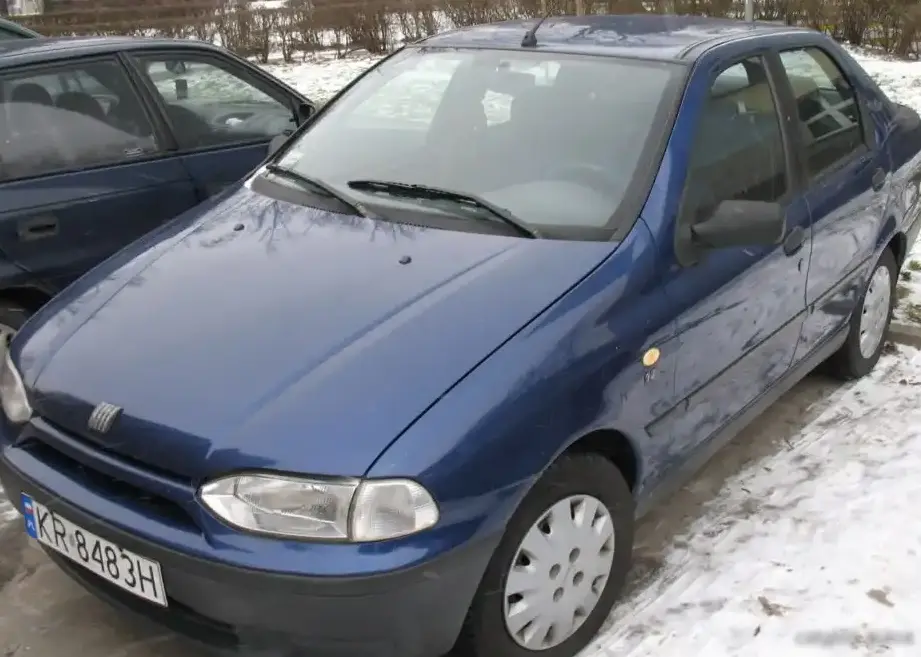
The Fiat Siena (178) 1.0 i, producing 61 horsepower, was a subcompact sedan manufactured between 1996 and 2000. It served as the entry-level model within the Siena range, a vehicle initially developed for the South American market and subsequently introduced to select European countries as an economical family car. The 178 series Siena was based on the Tipo platform, offering a practical and budget-friendly transportation solution. This particular variant, equipped with a smaller engine and a 5-speed manual transmission, catered to cost-conscious buyers who prioritized fuel efficiency and basic transportation over high performance.
Technical Specifications
| Brand | Fiat |
| Model | Siena |
| Generation | Siena (178) |
| Type (Engine) | 1.0 i (61 Hp) |
| Start of production | 1996 |
| End of production | 2000 |
| Powertrain Architecture | Internal Combustion engine |
| Body type | Sedan |
| Seats | 5 |
| Doors | 4 |
| Fuel Type | Petrol (Gasoline) |
| Acceleration 0 – 100 km/h | 17 sec |
| Acceleration 0 – 62 mph | 17 sec |
| Acceleration 0 – 60 mph | 16.2 sec |
| Maximum speed | 152 km/h (94.45 mph) |
| Weight-to-power ratio | 16.2 kg/Hp, 61.6 Hp/tonne |
| Weight-to-torque ratio | 12.5 kg/Nm, 79.8 Nm/tonne |
| Power | 61 Hp @ 6000 rpm |
| Power per litre | 61.4 Hp/l |
| Torque | 79 Nm @ 3000 rpm (58.27 lb.-ft. @ 3000 rpm) |
| Engine layout | Front, Transverse |
| Engine Model/Code | 178A1000 |
| Engine displacement | 994 cm3 (60.66 cu. in.) |
| Number of cylinders | 4 |
| Engine configuration | Inline |
| Cylinder Bore | 76 mm (2.99 in.) |
| Piston Stroke | 54.8 mm (2.16 in.) |
| Compression ratio | 9.5:1 |
| Number of valves per cylinder | 2 |
| Fuel injection system | Single-point injection |
| Engine aspiration | Naturally aspirated engine |
| Kerb Weight | 990 kg (2182.58 lbs) |
| Max. weight | 1390 kg (3064.43 lbs) |
| Max load | 400 kg (881.85 lbs) |
| Trunk (boot) space – minimum | 500 l (17.66 cu. ft.) |
| Trunk (boot) space – maximum | 859 l (30.34 cu. ft.) |
| Fuel tank capacity | 48 l (12.68 US gal | 10.56 UK gal) |
| Length | 4100 mm (161.42 in.) |
| Width | 1614 mm (63.54 in.) |
| Height | 1440 mm (56.69 in.) |
| Wheelbase | 2360 mm (92.91 in.) |
| Front track | 1394 mm (54.88 in.) |
| Rear (Back) track | 1384 mm (54.49 in.) |
| Drivetrain Architecture | The Internal combustion engine (ICE) drives the front wheels of the vehicle. |
| Drive wheel | Front wheel drive |
| Number of gears and type of gearbox | 5 gears, manual transmission |
| Front suspension | Coil spring |
| Rear suspension | Coil spring |
| Front brakes | Disc |
| Rear brakes | Drum |
| Assisting systems | ABS (Anti-lock braking system) |
| Steering type | Steering rack and pinion |
| Tires size | 145/85 R13 |
Powertrain & Engine Architecture
The Fiat Siena 1.0 i was powered by the 178A1000 engine, a 994cc inline-four cylinder unit. This engine employed a single-point fuel injection system, a cost-effective technology common during its production period. The engine featured two valves per cylinder and a compression ratio of 9.5:1. Its modest power output was a direct consequence of its small displacement and conservative engine tuning. A 5-speed manual transmission was the sole gearbox option, prioritizing fuel economy and affordability. The engine was mounted transversely at the front of the vehicle, driving the front wheels. This configuration was typical for compact, front-wheel-drive vehicles of the era, maximizing interior space and simplifying the drivetrain layout.
Driving Characteristics
The combination of the 61 horsepower engine and the 5-speed manual transmission resulted in a driving experience geared towards practicality rather than performance. Acceleration was notably slow, requiring approximately 17 seconds to reach 62 mph (100 km/h). The engine demanded frequent gear changes to maintain momentum, particularly when ascending inclines or attempting to overtake. The gear ratios were optimized for fuel efficiency, often leaving the engine feeling strained at higher speeds. In comparison to the more powerful 1.6-liter Siena variants, the 1.0 i offered a significantly less engaging driving experience. However, it excelled in urban environments, where its low-speed maneuverability and fuel economy were highly advantageous. The light clutch and relatively precise gear changes made it easy to drive in stop-and-go traffic.
Equipment & Trim Levels
The 1.0 i Siena typically represented the base trim level, featuring a relatively minimal equipment list. Standard features generally included basic cloth upholstery, a simple dashboard layout, and manual windows and door locks. Power steering was often offered as an optional extra, and air conditioning was rarely included on this base model. The interior design prioritized durability and ease of cleaning, reflecting the car’s target demographic. Available optional extras included a radio/cassette player and upgraded interior trim packages. The overall focus was on providing essential transportation at the lowest possible cost.
Chassis & Braking
The Siena 178 featured a straightforward chassis design. The front suspension utilized coil springs, while the rear suspension also employed coil springs. The front brakes were discs, providing adequate stopping power for the vehicle’s weight and performance characteristics. However, the rear brakes were drums, offering less stopping power and a greater susceptibility to fading under heavy use. ABS (Anti-lock Braking System) was frequently included as standard equipment, enhancing safety. The steering system was a rack and pinion setup, delivering reasonable steering precision and responsiveness.
Market Reception & Comparison
The Siena 1.0 i was generally well-received as an affordable and reliable family car, particularly in South America and emerging markets. Critics acknowledged its practicality and fuel efficiency, but often noted its lack of power and basic interior appointments. Compared to the higher-specification Siena models, such as those equipped with the 1.6-liter engine, the 1.0 i offered significantly lower performance but also a lower purchase price and superior fuel economy. The 1.0 i was often considered a sensible choice for first-time car buyers or those operating on a limited budget. It filled a crucial niche in the market, providing basic transportation to a wider range of customers.
Legacy
The Fiat Siena 1.0 i, while not a performance-oriented vehicle, proved to be a durable and dependable car. The 178A1000 engine, despite its modest output, was known for its longevity and relatively low maintenance costs. In the used car market, these models are often sought after by individuals seeking an inexpensive and practical vehicle. Parts availability remains reasonably good, and the simple mechanical design facilitates relatively easy repairs. The Siena 1.0 i represents a significant chapter in Fiat’s history, demonstrating the company’s commitment to providing affordable and accessible transportation to a broad customer base. Its enduring reputation for reliability and economy continues to make it a viable option for budget-conscious buyers today.
