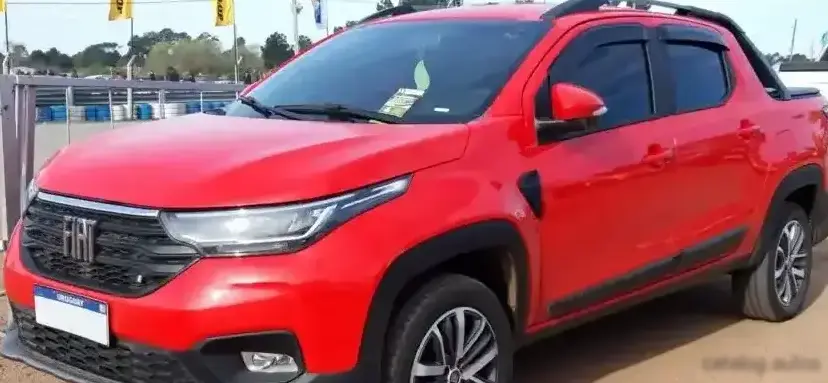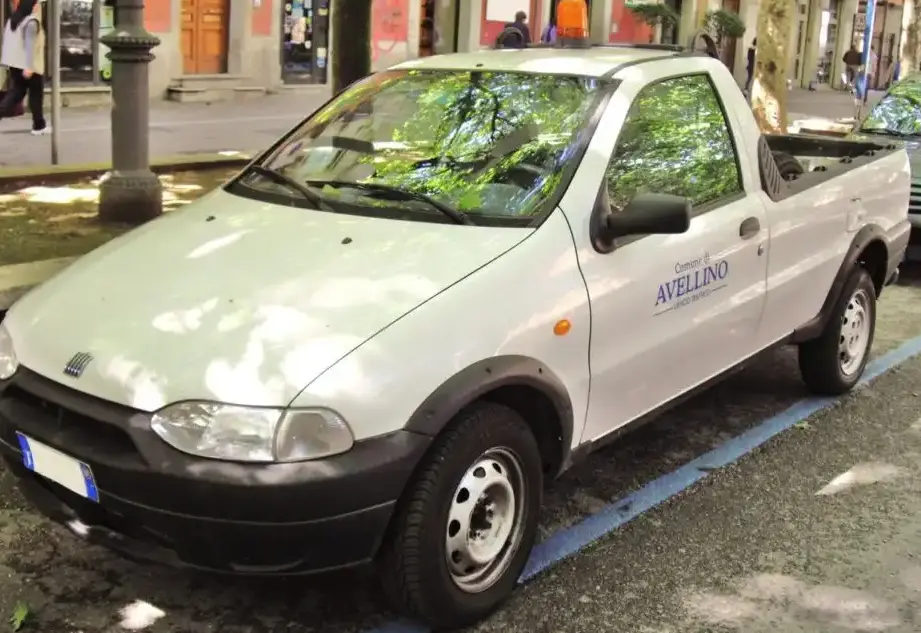
The Fiat Strada (178) 1.2, producing 73 horsepower, was a compact pickup truck manufactured by Fiat between 1999 and 2001. Positioned as the entry-level offering in the Strada (178) range, it served as an affordable and practical work vehicle primarily targeted at the European and South American markets. It was built on the 178 project platform, representing the second generation of the Strada, and offered a basic, utilitarian approach to small truck ownership. This variant was notable for its simplicity and fuel efficiency, making it a popular choice for small businesses and individuals needing a light-duty vehicle.
Technical Specifications
| Brand | Fiat |
| Model | Strada |
| Generation | Strada (178) |
| Type (Engine) | 1.2 (73 Hp) |
| Start of production | 1999 |
| End of production | 2001 |
| Powertrain Architecture | Internal Combustion engine |
| Body type | Pick-up |
| Seats | 2 |
| Doors | 2 |
| Fuel consumption (combined) | 8.3 l/100 km |
| Fuel consumption (US mpg) | 28.3 US mpg |
| Fuel consumption (UK mpg) | 34 UK mpg |
| Fuel consumption (km/l) | 12 km/l |
| Fuel Type | Petrol (Gasoline) |
| Acceleration 0 – 100 km/h | 21.3 sec |
| Acceleration 0 – 62 mph | 21.3 sec |
| Acceleration 0 – 60 mph | 20.2 sec |
| Maximum speed | 155 km/h (96.31 mph) |
| Weight-to-power ratio | 14.5 kg/Hp |
| Weight-to-torque ratio | 10.2 kg/Nm |
| Power | 73 Hp @ 6000 rpm |
| Power per litre | 58.8 Hp/l |
| Torque | 104 Nm @ 3000 rpm (76.71 lb.-ft. @ 3000 rpm) |
| Engine layout | Front, Transverse |
| Engine Model/Code | 178B5000 |
| Engine displacement | 1242 cm3 (75.79 cu. in.) |
| Number of cylinders | 4 |
| Engine configuration | Inline |
| Cylinder Bore | 70.8 mm (2.79 in.) |
| Piston Stroke | 78.9 mm (3.11 in.) |
| Compression ratio | 9.8:1 |
| Number of valves per cylinder | 2 |
| Fuel injection system | Multi-port manifold injection |
| Engine aspiration | Naturally aspirated engine |
| Valvetrain | SOHC |
| Engine oil capacity | 2.5 l (2.64 US qt | 2.2 UK qt) |
| Coolant capacity | 6 l (6.34 US qt | 5.28 UK qt) |
| Kerb Weight | 1060 kg (2336.9 lbs.) |
| Max. weight | 1765 kg (3891.16 lbs.) |
| Max load | 705 kg (1554.26 lbs.) |
| Fuel tank capacity | 58 l (15.32 US gal | 12.76 UK gal) |
| Permitted trailer load with brakes (12%) | 1000 kg (2204.62 lbs.) |
| Permitted trailer load without brakes | 500 kg (1102.31 lbs.) |
| Length | 4398 mm (173.15 in.) |
| Width | 1665 mm (65.55 in.) |
| Height | 1585 mm (62.4 in.) |
| Wheelbase | 2718 mm (107.01 in.) |
| Front track | 1425 mm (56.1 in.) |
| Rear track | 1390 mm (54.72 in.) |
| Minimum turning circle | 11.1 m (36.42 ft.) |
| Drivetrain Architecture | Front wheel drive |
| Number of gears | 5 gears, manual transmission |
| Front suspension | Independent, McPherson with coil spring and anti-roll bar |
| Rear suspension | Rigid axle, Leaf spring |
| Front brakes | Ventilated discs, 257 mm |
| Rear brakes | Drum, 228 mm |
| Steering type | Steering rack and pinion |
| Tires size | 175/70 R14 |
| Wheel rims size | 5.5J x 14 |
Powertrain & Engine Architecture
The Strada 1.2 was powered by the Fiat 178B5000 engine, a 1.2-liter inline-four cylinder gasoline engine. This engine was a relatively simple design, utilizing a single overhead camshaft (SOHC) valvetrain with two valves per cylinder. It employed multi-port fuel injection, a common technology at the time, to deliver fuel to the cylinders. The engine’s modest output of 73 horsepower at 6000 rpm and 104 Nm (76.71 lb-ft) of torque at 3000 rpm was achieved through a relatively low compression ratio of 9.8:1. The engine was transversely mounted in the front of the vehicle, driving the front wheels. The transmission was a standard five-speed manual gearbox, chosen for its simplicity and cost-effectiveness. This configuration was typical for entry-level vehicles in Europe during the late 1990s and early 2000s.
Driving Characteristics
The 1.2-liter engine in the Strada provided adequate, but not exhilarating, performance. Acceleration was slow, with a 0-60 mph time of around 20.2 seconds, and a top speed of 155 km/h (96.31 mph). The five-speed manual transmission was geared to prioritize fuel economy over outright speed. The gear ratios were relatively tall, requiring frequent downshifts when climbing hills or overtaking. Compared to higher-spec Strada models equipped with larger engines, such as the 1.6-liter, the 1.2 felt noticeably underpowered. However, the lighter engine weight contributed to nimble handling, particularly in urban environments. The suspension, while basic, provided a reasonably comfortable ride, although the leaf spring rear suspension could feel harsh when the vehicle was lightly loaded.
Equipment & Trim Levels
The 1.2-liter Strada was typically offered with a very basic level of equipment. Standard features generally included a simple dashboard, cloth upholstery, and manual windows and door locks. Power steering was often an optional extra. Safety features were minimal, typically consisting of only a driver’s airbag and seatbelts. The interior was designed for practicality and durability rather than luxury. Optional extras could include a radio/cassette player, upgraded upholstery, and central locking. The focus was on providing a functional and affordable work vehicle, so creature comforts were kept to a minimum.
Chassis & Braking
The Strada 1.2 featured a front-engine, front-wheel-drive layout. The front suspension utilized an independent McPherson strut design with coil springs and an anti-roll bar, providing reasonable handling and ride comfort. The rear suspension employed a more traditional rigid axle setup with leaf springs, which was cost-effective but less refined than independent suspension. Braking was provided by ventilated discs on the front wheels and drum brakes on the rear. The braking system was adequate for the vehicle’s weight and performance, but lacked the stopping power of more advanced systems found on higher-spec vehicles. The steering was a rack and pinion system, offering reasonably precise control.
Market Reception & Comparison
The Fiat Strada 1.2 was generally well-received as an affordable and practical small pickup truck. Critics praised its fuel efficiency and low running costs, but noted its lack of power and refinement. Compared to other small pickups available at the time, such as the Renault Kangoo or Citroen Berlingo, the Strada offered a more traditional pickup truck experience, with a dedicated cargo bed. The 1.6-liter Strada offered significantly more performance, but at a higher price point. The 1.2-liter model appealed to buyers who prioritized economy and practicality over outright speed and comfort. Its fuel consumption of 8.3 l/100 km (28.3 US mpg) was competitive for its class.
Legacy
The Fiat Strada 1.2, while not a performance icon, proved to be a reliable and durable workhorse. The 178B5000 engine, while simple, was generally robust and capable of withstanding years of use. Today, these vehicles are relatively rare, but those that remain are often sought after by enthusiasts and those needing a simple, affordable pickup truck. Parts availability can be a challenge, but many components are still available through Fiat dealerships or aftermarket suppliers. The Strada 1.2 represents a bygone era of simple, utilitarian vehicles, and its legacy as an affordable and practical work truck endures.