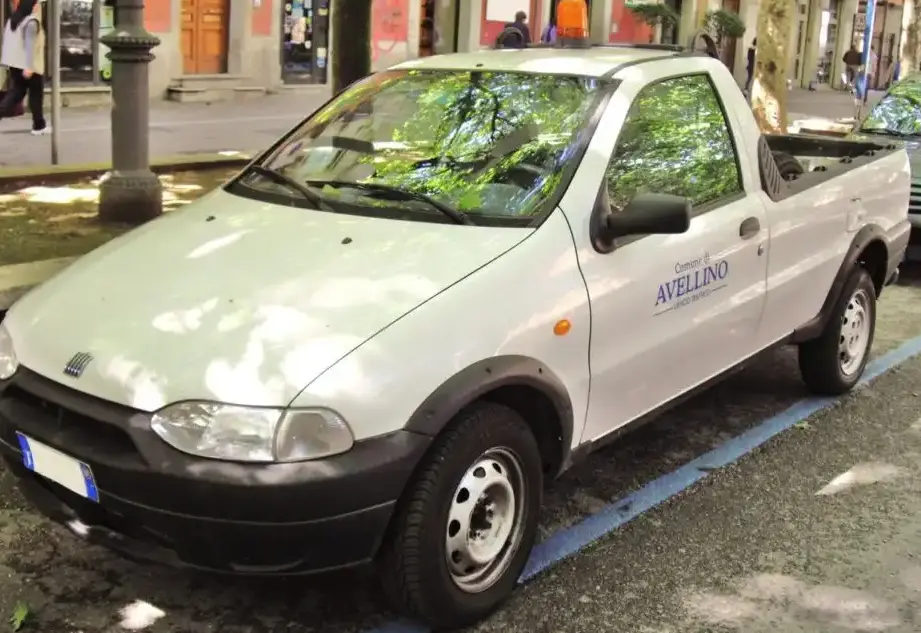
The Fiat Strada (178) 1.7 TD, produced between 1999 and 2001, represents a practical and economical offering within the second generation of the Strada pickup truck. Positioned as an entry-level workhorse, this variant catered to buyers prioritizing fuel efficiency and durability over outright performance. It was primarily sold in European and South American markets, where compact pickups were – and continue to be – popular for both commercial and personal use. The 178 series Strada was a significant update over its predecessor, offering improved comfort, safety, and a more modern aesthetic while retaining the core functionality expected of a small pickup.
Technical Specifications
| Brand | Fiat |
| Model | Strada |
| Generation | Strada (178) |
| Type (Engine) | 1.7 TD (69 Hp) |
| Start of production | 1999 year |
| End of production | 2001 year |
| Powertrain Architecture | Internal Combustion engine |
| Body type | Pick-up |
| Seats | 2 |
| Doors | 2 |
| Fuel consumption (combined) | 7.3 l/100 km |
| Fuel consumption (US mpg) | 32.2 US mpg |
| Fuel consumption (UK mpg) | 38.7 UK mpg |
| Fuel consumption (km/l) | 13.7 km/l |
| Fuel Type | Diesel |
| Acceleration 0 – 100 km/h | 24 sec |
| Acceleration 0 – 62 mph | 24 sec |
| Acceleration 0 – 60 mph | 22.8 sec |
| Maximum speed | 151 km/h |
| Maximum speed (mph) | 93.83 mph |
| Weight-to-power ratio | 16.6 kg/Hp |
| Weight-to-torque ratio | 8.5 kg/Nm |
| Power | 69 Hp @ 4500 rpm |
| Power per litre | 40.6 Hp/l |
| Torque | 134 Nm @ 2500 rpm |
| Torque (lb.-ft.) | 98.83 lb.-ft. @ 2500 rpm |
| Engine layout | Front, Transverse |
| Engine Model/Code | 176A3000 |
| Engine displacement | 1698 cm3 |
| Engine displacement (cu. in.) | 103.62 cu. in. |
| Number of cylinders | 4 |
| Engine configuration | Inline |
| Cylinder Bore | 82.6 mm |
| Cylinder Bore (in.) | 3.25 in. |
| Piston Stroke | 79.2 mm |
| Piston Stroke (in.) | 3.12 in. |
| Compression ratio | 20.3:1 |
| Number of valves per cylinder | 2 |
| Fuel injection system | Precombustion chamber injection |
| Engine aspiration | Turbocharger, Intercooler |
| Valvetrain | SOHC |
| Engine oil capacity | 4.8 l |
| Engine oil capacity (US qt) | 5.07 US qt |
| Engine oil capacity (UK qt) | 4.22 UK qt |
| Coolant | 7 l |
| Coolant (US qt) | 7.4 US qt |
| Coolant (UK qt) | 6.16 UK qt |
| Kerb Weight | 1145 kg |
| Kerb Weight (lbs.) | 2524.29 lbs. |
| Max. weight | 1850 kg |
| Max. weight (lbs.) | 4078.55 lbs. |
| Max load | 705 kg |
| Max load (lbs.) | 1554.26 lbs. |
| Fuel tank capacity | 58 l |
| Fuel tank capacity (US gal) | 15.32 US gal |
| Fuel tank capacity (UK gal) | 12.76 UK gal |
| Max. roof load | 75 kg |
| Max. roof load (lbs.) | 165.35 lbs. |
| Permitted trailer load with brakes (12%) | 1000 kg |
| Permitted trailer load with brakes (lbs.) | 2204.62 lbs. |
| Permitted trailer load without brakes | 500 kg |
| Permitted trailer load without brakes (lbs.) | 1102.31 lbs. |
| Length | 4398 mm |
| Length (in.) | 173.15 in. |
| Width | 1665 mm |
| Width (in.) | 65.55 in. |
| Height | 1585 mm |
| Height (in.) | 62.4 in. |
| Wheelbase | 2718 mm |
| Wheelbase (in.) | 107.01 in. |
| Front track | 1425 mm |
| Front track (in.) | 56.1 in. |
| Rear track | 1390 mm |
| Rear track (in.) | 54.72 in. |
| Front overhang | 760 mm |
| Front overhang (in.) | 29.92 in. |
| Rear overhang | 920 mm |
| Rear overhang (in.) | 36.22 in. |
| Minimum turning circle | 11.3 m |
| Minimum turning circle (ft.) | 37.07 ft. |
| Climb angle | 18.8° |
| Drivetrain Architecture | Front wheel drive |
| Drive wheel | Front wheel drive |
| Number of gears | 5 gears |
| Type of gearbox | manual transmission |
| Front suspension | Independent, type McPherson with coil spring and anti-roll bar |
| Rear suspension | Rigid axle suspension, Leaf spring |
| Front brakes | Ventilated discs, 257 mm |
| Rear brakes | Drum, 228 mm |
| Steering type | Steering rack and pinion |
| Tires size | 175/70 R14 |
| Wheel rims size | 5.5J x 14 |
INTRODUCTION
The Fiat Strada 1.7 TD, part of the 178 project series launched in 1999, was a key variant in the Strada lineup. It represented a balance between affordability and functionality, aimed at buyers needing a small, durable pickup for work or light commercial applications. The 178 series brought significant improvements to the original Strada, including a more refined interior, enhanced safety features, and updated styling. This generation of Strada was primarily sold in Europe and Latin America, where the demand for compact pickups remained strong. The 1.7 TD engine was a popular choice due to its fuel efficiency and relatively low maintenance costs.
Powertrain & Engine Architecture
The heart of the Strada 1.7 TD is the 176A3000 engine, a 1.7-liter inline-four cylinder diesel. This engine utilizes a precombustion chamber injection system, a common design for diesel engines of that era. This system involves injecting fuel into a precombustion chamber, which then ignites the main combustion chamber, promoting more complete combustion and reducing emissions. The engine is turbocharged and intercooled, boosting power output to 69 horsepower at 4500 rpm and 134 Nm (98.83 lb.-ft.) of torque at 2500 rpm. The turbocharger and intercooler work together to increase air density entering the engine, resulting in improved power and efficiency. The engine features a single overhead camshaft (SOHC) valvetrain, operating two valves per cylinder. The transmission is a five-speed manual, chosen for its simplicity and durability. This combination provided adequate, though not exhilarating, performance for typical pickup truck duties.
Driving Characteristics
The 1.7 TD Strada, with its 69 horsepower and five-speed manual transmission, offered a utilitarian driving experience. Acceleration was modest, taking approximately 24 seconds to reach 100 km/h (62 mph). The engine’s torque peak at 2500 rpm provided reasonable pulling power for hauling moderate loads, but it wasn’t designed for rapid acceleration or high-speed cruising. The gear ratios were optimized for fuel economy and low-end torque, making it suitable for city driving and navigating challenging terrain. Compared to higher-output versions of the Strada, such as those equipped with gasoline engines, the 1.7 TD prioritized fuel efficiency and durability over outright performance. The manual transmission allowed for greater driver control, but the overall driving experience was focused on practicality rather than sportiness.
Equipment & Trim Levels
The Strada 1.7 TD was typically offered in a basic trim level, reflecting its position as an entry-level model. Standard features generally included a basic dashboard, vinyl or cloth upholstery, and a functional, no-frills interior. Power steering was often optional, as were features like air conditioning and electric windows. The focus was on providing a durable and practical work vehicle, rather than luxury or comfort. Optional extras could include a more comfortable driver’s seat, upgraded audio systems, and protective bed liners. The exterior typically featured black plastic bumpers and side moldings, emphasizing its utilitarian nature.
Chassis & Braking
The Strada 178 utilized a front-engine, front-wheel-drive layout. The front suspension consisted of an independent McPherson strut setup with coil springs and an anti-roll bar, providing a reasonable level of ride comfort and handling. The rear suspension employed a rigid axle with leaf springs, a cost-effective and durable solution for carrying loads. The braking system featured ventilated discs on the front wheels and drum brakes on the rear. This configuration was typical for vehicles in this class and price range at the time. The steering system was a rack and pinion setup, providing adequate steering precision.
Market Reception & Comparison
The Fiat Strada 1.7 TD was generally well-received in its target markets as a practical and affordable pickup truck. Critics praised its fuel efficiency and durability, but noted its modest performance. Compared to other trims in the Strada lineup, such as those with gasoline engines, the 1.7 TD offered superior fuel economy but lacked the same level of performance. It was often compared to other small pickups available in Europe and Latin America, such as the Volkswagen Saveiro and the Renault Kangoo Express. The Strada 1.7 TD typically offered a competitive price point and a reputation for reliability, making it a popular choice for small businesses and individual buyers.
Legacy
The 1.7 TD engine, while not known for its high performance, proved to be a reliable and durable powerplant. Strada 1.7 TD models from the late 1990s and early 2000s can still be found on the road today, often with high mileage. The simplicity of the engine and its relatively low maintenance requirements contribute to its longevity. In the used car market, these vehicles are valued for their affordability and practicality. While not considered collector’s items, well-maintained examples are sought after by those needing a dependable and economical work vehicle. The Strada 1.7 TD represents a practical and enduring example of a small, functional pickup truck from a bygone era.