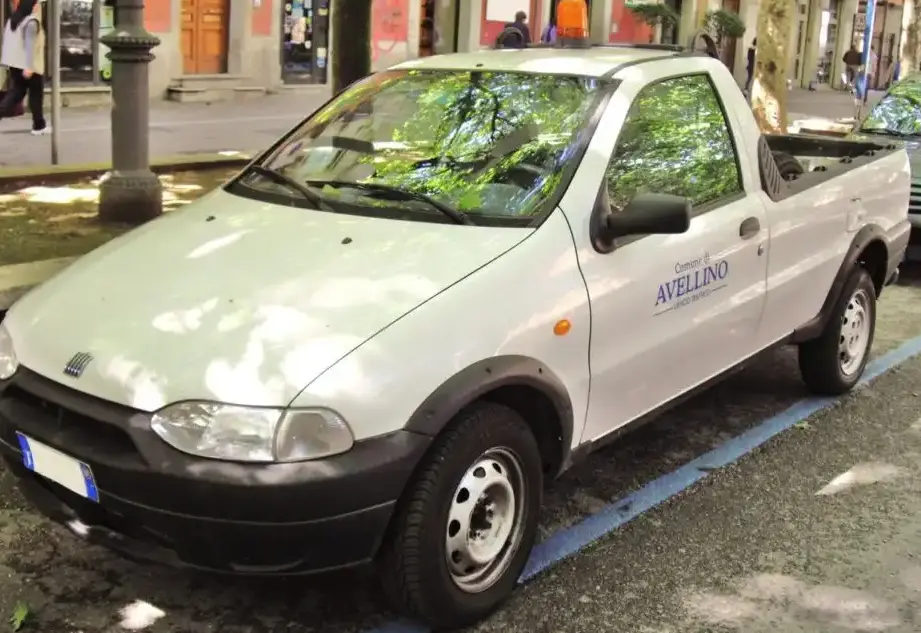
Technical Specifications
| Brand | Fiat |
| Model | Strada |
| Generation | Strada (281) Double Cab |
| Type (Engine) | 1.4 Flex (85/88 Hp) |
| Start of production | 2020 |
| Powertrain Architecture | Internal Combustion engine |
| Body type | Pick-up |
| Seats | 5 |
| Doors | 4 |
| Fuel consumption (economy) – urban | 8.6 l/100 km (27.4 US mpg, 32.8 UK mpg, 11.6 km/l) |
| Fuel consumption (economy) – urban (Ethanol – E100) | 12 l/100 km |
| Fuel consumption (economy) – extra urban | 8.1 l/100 km (29 US mpg, 34.9 UK mpg, 12.3 km/l) |
| Fuel consumption (economy) – extra urban (Ethanol – E100) | 11.2 l/100 km |
| Fuel Type | Petrol / Ethanol – E100 |
| Acceleration 0 – 100 km/h | 13.4 sec |
| Acceleration 0 – 62 mph | 13.4 sec |
| Acceleration 0 – 100 km/h (Ethanol – E100) | 12.8 sec |
| Acceleration 0 – 60 mph (Calculated) | 12.7 sec |
| Maximum speed | 157 km/h (97.56 mph) |
| Maximum speed (Ethanol – E100) | 158 km/h |
| Weight-to-power ratio | 13.4 kg/Hp, 74.6 Hp/tonne |
| Weight-to-torque ratio | 9.3 kg/Nm, 107 Nm/tonne |
| Power | 85 Hp @ 5750 rpm |
| Power per litre | 62.1 Hp/l |
| Power (Ethanol – E100) | 88 Hp @ 5750 rpm |
| Power per litre (Ethanol – E100) | 64.3 Hp/l |
| Torque | 122 Nm @ 3500 rpm (89.98 lb.-ft. @ 3500 rpm) |
| Torque (Ethanol – E100) | 123 Nm @ 3500 rpm |
| Engine layout | Front, Transverse |
| Engine Model/Code | 310A2011 |
| Engine displacement | 1368 cm3 (83.48 cu. in.) |
| Number of cylinders | 4 |
| Engine configuration | Inline |
| Cylinder Bore | 72 mm (2.83 in.) |
| Piston Stroke | 84 mm (3.31 in.) |
| Compression ratio | 12.35:1 |
| Number of valves per cylinder | 2 |
| Fuel injection system | Multi-port manifold injection |
| Engine aspiration | Naturally aspirated |
| Valvetrain | SOHC |
| Engine oil capacity | 2.7 l (2.85 US qt, 2.38 UK qt) |
| Coolant capacity | 5.2 l (5.49 US qt, 4.58 UK qt) |
| Kerb Weight | 1140 kg (2513.27 lbs.) |
| Max. weight | 1790 kg (3946.27 lbs.) |
| Max load | 650 kg (1433 lbs.) |
| Trunk (boot) space – minimum | 844 l (29.81 cu. ft.) |
| Fuel tank capacity | 55 l (14.53 US gal, 12.1 UK gal) |
| Permitted trailer load without brakes | 400 kg (881.85 lbs.) |
| Length | 4474 mm (176.14 in.) |
| Width | 1732 mm (68.19 in.) |
| Width including mirrors | 1967 mm (77.44 in.) |
| Height | 1599 mm (62.95 in.) |
| Wheelbase | 2737 mm (107.76 in.) |
| Front track | 1457 mm (57.36 in.) |
| Rear track | 1480 mm (58.27 in.) |
| Front overhang | 820 mm (32.28 in.) |
| Rear overhang | 917 mm (36.1 in.) |
| Ride height (ground clearance) | 212 mm (8.35 in.) |
| Minimum turning circle | 10.7 m (35.1 ft.) |
| Approach angle | 23.7° |
| Departure angle | 26.5° |
| Ramp-over angle | 20.9° |
| Drivetrain Architecture | Front wheel drive |
| Drive wheel | Front wheel drive |
| Number of gears and type of gearbox | 5 gears, manual transmission |
| Front suspension | Independent, McPherson with coil spring and anti-roll bar |
| Rear suspension | Rigid axle, Leaf spring |
| Front brakes | Ventilated discs, 257 mm |
| Rear brakes | Drum, 228.6 mm |
| Assisting systems | ABS (Anti-lock braking system) |
| Steering type | Steering rack and pinion |
| Power steering | Hydraulic |
| Tires size | 195/65 R15 |
| Wheel rims size | 6J x 15 |
The Fiat Strada Double Cab 1.4 Flex, introduced in 2020 as part of the Strada (281) generation, represents an entry-level configuration within the popular Brazilian pickup truck lineup. This compact pickup is specifically designed for the South American market, offering a blend of commercial practicality and personal usability. The “Double Cab” designation signifies the addition of a second row of seats, expanding passenger capacity to five, a key differentiator from the standard Strada models. Positioned at the lower end of the Strada range, this variant prioritizes affordability and functionality over outright performance, appealing to a broad customer base. It competes with other small pickups and increasingly, compact crossover SUVs in the region.
Powertrain & Engine Architecture
The Strada 1.4 Flex is powered by Fiat’s 310A2011 engine, a 1.4-liter inline-four cylinder engine engineered to operate on gasoline, ethanol, or any mixture of the two – a capability known as “Flex” fuel. This adaptability is crucial in Brazil, where ethanol is widely available and often incentivized by government policies. The engine employs a multi-point fuel injection system and a single overhead camshaft (SOHC) valvetrain. A compression ratio of 12.35:1 is optimized for both fuel types. When fueled by ethanol, the engine produces 88 horsepower, a slight increase compared to the 85 horsepower output on gasoline. Torque remains consistent at approximately 122 Nm (89.98 lb-ft) regardless of the fuel used. The engine’s design emphasizes reliability and cost-effectiveness rather than high-performance characteristics. A five-speed manual transmission is the sole transmission option offered with this engine, chosen for its simplicity and affordability, aligning with the vehicle’s overall positioning.
Driving Characteristics
The combination of the 1.4-liter engine and the five-speed manual transmission results in modest performance. Acceleration from 0 to 100 km/h (0-62 mph) takes around 13.4 seconds. The engine provides sufficient power for urban driving and light-duty hauling, but feels strained when fully loaded or during highway overtaking maneuvers. The gear ratios are calibrated for fuel efficiency and everyday usability, rather than providing a sporty driving experience. Compared to higher-trim Strada models equipped with larger engines, such as the 1.3 Firefly, the 1.4 Flex delivers noticeably less power and torque. However, it presents a more economical option for buyers prioritizing fuel costs and basic functionality. The front-wheel-drive configuration offers predictable handling, though it can limit traction on loose or slippery surfaces.
Equipment & Trim Levels
The Strada Double Cab 1.4 Flex typically comes equipped with a basic set of standard features. These generally include air conditioning, power steering, central locking, and electric front windows. Safety features commonly include ABS brakes and dual front airbags. The interior is characterized by durable, utilitarian materials, with upholstery typically consisting of vinyl or basic cloth. Optional extras, depending on the specific market and package, could include a radio with Bluetooth connectivity, alloy wheels, and body-colored exterior trim. The primary focus of this trim level is to provide essential features at an accessible price point.
Chassis & Braking
The Strada Double Cab utilizes a front-engine, front-wheel-drive layout. The front suspension consists of an independent McPherson strut setup with coil springs and an anti-roll bar, offering a reasonable level of ride comfort. The rear suspension employs a rigid axle with leaf springs, a cost-effective solution that prioritizes load-carrying capacity over sophisticated handling dynamics. The braking system features ventilated discs on the front wheels and drum brakes on the rear. ABS (Anti-lock Braking System) is standard, enhancing safety during emergency braking situations. The relatively simple suspension and braking setup are designed to withstand the demands of typical usage in the target market.
Market Reception & Comparison
The Strada Double Cab 1.4 Flex has enjoyed considerable success in the South American market, particularly in Brazil, consistently ranking among the best-selling pickup trucks in its segment. Critics generally commend its versatility, affordability, and fuel efficiency. However, the 1.4-liter engine is often criticized for its lack of power, especially when compared to competitors offering larger displacement engines. Compared to other Strada trims, the 1.4 Flex offers the lowest price of entry but sacrifices performance. The 1.3 Firefly engine provides a noticeable improvement in power and refinement, while the diesel options offer superior torque for heavier-duty applications. Despite its limitations, the 1.4 Flex remains a popular choice for buyers seeking a practical and economical pickup truck.
Legacy
The 310A2011 1.4-liter engine has proven to be a reliable and durable powerplant within the Strada lineup. While not known for groundbreaking technology, its simplicity contributes to its longevity and ease of maintenance. In the used car market, the Strada 1.4 Flex is generally considered a good value, offering a low cost of ownership and relatively straightforward maintenance procedures. Parts availability is good, and the engine is known to withstand considerable use and abuse. Consequently, these models continue to be popular choices for budget-conscious buyers and those seeking a dependable work vehicle.