
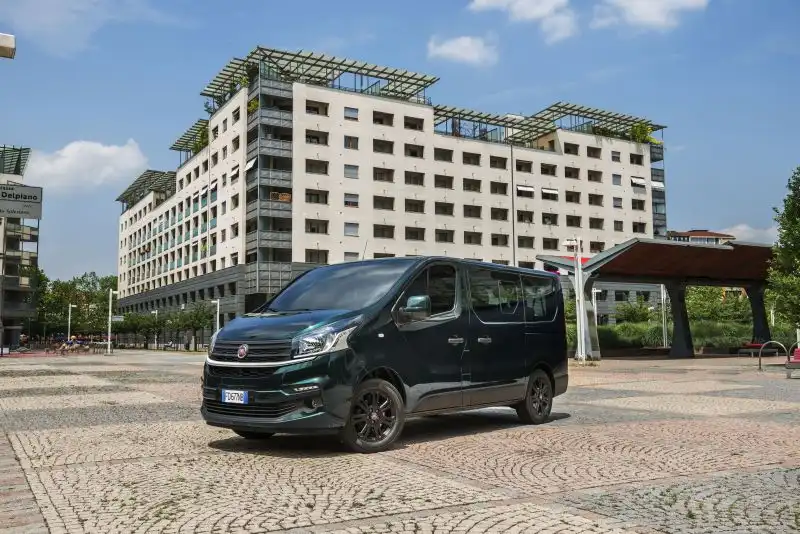
The Fiat Talento Combi 1.6 Ecojet (145 hp) L2H1 M1 is a commercial vehicle produced by Fiat Professional from 2016 to 2021. Positioned as a versatile passenger and cargo transport solution, the Talento Combi falls into the mid-size van category, designed to bridge the gap between smaller, car-derived vans and larger, full-size commercial vehicles. The “L2H1” designation refers to the vehicle’s body length (L2 – long wheelbase) and roof height (H1 – standard roof). The “M1” classification signifies its approval for passenger transport, accommodating between six and nine occupants depending on the seating configuration. This variant, equipped with the 1.6 Ecojet engine and a six-speed manual transmission, aimed to provide a balance of fuel efficiency, practicality, and affordability within the Talento range.
Technical Specifications
| Brand | Fiat |
| Model | Talento |
| Generation | Talento Combi |
| Type (Engine) | 1.6 Ecojet (145 Hp) L2H1 M1 |
| Start of production | 2016 |
| End of production | 2021 |
| Powertrain Architecture | Internal Combustion engine |
| Body type | Minivan |
| Seats | 6-9 |
| Doors | 5 |
| Fuel consumption (urban) | 6.6 l/100 km (35.6 US mpg, 42.8 UK mpg, 15.2 km/l) |
| Fuel consumption (extra urban) | 5.4 l/100 km (43.6 US mpg, 52.3 UK mpg, 18.5 km/l) |
| Fuel consumption (combined) | 5.9 l/100 km (39.9 US mpg, 47.9 UK mpg, 16.9 km/l) |
| CO2 emissions | 152 g/km |
| Fuel Type | Diesel |
| Maximum speed | 177 km/h (109.98 mph) |
| Emission standard | Euro 6 |
| Weight-to-power ratio | 13.3 kg/Hp, 75.4 Hp/tonne |
| Weight-to-torque ratio | 5.7 kg/Nm, 176.7 Nm/tonne |
| Power | 145 Hp @ 3500 rpm |
| Power per litre | 90.7 Hp/l |
| Torque | 340 Nm @ 1500 rpm (250.77 lb.-ft. @ 1500 rpm) |
| Engine layout | Front, Transverse |
| Engine Model/Code | R9M 452 |
| Engine displacement | 1598 cm3 (97.52 cu. in.) |
| Number of cylinders | 4 |
| Engine configuration | Inline |
| Cylinder Bore | 80 mm (3.15 in.) |
| Piston Stroke | 79.5 mm (3.13 in.) |
| Compression ratio | 15.45:1 |
| Number of valves per cylinder | 4 |
| Fuel injection system | Diesel Commonrail |
| Engine aspiration | Twin-Turbo, Intercooler |
| Engine oil capacity | 7.4 l (7.82 US qt | 6.51 UK qt) |
| Coolant | 9.5 l (10.04 US qt | 8.36 UK qt) |
| Kerb Weight | 1924-1987 kg (4241.69 – 4380.59 lbs.) |
| Max. weight | 3020 kg (6657.96 lbs.) |
| Max load | 1033-1096 kg (2277.38 – 2416.27 lbs.) |
| Trunk (boot) space – minimum | 1800 l (63.57 cu. ft.) |
| Trunk (boot) space – maximum | 4000 l (141.26 cu. ft.) |
| Fuel tank capacity | 80 l (21.13 US gal | 17.6 UK gal) |
| Permitted trailer load with brakes (12%) | 2000 kg (4409.25 lbs.) |
| Permitted trailer load without brakes | 750 kg (1653.47 lbs.) |
| Length | 5399 mm (212.56 in.) |
| Width | 1956 mm (77.01 in.) |
| Width including mirrors | 2283 mm (89.88 in.) |
| Height | 1971 mm (77.6 in.) |
| Wheelbase | 3498 mm (137.72 in.) |
| Front track | 1615 mm (63.58 in.) |
| Rear (Back) track | 1628 mm (64.09 in.) |
| Front overhang | 933 mm (36.73 in.) |
| Rear overhang | 968 mm (38.11 in.) |
| Minimum turning circle | 13.73 m (45.05 ft.) |
| Drivetrain | Front wheel drive |
| Number of gears | 6 gears, manual transmission |
| Front suspension | Independent, type McPherson with coil spring and anti-roll bar |
| Rear suspension | Semi-independent, coil spring |
| Front brakes | Ventilated discs |
| Rear brakes | Disc |
| Assisting systems | ABS (Anti-lock braking system) |
| Steering type | Steering rack and pinion |
| Power steering | Hydraulic Steering |
| Tires size | 205/65 R16; 215/60 R17 |
| Wheel rims size | 16; 17 |
Powertrain & Engine Architecture
The Talento Combi 1.6 Ecojet utilizes the R9M engine family, a 1.6-liter inline-four cylinder diesel engine. This engine is a product of a collaboration between Renault and Nissan, and has been adapted for use in various commercial vehicles across the Stellantis portfolio. The 145 hp version employs a twin-turbocharger setup, which helps to mitigate turbo lag and deliver a broader torque curve. The engine features a common-rail direct fuel injection system, operating at high pressure to ensure efficient combustion and reduced emissions. The six-speed manual transmission provides a good balance between fuel economy and drivability. Gear ratios are tuned for maximizing torque utilization at lower speeds, suitable for carrying loads and navigating urban environments.
Driving Characteristics
The 1.6 Ecojet engine, producing 340 Nm (250.77 lb-ft) of torque, provides adequate performance for the Talento Combi, even when fully loaded. While not a particularly sporty vehicle, the engine delivers sufficient power for highway cruising and overtaking maneuvers. The manual transmission allows for driver control over gear selection, enabling efficient use of the engine’s torque band. Compared to higher-output versions of the Talento, this 145 hp variant offers a more economical driving experience, but at the expense of outright acceleration. The gear ratios are optimized for load-carrying, meaning that the engine may feel slightly strained when pushed hard at higher speeds. The front-wheel-drive configuration provides predictable handling, but traction can be limited on slippery surfaces when heavily laden.
Equipment & Trim Levels
The Talento Combi 1.6 Ecojet L2H1 M1 typically came equipped with a functional, rather than luxurious, interior. Standard features included air conditioning, a basic audio system with USB connectivity, and power windows. Safety equipment included ABS, electronic stability control, and driver and passenger airbags. The seating configuration varied depending on customer requirements, with options for multiple rows of seats and different seating arrangements. Optional extras included rear parking sensors, a touchscreen infotainment system with navigation, and upgraded interior trim materials. The dashboard layout is straightforward and designed for practicality, with clearly labeled controls and ample storage compartments.
Chassis & Braking
The Talento Combi utilizes a McPherson strut front suspension and a semi-independent coil spring rear suspension. This setup provides a reasonable compromise between ride comfort and load-carrying capacity. The front brakes are ventilated discs, offering good stopping power, while the rear brakes are solid discs. The hydraulic power steering provides a light and responsive feel, making the van easy to maneuver in tight spaces. Stabilizer bars are fitted to both the front and rear axles to reduce body roll during cornering. The suspension is tuned to prioritize stability and comfort when carrying a load, rather than sporty handling.
Market Reception & Comparison
The Fiat Talento Combi 1.6 Ecojet was generally well-received in the commercial vehicle market as a practical and affordable option. Critics praised its fuel efficiency, spacious interior, and versatility. However, some reviewers noted that the engine could feel underpowered when fully loaded, and the interior lacked the refinement of some competitors. Compared to other vans in its class, such as the Volkswagen Transporter or the Mercedes-Benz Vito, the Talento offered a more competitive price point. The 1.6 Ecojet engine provided better fuel economy than the higher-output diesel options, but at the cost of performance. Reliability reports suggest that the R9M engine is generally robust, but regular maintenance is essential to prevent issues.
Legacy
The Fiat Talento Combi, and specifically the 1.6 Ecojet variant, has established itself as a dependable workhorse in the commercial vehicle sector. On the used car market, these vans are often sought after for their practicality and affordability. The R9M engine, while not without its potential issues (such as turbocharger wear and injector problems), is generally considered to be relatively reliable if properly maintained. The Talento Combi continues to be a popular choice for businesses and families requiring a versatile and spacious vehicle for both passenger and cargo transport. Its blend of functionality, fuel efficiency, and competitive pricing ensures its continued presence in the used vehicle landscape.
