
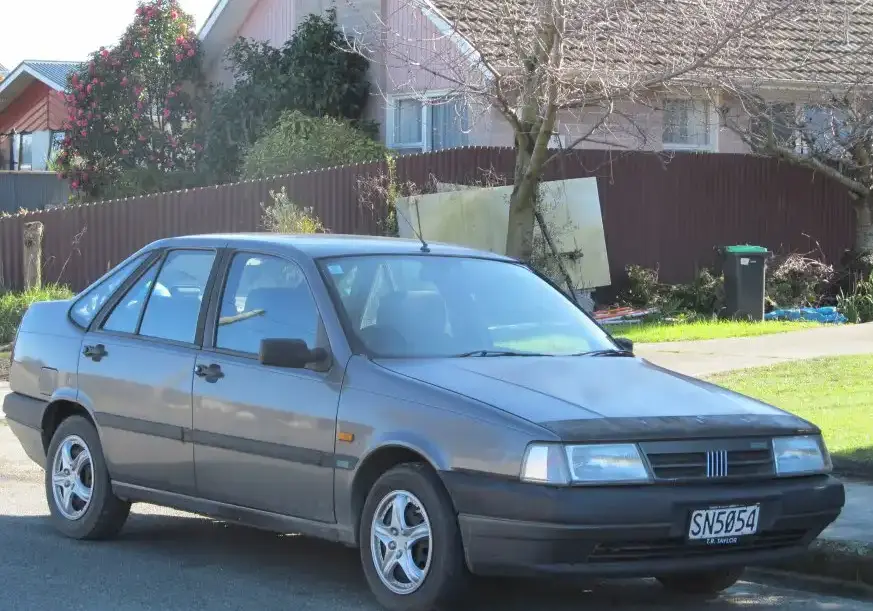
Technical Specifications
| Brand | Fiat |
| Model | Tempra |
| Generation | Tempra (159) |
| Type (Engine) | 1.4 (78 Hp) |
| Start of production | 1990 |
| End of production | 1993 |
| Powertrain Architecture | Internal Combustion engine |
| Body type | Sedan |
| Seats | 5 |
| Doors | 4 |
| Fuel consumption (urban) | 9 l/100 km (26.1 US mpg, 31.4 UK mpg, 11.1 km/l) |
| Fuel consumption (extra urban) | 5.6 l/100 km (42 US mpg, 50.4 UK mpg, 17.9 km/l) |
| Fuel consumption (combined) | 7.4 l/100 km (31.8 US mpg, 38.2 UK mpg, 13.5 km/l) |
| Fuel Type | Petrol (Gasoline) |
| Acceleration 0 – 100 km/h | 13.4 sec |
| Acceleration 0 – 62 mph | 13.4 sec |
| Acceleration 0 – 60 mph | 12.7 sec |
| Maximum speed | 172 km/h (106.88 mph) |
| Weight-to-power ratio | 13.2 kg/Hp, 75.7 Hp/tonne |
| Weight-to-torque ratio | 9.5 kg/Nm, 104.9 Nm/tonne |
| Power | 78 Hp @ 6000 rpm |
| Power per litre | 56.9 Hp/l |
| Torque | 108 Nm @ 2900 rpm (79.66 lb.-ft. @ 2900 rpm) |
| Engine layout | Front, Transverse |
| Engine Model/Code | 159 A2.000 |
| Engine displacement | 1372 cm3 (83.72 cu. in.) |
| Number of cylinders | 4 |
| Engine configuration | Inline |
| Cylinder Bore | 80.5 mm (3.17 in.) |
| Piston Stroke | 67.4 mm (2.65 in.) |
| Compression ratio | 9.2:1 |
| Number of valves per cylinder | 2 |
| Fuel injection system | Carburettor |
| Engine aspiration | Naturally aspirated engine |
| Valvetrain | OHC |
| Engine oil capacity | 3.7 l (3.91 US qt | 3.26 UK qt) |
| Coolant | 5.5 l (5.81 US qt | 4.84 UK qt) |
| Kerb Weight | 1030 kg (2270.76 lbs.) |
| Max. weight | 1570 kg (3461.26 lbs.) |
| Max load | 540 kg (1190.5 lbs.) |
| Trunk (boot) space – minimum | 500 l (17.66 cu. ft.) |
| Fuel tank capacity | 60 l (15.85 US gal | 13.2 UK gal) |
| Length | 4354 mm (171.42 in.) |
| Width | 1695 mm (66.73 in.) |
| Height | 1445 mm (56.89 in.) |
| Wheelbase | 2540 mm (100 in.) |
| Front track | 1435 mm (56.5 in.) |
| Rear (Back) track | 1415 mm (55.71 in.) |
| Front overhang | 918 mm (36.14 in.) |
| Rear overhang | 896 mm (35.28 in.) |
| Drivetrain Architecture | The Internal combustion engine (ICE) drives the front wheels of the vehicle. |
| Drive wheel | Front wheel drive |
| Number of gears and type of gearbox | 5 gears, manual transmission |
| Front suspension | Wishbone |
| Rear suspension | Coil spring |
| Front brakes | Disc |
| Rear brakes | Drum |
| Assisting systems | ABS (Anti-lock braking system) |
| Steering type | Steering rack and pinion |
| Power steering | Hydraulic Steering |
| Tires size | 165/70 R13 |
The Fiat Tempra 1.4 was a variant of the Tempra (Type 159) produced between 1990 and 1993. Positioned as the entry-level model in the Tempra range, it offered a more affordable option for buyers seeking a spacious and practical family sedan. The Tempra itself was Fiat’s replacement for the aging Regata, representing a significant step forward in terms of design, technology, and overall refinement. It was primarily aimed at the European market, where it competed with vehicles like the Ford Sierra and Opel/Vauxhall Vectra. The 1.4-liter engine and five-speed manual transmission combination was designed to prioritize fuel economy and accessibility, making it a popular choice for everyday commuting and family transport.
Powertrain & Engine Architecture
The Fiat Tempra 1.4 utilized the 159 A2.000 engine, a 1372cc inline-four cylinder petrol engine. This engine was a relatively simple design, employing a single overhead camshaft (OHC) and two valves per cylinder. Crucially, it featured a carburettor fuel injection system, a common feature for vehicles of this era, but increasingly superseded by fuel injection in higher-performance models. The carburettor provided adequate fuel delivery for the engine’s modest power output. The engine produced 78 horsepower at 6000 rpm and 108 Nm (79.66 lb-ft) of torque at 2900 rpm. The engine’s relatively low compression ratio of 9.2:1 contributed to its ability to run on lower octane fuel, common in many European markets. The engine was transversely mounted in the front of the vehicle, driving the front wheels. The transmission was a standard five-speed manual gearbox, chosen for its simplicity and cost-effectiveness.
Driving Characteristics
The Tempra 1.4 offered a predictable, if not particularly exciting, driving experience. With 78 hp, acceleration was modest, taking approximately 13.4 seconds to reach 62 mph (100 km/h). The carbureted engine delivered power in a linear fashion, but lacked the responsiveness of fuel-injected counterparts or the higher-output 1.6 and 2.0-liter versions of the Tempra. The five-speed manual transmission was well-matched to the engine’s characteristics, allowing drivers to keep the engine in its optimal power band. Compared to the more powerful Tempra variants, the 1.4 prioritized fuel economy over outright performance. The gear ratios were geared towards maximizing efficiency, resulting in a comfortable cruising experience on the highway. The relatively light weight of the 1.4 model (1030 kg) helped to mitigate the effects of its lower power output.
Equipment & Trim Levels
The Tempra 1.4 typically came with a basic level of equipment, reflecting its position as the entry-level model. Standard features generally included cloth upholstery, a basic instrument cluster, and manual windows and door locks. Power steering was often included, but air conditioning and central locking were typically optional extras. Interior trim was functional and durable, prioritizing practicality over luxury. Optional extras could include a radio/cassette player, upgraded seat fabrics, and alloy wheels. The dashboard layout was straightforward and easy to use, with clearly labeled controls.
Chassis & Braking
The Tempra 1.4 featured a front-wheel-drive layout with independent wishbone suspension at the front and a coil spring rear suspension. This suspension setup provided a reasonable balance between ride comfort and handling. The front brakes were disc brakes, while the rear brakes were drum brakes, a common configuration for vehicles in this price range. Anti-lock braking system (ABS) was available as an option, enhancing safety. The steering was a rack and pinion system with hydraulic power assistance, providing light and precise steering feel. The tires were typically 165/70 R13, offering a good compromise between grip and fuel economy.
Market Reception & Comparison
The Fiat Tempra 1.4 was generally well-received as an affordable and practical family sedan. Critics praised its spacious interior, comfortable ride, and reasonable fuel economy. However, the 1.4-liter engine was often criticized for its lack of power, particularly when compared to the more potent 1.6 and 2.0-liter versions of the Tempra. The 1.6-liter offered a noticeable performance improvement, while the 2.0-liter provided significantly more power and a more refined driving experience. In terms of reliability, the Tempra 1.4 was generally considered to be a dependable vehicle, although the carburettor fuel system could require occasional maintenance. Fuel economy was a strong point, with combined fuel consumption figures around 31.8 US mpg.
Legacy
The Fiat Tempra 1.4, while not the most exciting variant in the range, remains a fondly remembered vehicle for many owners. Its simplicity and affordability made it a popular choice for families and first-time car buyers. Today, surviving examples are relatively rare, and well-maintained Tempra 1.4s are becoming increasingly sought after by classic car enthusiasts. The 159 A2.000 engine, while not known for its high performance, is generally considered to be a robust and reliable unit, provided it has been properly maintained. The Tempra, as a whole, represented a significant step forward for Fiat, and paved the way for future models like the Bravo and Brava.
