
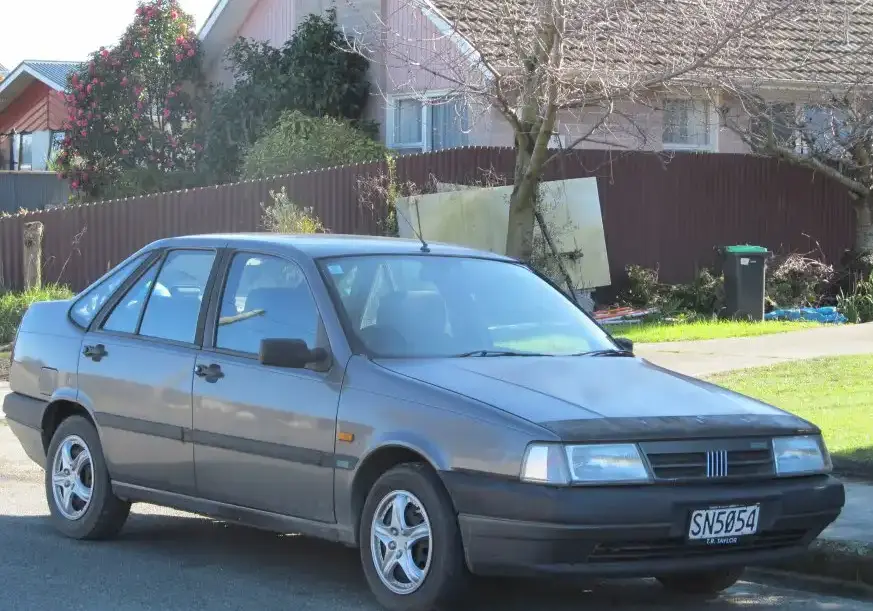
The Fiat Tempra 1.4 i.e. (chassis codes 159.AC and 159.AX) was a mainstream, entry-level variant of the Tempra range produced between 1990 and 1996. Positioned as the most economical option in the lineup, it served as the gateway to the Tempra model, appealing to buyers prioritizing affordability and fuel efficiency. The Tempra (Type 159) itself represented Fiat’s attempt to move upmarket in the mid-size sedan segment, replacing the aging Tipo. This 1.4-liter version was primarily sold in European and Latin American markets, where smaller displacement engines were favored due to taxation and fuel costs.
Technical Specifications
| Brand | Fiat |
| Model | Tempra |
| Generation | Tempra (159) |
| Type (Engine) | 1.4 i.e. (159.AC,159.AX) (69 Hp) |
| Start of production | 1990 |
| End of production | 1996 |
| Powertrain Architecture | Internal Combustion engine |
| Body type | Sedan |
| Seats | 5 |
| Doors | 4 |
| Fuel consumption (combined) | 7.3 l/100 km (32.2 US mpg, 38.7 UK mpg, 13.7 km/l) |
| Fuel Type | Petrol (Gasoline) |
| Acceleration 0 – 100 km/h | 14.4 sec |
| Acceleration 0 – 62 mph | 14.4 sec |
| Acceleration 0 – 60 mph | 13.7 sec |
| Maximum speed | 163 km/h (101.28 mph) |
| Weight-to-power ratio | 15.3 kg/Hp, 65.5 Hp/tonne |
| Weight-to-torque ratio | 9.9 kg/Nm, 100.7 Nm/tonne |
| Power | 69 Hp @ 6000 rpm |
| Power per litre | 50.3 Hp/l |
| Torque | 106 Nm @ 3000 rpm (78.18 lb.-ft. @ 3000 rpm) |
| Engine layout | Front, Transverse |
| Engine Model/Code | 836 A4.000 |
| Engine displacement | 1372 cm3 (83.72 cu. in.) |
| Number of cylinders | 4 |
| Engine configuration | Inline |
| Cylinder Bore | 80.5 mm (3.17 in.) |
| Piston Stroke | 67.4 mm (2.65 in.) |
| Compression ratio | 9.2:1 |
| Number of valves per cylinder | 2 |
| Fuel injection system | Single-point injection |
| Engine aspiration | Naturally aspirated engine |
| Valvetrain | OHC |
| Engine oil capacity | 3.7 l (3.91 US qt | 3.26 UK qt) |
| Coolant capacity | 5.5 l (5.81 US qt | 4.84 UK qt) |
| Kerb Weight | 1053 kg (2321.47 lbs.) |
| Max. weight | 1575 kg (3472.28 lbs.) |
| Max load | 522 kg (1150.81 lbs.) |
| Trunk (boot) space – minimum | 500 l (17.66 cu. ft.) |
| Fuel tank capacity | 60 l (15.85 US gal | 13.2 UK gal) |
| Length | 4354 mm (171.42 in.) |
| Width | 1695 mm (66.73 in.) |
| Height | 1445 mm (56.89 in.) |
| Wheelbase | 2540 mm (100 in.) |
| Front track | 1435 mm (56.5 in.) |
| Rear (Back) track | 1415 mm (55.71 in.) |
| Front overhang | 918 mm (36.14 in.) |
| Rear overhang | 896 mm (35.28 in.) |
| Drivetrain Architecture | The Internal combustion engine (ICE) drives the front wheels of the vehicle. |
| Drive wheel | Front wheel drive |
| Number of gears and type of gearbox | 5 gears, manual transmission |
| Front suspension | Wishbone |
| Rear suspension | Coil spring |
| Front brakes | Disc |
| Rear brakes | Disc |
| Assisting systems | ABS (Anti-lock braking system) |
| Steering type | Steering rack and pinion |
| Power steering | Hydraulic Steering |
| Tires size | 175/65 R14 |
Powertrain & Engine Architecture
The heart of the Tempra 1.4 i.e. was the Fiat 836 A4.000 engine, a 1372cc inline-four cylinder unit. This engine featured a single overhead camshaft (OHC) operating two valves per cylinder. The fuel system employed single-point fuel injection, a relatively basic system for the early 1990s, but one that contributed to the engine’s fuel efficiency. The 836 A4.000 engine was a development of Fiat’s earlier 1.4-liter designs, known for its simplicity and relative reliability. The engine produced 69 horsepower at 6000 rpm and 106 Nm (78.18 lb-ft) of torque at 3000 rpm. The engine was transversely mounted in the front of the vehicle, driving the front wheels. The standard transmission was a five-speed manual gearbox, optimized for fuel economy rather than outright performance.
Driving Characteristics
The Tempra 1.4 i.e. offered modest performance. Acceleration from 0 to 60 mph took approximately 13.7 seconds, and the top speed was around 101 mph. The engine felt somewhat underpowered, especially when fully loaded or tackling inclines. The five-speed manual transmission helped to keep the engine in its optimal power band, but the lack of torque meant frequent downshifts were necessary. Compared to the more powerful 1.8-liter and 2.0-liter Tempra variants, the 1.4 i.e. felt significantly slower and less refined. However, it provided adequate performance for everyday commuting and urban driving. The steering was light and easy, making it maneuverable in city traffic, but lacked the precision of more sporting sedans.
Equipment & Trim Levels
The 1.4 i.e. Tempra typically came with a basic level of equipment. Standard features included central locking, power steering, and a basic stereo system. Interior upholstery was typically cloth, and the dashboard featured a simple, functional design. Optional extras included air conditioning, electric windows, and upgraded audio systems. The trim level was generally considered the entry point to the Tempra range, aimed at budget-conscious buyers. It lacked the more luxurious appointments found in the higher-spec models.
Chassis & Braking
The Tempra 1.4 i.e. utilized a relatively conventional chassis design. The front suspension featured independent wishbones, while the rear suspension employed a coil spring setup. Brakes were disc brakes on all four wheels, providing adequate stopping power for the vehicle’s weight and performance. An anti-lock braking system (ABS) was often included as standard equipment, enhancing safety. The relatively lightweight nature of the 1.4 i.e. compared to its larger-engined siblings contributed to its slightly more agile handling.
Market Reception & Comparison
The Tempra 1.4 i.e. was generally well-received as an affordable and economical family sedan. Critics praised its fuel efficiency and practicality, but noted its lack of performance. Compared to rivals like the Ford Escort and Opel Astra, the Tempra 1.4 i.e. offered a competitive price point but lacked the refinement and driving dynamics of some of its competitors. The 1.8-liter Tempra offered a significant performance upgrade, while the diesel variants provided even better fuel economy, but at a higher initial cost. The 1.4 i.e. appealed to buyers who prioritized value for money and low running costs.
Legacy
The Fiat Tempra 1.4 i.e. powertrain, while not particularly groundbreaking, proved to be reasonably reliable. The 836 A4.000 engine is known for its durability, and with regular maintenance, it can provide many years of service. In the used car market, the Tempra 1.4 i.e. remains an affordable option for those seeking a basic, reliable family sedan. Parts availability can be a challenge in some regions, but the engine’s simplicity makes it relatively easy to repair. The Tempra, in general, is remembered as a significant step forward for Fiat in terms of design and build quality, and the 1.4 i.e. played a crucial role in making the model accessible to a wider range of buyers.
