
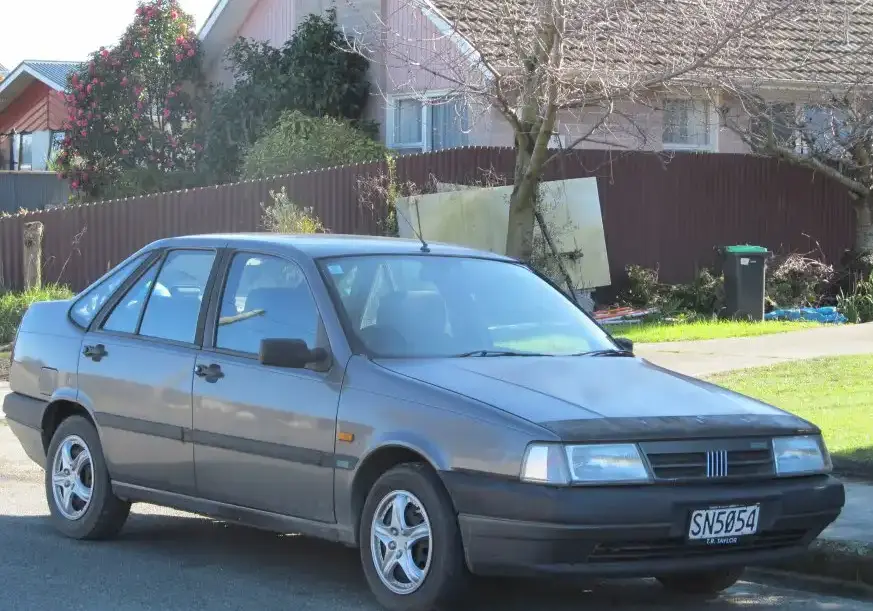
The Fiat Tempra 1.6 i.e., produced between 1992 and 1996, represented a significant step forward for Fiat in the mid-size sedan segment. Part of the 159 project, the Tempra aimed to replace the aging Fiat Regata and offered a more modern design, improved comfort, and a range of engines. The 1.6 i.e. variant, designated 159.AS and 159.AT, served as the entry-level offering in many European markets, providing a balance of affordability and practicality. It was positioned below the more powerful 2.0-liter versions and, in some markets, alongside a diesel option. The Tempra was a key model for Fiat, intended to compete with established rivals like the Ford Sierra and Opel/Vauxhall Vectra.
Technical Specifications
| Brand | Fiat |
| Model | Tempra |
| Generation | Tempra (159) |
| Type (Engine) | 1.6 i.e. (159.AS,159.AT) (75 Hp) |
| Start of production | 1992 |
| End of production | 1996 |
| Powertrain Architecture | Internal Combustion engine |
| Body type | Sedan |
| Seats | 5 |
| Doors | 4 |
| Fuel consumption (combined) | 7.8 l/100 km (30.2 US mpg, 36.2 UK mpg, 12.8 km/l) |
| Fuel Type | Petrol (Gasoline) |
| Acceleration 0 – 100 km/h | 13.8 sec |
| Acceleration 0 – 62 mph | 13.8 sec |
| Acceleration 0 – 60 mph | 13.1 sec |
| Maximum speed | 170 km/h (105.63 mph) |
| Weight-to-power ratio | 14.3 kg/Hp, 69.8 Hp/tonne |
| Weight-to-torque ratio | 8.6 kg/Nm, 116.3 Nm/tonne |
| Power | 75 Hp @ 6000 rpm |
| Power per litre | 47.4 Hp/l |
| Torque | 125 Nm @ 3000 rpm (92.2 lb.-ft. @ 3000 rpm) |
| Engine layout | Front, Transverse |
| Engine Model/Code | 159 A3.048 |
| Engine displacement | 1581 cm3 (96.48 cu. in.) |
| Number of cylinders | 4 |
| Engine configuration | Inline |
| Cylinder Bore | 86.4 mm (3.4 in.) |
| Piston Stroke | 67.4 mm (2.65 in.) |
| Compression ratio | 9.2:1 |
| Number of valves per cylinder | 2 |
| Fuel injection system | Single-point injection |
| Engine aspiration | Naturally aspirated engine |
| Valvetrain | OHC |
| Engine oil capacity | 3.7 l (3.91 US qt | 3.26 UK qt) |
| Coolant | 5.5 l (5.81 US qt | 4.84 UK qt) |
| Kerb Weight | 1075 kg (2369.97 lbs.) |
| Max. weight | 1580 kg (3483.3 lbs.) |
| Max load | 505 kg (1113.33 lbs.) |
| Trunk (boot) space – minimum | 500 l (17.66 cu. ft.) |
| Fuel tank capacity | 60 l (15.85 US gal | 13.2 UK gal) |
| Length | 4354 mm (171.42 in.) |
| Width | 1695 mm (66.73 in.) |
| Height | 1445 mm (56.89 in.) |
| Wheelbase | 2450 mm (96.46 in.) |
| Front track | 1435 mm (56.5 in.) |
| Rear (Back) track | 1415 mm (55.71 in.) |
| Front overhang | 918 mm (36.14 in.) |
| Rear overhang | 896 mm (35.28 in.) |
| Drivetrain Architecture | The Internal combustion engine (ICE) drives the front wheels of the vehicle. |
| Drive wheel | Front wheel drive |
| Number of gears and type of gearbox | 5 gears, manual transmission |
| Front suspension | Wishbone |
| Rear suspension | Coil spring |
| Front brakes | Disc |
| Rear brakes | Drum |
| Assisting systems | ABS (Anti-lock braking system) |
| Steering type | Steering rack and pinion |
| Power steering | Hydraulic Steering |
| Tires size | 175/65 R14 |
Powertrain & Engine Architecture
The Fiat Tempra 1.6 i.e. was powered by the 159 A3.048 engine, a 1581cc inline-four cylinder unit. This engine featured a single-point fuel injection system, a relatively common technology in the early 1990s. The single-point injection, while simpler and less expensive than multi-point injection, provided adequate fuel delivery for the engine’s modest power output. The engine utilized an overhead camshaft (OHC) valvetrain with two valves per cylinder. This configuration was chosen for its balance of simplicity, reliability, and cost-effectiveness. The 75 horsepower output was achieved at 6000 rpm, while peak torque of 125 Nm (92.2 lb-ft) arrived at 3000 rpm. The engine’s design prioritized fuel economy and smooth operation over outright performance. The standard transmission was a five-speed manual, although a four-speed automatic transmission was also available (designated 159.AT), albeit less common.
Driving Characteristics
The Tempra 1.6 i.e. offered a comfortable, if not particularly exciting, driving experience. Acceleration from 0 to 60 mph took around 13.1 seconds, and top speed was limited to 170 km/h (105.63 mph). Compared to the 2.0-liter versions, the 1.6 i.e. felt noticeably slower, especially when fully loaded or tackling inclines. The five-speed manual transmission was well-matched to the engine’s characteristics, allowing drivers to keep the engine in its optimal power band. The automatic transmission, while providing convenience, further reduced acceleration performance. The suspension, tuned for comfort, absorbed bumps reasonably well, but the car wasn’t particularly sporty in handling. Steering was light and easy, making it suitable for city driving.
Equipment & Trim Levels
The 1.6 i.e. Tempra typically came with a fairly basic level of equipment, reflecting its position as the entry-level model. Standard features generally included central locking, power steering, and a basic stereo system. Interior upholstery was typically cloth, and the dashboard featured a functional, if somewhat dated, design. Optional extras included air conditioning, electric windows, and upgraded audio systems. Higher trim levels, available with the 2.0-liter engines, offered more luxurious features such as leather upholstery and alloy wheels.
Chassis & Braking
The Tempra 1.6 i.e. utilized a front-wheel-drive layout with a wishbone front suspension and a coil spring rear suspension. The front brakes were discs, providing adequate stopping power, while the rear brakes were drums, a cost-saving measure common in this class of vehicle. An anti-lock braking system (ABS) was available as an option, enhancing safety. The car’s weight of around 1075 kg (2369.97 lbs) contributed to its relatively modest performance. The steering system employed a rack and pinion setup with hydraulic power assistance.
Market Reception & Comparison
The Fiat Tempra 1.6 i.e. was generally well-received as a practical and affordable family sedan. Critics praised its comfortable ride and spacious interior, but noted its lack of outright performance compared to some rivals. Fuel economy was considered reasonable for the time, averaging around 7.8 l/100 km (30.2 US mpg). Compared to the 2.0-liter Tempra, the 1.6 i.e. offered lower running costs but sacrificed performance. The diesel versions provided even better fuel economy but were slower still. The Tempra faced stiff competition from established players like the Ford Sierra, Opel/Vauxhall Vectra, and Peugeot 405.
Legacy
The Fiat Tempra, while not a groundbreaking vehicle, played an important role in Fiat’s lineup during the early 1990s. The 1.6 i.e. variant, in particular, offered a budget-friendly option for families seeking a reliable and practical sedan. The engine itself proved to be relatively durable, and well-maintained examples can still be found on the road today. However, age and mileage have taken their toll on many examples, and finding parts can sometimes be challenging. The Tempra’s simple design and relatively low complexity make it a potentially appealing project car for enthusiasts, but it lacks the collectibility of some other classic Fiats.
