
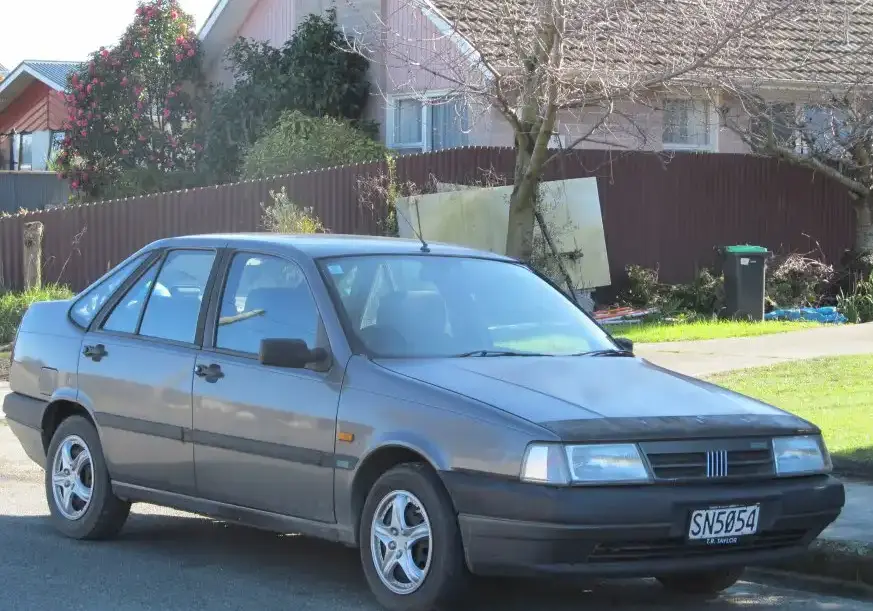
The Fiat Tempra 1.6 i.e. (78 hp) was a mainstream variant of the Tempra (Type 159) sedan, produced between 1990 and 1992. Positioned as an entry-level to mid-range offering within the Tempra lineup, it aimed to provide affordable family transportation. The Tempra itself represented Fiat’s attempt to move upmarket in the mid-size segment, replacing the aging Fiat Regata and offering a more modern and spacious alternative to competitors like the Ford Escort and Opel/Vauxhall Astra. The 1.6 i.e. model was particularly significant in markets where smaller displacement engines were favored due to taxation or fuel economy concerns.
Technical Specifications
| Brand | Fiat |
| Model | Tempra |
| Generation | Tempra (159) |
| Type (Engine) | 1.6 i.e. (78 Hp) |
| Start of production | 1990 |
| End of production | 1992 |
| Powertrain Architecture | Internal Combustion engine |
| Body type | Sedan |
| Doors | 5 |
| Fuel consumption (combined) | 8.3 l/100 km |
| Fuel consumption (US mpg) | 28.3 US mpg |
| Fuel consumption (UK mpg) | 34 UK mpg |
| Fuel consumption (km/l) | 12 km/l |
| Fuel Type | Petrol (Gasoline) |
| Acceleration 0 – 100 km/h | 13.6 sec |
| Acceleration 0 – 62 mph | 13.6 sec |
| Acceleration 0 – 60 mph | 12.9 sec |
| Maximum speed | 168 km/h (104.39 mph) |
| Weight-to-power ratio | 13.8 kg/Hp |
| Weight-to-torque ratio | 8.7 kg/Nm |
| Power | 78 Hp @ 6000 rpm |
| Power per litre | 48.8 Hp/l |
| Torque | 124 Nm @ 3000 rpm (91.46 lb.-ft. @ 3000 rpm) |
| Engine Model/Code | 159 A3.046 |
| Engine displacement | 1600 cm3 (97.64 cu. in.) |
| Engine configuration | Inline |
| Fuel injection system | Single-point injection |
| Engine aspiration | Naturally aspirated engine |
| Engine oil capacity | 3.7 l (3.91 US qt | 3.26 UK qt) |
| Coolant capacity | 6.5 l (6.87 US qt | 5.72 UK qt) |
| Kerb Weight | 1080 kg (2380.99 lbs) |
| Fuel tank capacity | 63 l (16.64 US gal | 13.86 UK gal) |
| Length | 4354 mm (171.42 in) |
| Width | 1695 mm (66.73 in) |
| Height | 1445 mm (56.89 in) |
| Front overhang | 918 mm (36.14 in) |
| Rear overhang | 896 mm (35.28 in) |
| Drivetrain Architecture | Front wheel drive |
| Number of gears | 5 gears, manual transmission |
| Power steering | Hydraulic Steering |
Powertrain & Engine Architecture
The heart of the Tempra 1.6 i.e. was the 159 A3.046 engine, a 1.6-liter inline four-cylinder unit. This engine utilized a single-point fuel injection system, a relatively common technology in the early 1990s, but less sophisticated than the multi-point injection systems found in some of its competitors. The single-point system, while simpler and cheaper to manufacture, generally resulted in slightly less precise fuel delivery and lower overall efficiency. The engine featured an overhead camshaft (OHC) valvetrain, operating two valves per cylinder. The 78 horsepower output at 6000 rpm and 124 Nm (91.46 lb-ft) of torque at 3000 rpm were typical figures for a naturally aspirated 1.6-liter engine of that era. The engine was paired with a standard five-speed manual transmission, providing a relatively conventional driving experience.
Driving Characteristics
The Tempra 1.6 i.e. offered modest performance. Acceleration from 0 to 60 mph took approximately 12.9 seconds, and the top speed was around 104 mph. While adequate for everyday driving, it wasn’t particularly sporty or quick. The gear ratios in the five-speed manual transmission were geared towards fuel efficiency rather than outright acceleration. Compared to the more powerful 2.0-liter versions of the Tempra, the 1.6 i.e. felt noticeably slower, especially when fully loaded or tackling inclines. However, the 1.6-liter engine was smoother and more refined than the smaller 1.4-liter engine offered in some markets, making it a more pleasant choice for longer journeys.
Equipment & Trim Levels
The 1.6 i.e. trim level typically included basic features such as power steering, central locking, and a basic stereo system. Interior upholstery was usually cloth, and the dashboard featured a functional but somewhat utilitarian design. Optional extras included air conditioning, electric windows, and upgraded audio systems. The trim level was generally considered a step up from the base models, offering a slightly more comfortable and well-equipped interior. The focus was on providing a practical and affordable family car, rather than luxury or high-performance features.
Chassis & Braking
The Tempra 1.6 i.e. utilized a MacPherson strut front suspension and a torsion beam rear suspension. The braking system consisted of disc brakes on the front wheels and drum brakes on the rear. This configuration was typical for cars in this class at the time, balancing cost and performance. The suspension provided a reasonably comfortable ride, although it wasn’t particularly sporty or engaging. The relatively light weight of the 1.6-liter engine helped to reduce stress on the suspension components, contributing to its durability.
Market Reception & Comparison
The Fiat Tempra 1.6 i.e. was generally well-received as a practical and affordable family car. Critics praised its spacious interior and comfortable ride, but noted its somewhat uninspired styling and modest performance. Compared to other trims in the Tempra lineup, the 1.6 i.e. offered a more economical option, appealing to buyers who prioritized fuel efficiency and affordability over outright performance. The 2.0-liter versions were favored by those seeking more power, while the diesel models appealed to those who prioritized fuel economy above all else. Fuel economy for the 1.6 i.e. was rated at around 28.3 US mpg, which was competitive for its time.
Legacy
The Fiat Tempra 1.6 i.e. powertrain proved to be reasonably reliable, although the single-point fuel injection system could require occasional maintenance. The engine was generally durable, and spare parts were readily available for many years after production ceased. Today, the Tempra 1.6 i.e. is a relatively rare sight on the roads, but it remains a popular choice among classic Fiat enthusiasts. Its affordability and simplicity make it an attractive option for those seeking a classic Italian car that is relatively easy to maintain. The Tempra, in general, is remembered as a significant step forward for Fiat, representing a move towards more modern and sophisticated vehicles.
