
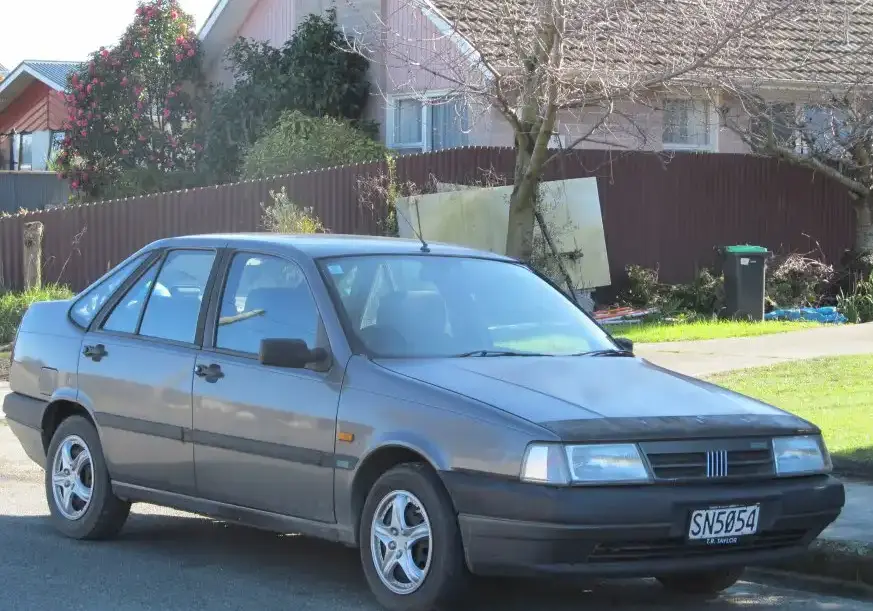
The Fiat Tempra 1.8 i.e. (159.BY), produced between 1994 and 1996, represented a mid-range offering within the Tempra (159) lineup. The Tempra itself was Fiat’s replacement for the aging Tipo, aiming to provide a more modern and spacious family sedan. Positioned above the base 1.6-liter models and below the more powerful 2.0-liter versions, the 1.8 i.e. sought to balance performance, fuel economy, and affordability for European buyers. It was a key model in Fiat’s attempt to compete in the increasingly competitive mid-size sedan segment.
Technical Specifications
| Brand | Fiat |
| Model | Tempra |
| Generation | Tempra (159) |
| Type (Engine) | 1.8 i.e. (159.BY) (101 Hp) |
| Start of production | 1994 |
| End of production | 1996 |
| Powertrain Architecture | Internal Combustion engine |
| Body type | Sedan |
| Seats | 5 |
| Doors | 4 |
| Fuel consumption (combined) | 8.8 l/100 km (26.7 US mpg, 32.1 UK mpg, 11.4 km/l) |
| Fuel Type | Petrol (Gasoline) |
| Acceleration 0 – 100 km/h | 12.5 sec |
| Acceleration 0 – 62 mph | 12.5 sec |
| Acceleration 0 – 60 mph | 11.9 sec |
| Maximum speed | 188 km/h (116.82 mph) |
| Weight-to-power ratio | 11.6 kg/Hp, 86.5 Hp/tonne |
| Weight-to-torque ratio | 8.3 kg/Nm, 119.9 Nm/tonne |
| Power | 101 Hp @ 6000 rpm |
| Power per litre | 57.5 Hp/l |
| Torque | 140 Nm @ 2750 rpm (103.26 lb.-ft. @ 2750 rpm) |
| Engine layout | Front, Transverse |
| Engine Model/Code | 836 A5.000 |
| Engine displacement | 1756 cm3 (107.16 cu. in.) |
| Number of cylinders | 4 |
| Engine configuration | Inline |
| Cylinder Bore | 84 mm (3.31 in.) |
| Piston Stroke | 79.2 mm (3.12 in.) |
| Compression ratio | 9.5:1 |
| Number of valves per cylinder | 2 |
| Fuel injection system | Multi-port manifold injection |
| Engine aspiration | Naturally aspirated engine |
| Valvetrain | DOHC |
| Engine oil capacity | 5.2 l (5.49 US qt | 4.58 UK qt) |
| Coolant | 6.9 l (7.29 US qt | 6.07 UK qt) |
| Kerb Weight | 1168 kg (2575 lbs.) |
| Max. weight | 1690 kg (3725.81 lbs.) |
| Max load | 522 kg (1150.81 lbs.) |
| Trunk (boot) space – minimum | 500 l (17.66 cu. ft.) |
| Fuel tank capacity | 60 l (15.85 US gal | 13.2 UK gal) |
| Length | 4354 mm (171.42 in.) |
| Width | 1695 mm (66.73 in.) |
| Height | 1445 mm (56.89 in.) |
| Wheelbase | 2540 mm (100 in.) |
| Front track | 1435 mm (56.5 in.) |
| Rear (Back) track | 1415 mm (55.71 in.) |
| Front overhang | 918 mm (36.14 in.) |
| Rear overhang | 896 mm (35.28 in.) |
| Drivetrain Architecture | The Internal combustion engine (ICE) drives the front wheels of the vehicle. |
| Drive wheel | Front wheel drive |
| Number of gears and type of gearbox | 5 gears, manual transmission |
| Front suspension | Wishbone |
| Rear suspension | Coil spring |
| Front brakes | Disc |
| Rear brakes | Disc |
| Steering type | Steering rack and pinion |
| Power steering | Hydraulic Steering |
| Tires size | 175/65 R14 |
Powertrain & Engine Architecture
The heart of the Tempra 1.8 i.e. was the 836 A5.000 engine, a 1.8-liter (1756 cc) inline-four cylinder gasoline engine. This engine featured a dual overhead camshaft (DOHC) valvetrain with two valves per cylinder. It utilized a multi-port fuel injection system, a significant upgrade over earlier carburetor-equipped Fiat models, contributing to improved fuel efficiency and smoother power delivery. The engine produced 101 horsepower at 6000 rpm and 140 Nm (103 lb-ft) of torque at 2750 rpm. The engine’s design prioritized reliability and ease of maintenance, typical of Fiat engineering at the time. The 5-speed manual transmission was the standard offering, providing a reasonable balance between performance and fuel economy. While an automatic transmission was available in some markets, it wasn’t commonly paired with the 1.8L engine.
Driving Characteristics
The Tempra 1.8 i.e. offered a comfortable and predictable driving experience. Acceleration from 0 to 60 mph took around 11.9 seconds, and it had a top speed of approximately 116.82 mph. While not a sports car, the 1.8-liter engine provided adequate power for everyday driving and highway cruising. The 5-speed manual transmission allowed drivers to keep the engine in its optimal power band. Compared to the base 1.6-liter Tempra, the 1.8 i.e. offered noticeably improved acceleration and responsiveness. However, it lacked the outright performance of the 2.0-liter models. The suspension was tuned for comfort, providing a relatively smooth ride, although it wasn’t particularly sporty in handling. The steering was light and easy to use, making it well-suited for urban driving.
Equipment & Trim Levels
The Tempra 1.8 i.e. typically came equipped with features considered standard for a mid-range family sedan in the early 1990s. These included power steering, central locking, electric front windows, and a basic audio system. Interior upholstery was typically cloth, with a relatively simple dashboard layout. Optional extras included air conditioning, alloy wheels, and a more advanced audio system. Higher trim levels offered features like a sunroof and upgraded interior trim. The Tempra aimed for a practical and functional interior rather than luxurious appointments.
Chassis & Braking
The Tempra utilized a front-wheel-drive layout with an independent wishbone suspension at the front and a coil spring suspension at the rear. Brakes were disc brakes on all four wheels, providing adequate stopping power for the vehicle’s weight and performance. The steering system was a rack and pinion setup with hydraulic power assistance. The Tempra’s chassis was designed to prioritize ride comfort and stability, rather than sporty handling. Tire size was typically 175/65 R14.
Market Reception & Comparison
The Fiat Tempra 1.8 i.e. was generally well-received by automotive critics as a competent and practical family sedan. It was praised for its spacious interior, comfortable ride, and relatively fuel-efficient engine. However, some critics noted that its styling was somewhat conservative and that its handling wasn’t particularly engaging. Compared to the 1.6-liter Tempra, the 1.8 i.e. offered a worthwhile performance upgrade for a modest price increase. The 2.0-liter Tempra provided more power but came at a higher cost. In terms of fuel economy, the 1.8 i.e. offered a good balance between performance and efficiency, typically achieving around 26.7 US mpg in combined driving.
Legacy
The Fiat Tempra, while not a groundbreaking vehicle, played an important role in Fiat’s model lineup during the early to mid-1990s. The 1.8 i.e. variant, in particular, proved to be a popular choice for buyers seeking a reliable and affordable family sedan. The 836 A5.000 engine is known for its durability and relatively simple design, making it relatively easy and inexpensive to maintain. Today, Tempra 1.8 i.e. models are becoming increasingly rare, and well-maintained examples are sought after by classic Fiat enthusiasts. The Tempra’s legacy lies in its practicality, affordability, and the solid engineering that characterized Fiat vehicles of that era.
