
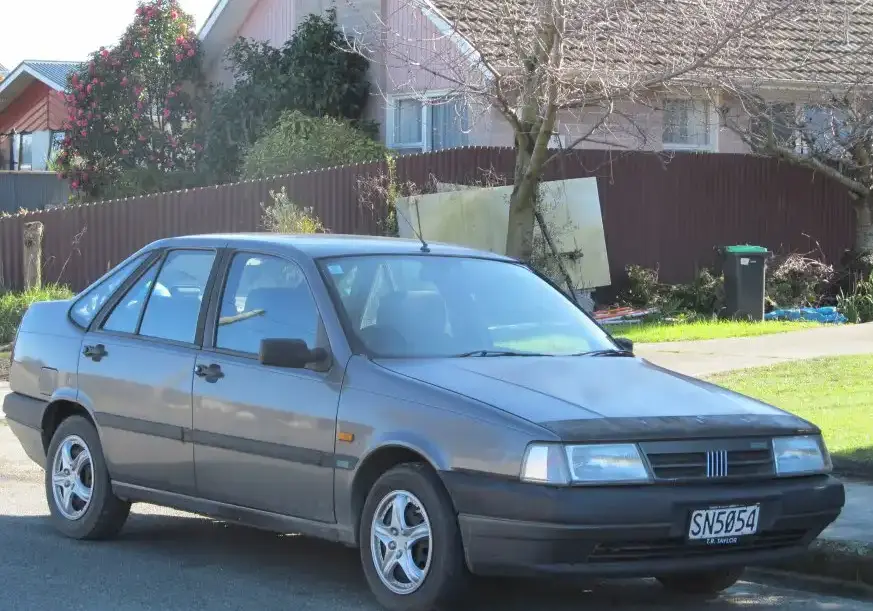
The Fiat Tempra 1.9 D (65 hp) was a diesel-powered variant of the Tempra (Type 159) sedan, produced between 1990 and 1993. Positioned as the entry-level diesel offering within the Tempra range, it aimed to provide economical transportation for families and fleet buyers. The Tempra itself was Fiat’s replacement for the aging Tipo, representing a significant step up in terms of size, comfort, and technology for the Italian automaker. This particular 1.9-liter diesel version was primarily sold in European markets where diesel fuel was more prevalent and tax incentives favored lower-displacement engines. It was a key model in Fiat’s lineup during a period of modernization and expansion, offering a practical and affordable option in the competitive mid-size sedan segment.
Technical Specifications
| Brand | Fiat |
| Model | Tempra |
| Generation | Tempra (159) |
| Type (Engine) | 1.9 D (65 Hp) |
| Start of production | 1990 year |
| End of production | 1993 year |
| Powertrain Architecture | Internal Combustion engine |
| Body type | Sedan |
| Seats | 5 |
| Doors | 4 |
| Fuel consumption (urban) | 6.4 l/100 km (36.8 US mpg, 44.1 UK mpg, 15.6 km/l) |
| Fuel consumption (extra urban) | 4.5 l/100 km (52.3 US mpg, 62.8 UK mpg, 22.2 km/l) |
| Fuel consumption (combined) | 6.3 l/100 km (37.3 US mpg, 44.8 UK mpg, 15.9 km/l) |
| Fuel Type | Diesel |
| Acceleration 0 – 100 km/h | 17.4 sec |
| Acceleration 0 – 62 mph | 17.4 sec |
| Acceleration 0 – 60 mph | 16.5 sec |
| Maximum speed | 162 km/h (100.66 mph) |
| Weight-to-power ratio | 17.4 kg/Hp, 57.5 Hp/tonne |
| Weight-to-torque ratio | 9.5 kg/Nm, 105.3 Nm/tonne |
| Power | 65 Hp @ 4600 rpm |
| Power per litre | 33.7 Hp/l |
| Torque | 119 Nm @ 2000 rpm (87.77 lb.-ft. @ 2000 rpm) |
| Engine layout | Front, Transverse |
| Engine Model/Code | 160 A7.000 |
| Engine displacement | 1929 cm3 (117.71 cu. in.) |
| Number of cylinders | 4 |
| Engine configuration | Inline |
| Cylinder Bore | 82.6 mm (3.25 in.) |
| Piston Stroke | 90 mm (3.54 in.) |
| Compression ratio | 21:1 |
| Number of valves per cylinder | 2 |
| Fuel injection system | Precombustion chamber injection |
| Engine aspiration | Naturally aspirated engine |
| Valvetrain | OHC |
| Engine oil capacity | 5 l (5.28 US qt | 4.4 UK qt) |
| Coolant | 8.8 l (9.3 US qt | 7.74 UK qt) |
| Kerb Weight | 1130 kg (2491.22 lbs.) |
| Max. weight | 1670 kg (3681.72 lbs.) |
| Max load | 540 kg (1190.5 lbs.) |
| Trunk (boot) space – minimum | 500 l (17.66 cu. ft.) |
| Fuel tank capacity | 60 l (15.85 US gal | 13.2 UK gal) |
| Length | 4354 mm (171.42 in.) |
| Width | 1695 mm (66.73 in.) |
| Height | 1445 mm (56.89 in.) |
| Wheelbase | 2540 mm (100 in.) |
| Front track | 1435 mm (56.5 in.) |
| Rear (Back) track | 1415 mm (55.71 in.) |
| Front overhang | 918 mm (36.14 in.) |
| Rear overhang | 896 mm (35.28 in.) |
| Drivetrain Architecture | The Internal combustion engine (ICE) drives the front wheels of the vehicle. |
| Drive wheel | Front wheel drive |
| Number of gears and type of gearbox | 5 gears, manual transmission |
| Front suspension | Wishbone |
| Rear suspension | Coil spring |
| Front brakes | Disc |
| Rear brakes | Disc |
| Assisting systems | ABS (Anti-lock braking system) |
| Steering type | Steering rack and pinion |
| Power steering | Hydraulic Steering |
| Tires size | 175/65 R14 |
Powertrain & Engine Architecture
The Tempra 1.9 D was powered by Fiat’s 160 A7.000 engine, a 1929cc inline-four cylinder diesel. This engine utilized precombustion chamber injection, a common diesel technology of the era. This system involved injecting fuel into a small pre-chamber within the cylinder head, where it partially combusted before igniting the main charge. This aided in cold starting and reduced engine noise compared to direct injection systems. The engine featured an overhead camshaft (OHC) valvetrain with two valves per cylinder. The 1.9-liter diesel produced 65 horsepower at 4600 rpm and 119 Nm (87.77 lb-ft) of torque at 2000 rpm. The engine was transversely mounted in the front of the vehicle, driving the front wheels. The standard transmission was a five-speed manual gearbox. This configuration was typical for European diesel cars of the time, prioritizing fuel efficiency and durability over outright performance.
Driving Characteristics
The Tempra 1.9 D was not designed for performance. Its focus was on fuel efficiency and low-cost operation. Acceleration was leisurely, taking approximately 17.4 seconds to reach 100 km/h (62 mph). Top speed was around 162 km/h (100.66 mph). The five-speed manual transmission was geared for economy, with relatively tall ratios. Compared to the more powerful gasoline-powered Tempra variants, the 1.9 D felt significantly slower, particularly when fully loaded. However, the diesel engine’s torque delivery provided reasonable usability in everyday driving situations, making it suitable for highway cruising and city commuting. The manual transmission offered more driver control than an automatic would have, but also required more driver involvement. The engine was relatively quiet for a diesel of its era, thanks to the precombustion chamber injection system, but still exhibited the characteristic diesel clatter under heavy load.
Equipment & Trim Levels
The 1.9 D Tempra typically came with a basic level of equipment. Standard features included power steering, central locking, and a basic stereo system. Interior upholstery was typically cloth, and the dashboard featured a functional but somewhat austere design. Optional extras included air conditioning, electric windows, and upgraded audio systems. The trim level was generally considered the base model for the Tempra range, appealing to buyers prioritizing affordability and fuel economy over luxury features. It was often chosen by fleet operators and families seeking a reliable and economical vehicle. The interior plastics were durable but lacked the refinement found in higher-trim Tempra models.
Chassis & Braking
The Tempra 1.9 D utilized a front-wheel-drive layout with independent wishbone suspension at the front and a coil spring rear suspension. The braking system consisted of disc brakes on all four wheels, a relatively advanced feature for a car in this class at the time. Anti-lock braking system (ABS) was available as an option, enhancing safety. The chassis was designed to provide a comfortable ride, prioritizing smoothness over sporty handling. The relatively modest power output of the 1.9 D engine meant that the braking system was generally adequate for the car’s performance capabilities. The suspension was tuned for comfort, absorbing bumps and providing a stable ride even on uneven surfaces.
Market Reception & Comparison
The Tempra 1.9 D was well-received in European markets as an economical and practical family sedan. Critics praised its fuel efficiency and low running costs. However, its performance was often criticized as being underwhelming. Compared to the gasoline-powered Tempra variants, the 1.9 D offered significantly lower performance but superior fuel economy. It also competed with other diesel sedans of the era, such as the Volkswagen Jetta Diesel and the Peugeot 405 Diesel. The Tempra 1.9 D generally offered a competitive price point and a spacious interior, making it an attractive option for budget-conscious buyers. It filled a niche for those needing a reliable and fuel-efficient vehicle for daily commuting and long-distance travel.
Legacy
The Fiat Tempra 1.9 D, while not a performance icon, proved to be a reliable and durable vehicle. The 160 A7.000 diesel engine, while simple in design, was known for its longevity. Today, Tempra 1.9 D models are relatively rare, but those that remain are often sought after by enthusiasts looking for a classic Italian sedan. The powertrain, while dated by modern standards, is still capable of providing economical transportation. Maintenance is generally straightforward due to the engine’s simplicity, but finding parts can sometimes be a challenge. The Tempra 1.9 D represents a significant chapter in Fiat’s history, showcasing the automaker’s commitment to providing affordable and practical vehicles to the European market. It remains a testament to the enduring appeal of simple, reliable diesel technology.
