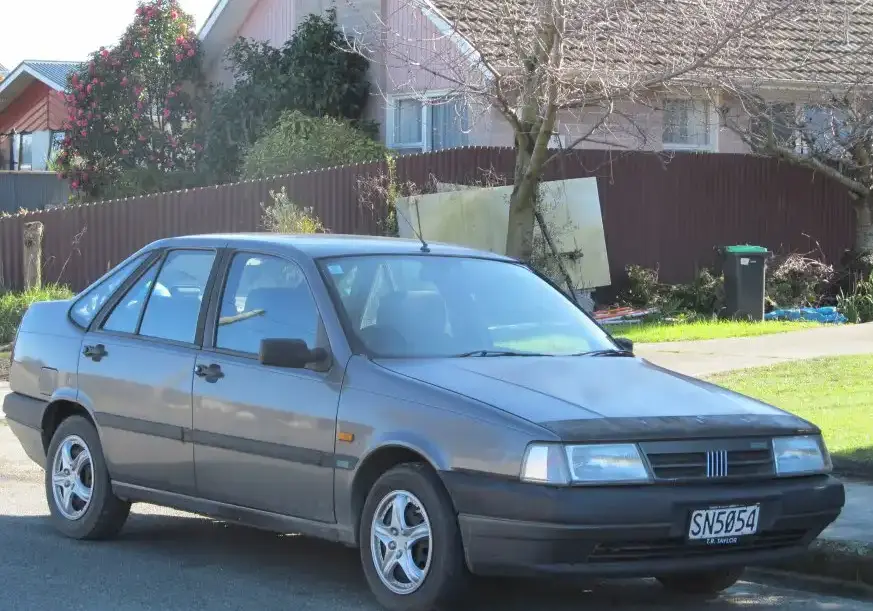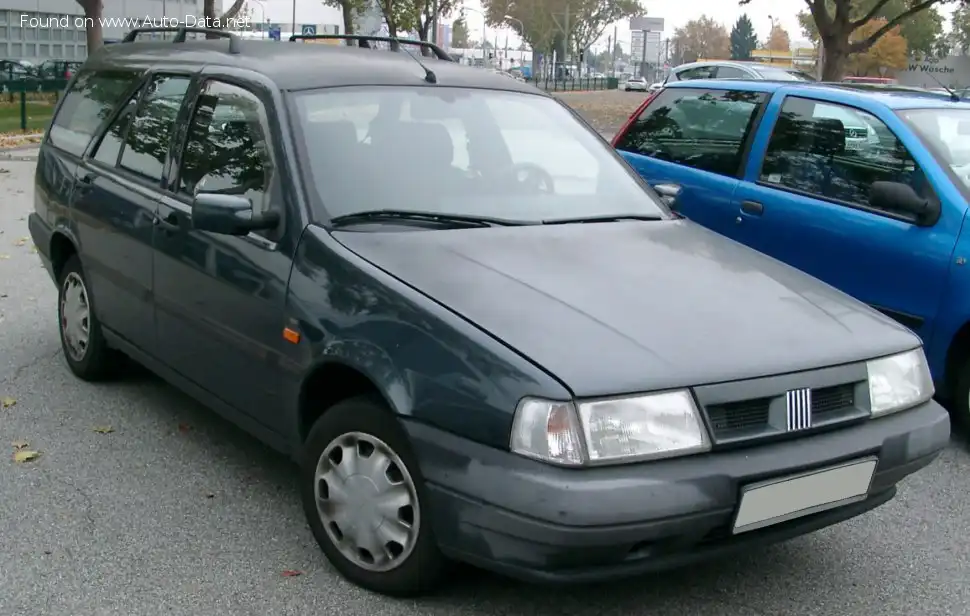
The Fiat Tempra Station Wagon (SW), specifically the 1.6 i.e. variant (model codes 159.AS and 159.AT), was a practical and affordable family car produced by the Italian manufacturer Fiat between 1992 and 1996. Positioned as an entry-level offering within the Tempra SW range, it provided a spacious and economical option for buyers needing a versatile vehicle. The Tempra SW itself was a significant model for Fiat, representing a move towards more modern and spacious designs compared to its predecessors. It was based on the Type Three platform, shared with other Fiat and Lancia models of the era.
Technical Specifications
| Brand | Fiat |
| Model | Tempra |
| Generation | Tempra S.w. (159) |
| Type (Engine) | 1.6 i.e. (159.AS,159.AT) (75 Hp) |
| Start of production | 1992 |
| End of production | 1996 |
| Powertrain Architecture | Internal Combustion engine |
| Body type | Station wagon (estate) |
| Seats | 5 |
| Doors | 5 |
| Fuel consumption (combined) | 7.8 l/100 km (30.2 US mpg, 36.2 UK mpg, 12.8 km/l) |
| Fuel Type | Petrol (Gasoline) |
| Acceleration 0 – 100 km/h | 14.3 sec |
| Acceleration 0 – 62 mph | 14.3 sec |
| Acceleration 0 – 60 mph | 13.6 sec |
| Maximum speed | 165 km/h (102.53 mph) |
| Weight-to-power ratio | 14.8 kg/Hp, 67.5 Hp/tonne |
| Weight-to-torque ratio | 8.9 kg/Nm, 112.5 Nm/tonne |
| Power | 75 Hp @ 6000 rpm |
| Power per litre | 47.4 Hp/l |
| Torque | 125 Nm @ 3000 rpm (92.2 lb.-ft. @ 3000 rpm) |
| Engine layout | Front, Transverse |
| Engine Model/Code | 159 A3.048 |
| Engine displacement | 1581 cm3 (96.48 cu. in.) |
| Number of cylinders | 4 |
| Engine configuration | Inline |
| Cylinder Bore | 86.4 mm (3.4 in.) |
| Piston Stroke | 67.4 mm (2.65 in.) |
| Compression ratio | 9.2:1 |
| Number of valves per cylinder | 2 |
| Fuel injection system | Single-point injection |
| Engine aspiration | Naturally aspirated engine |
| Valvetrain | OHC |
| Engine oil capacity | 3.7 l (3.91 US qt | 3.26 UK qt) |
| Coolant | 5.5 l (5.81 US qt | 4.84 UK qt) |
| Kerb Weight | 1111 kg (2449.34 lbs.) |
| Max. weight | 1710 kg (3769.9 lbs.) |
| Max load | 599 kg (1320.57 lbs.) |
| Trunk (boot) space – minimum | 500 l (17.66 cu. ft.) |
| Fuel tank capacity | 60 l (15.85 US gal | 13.2 UK gal) |
| Length | 4472 mm (176.06 in.) |
| Width | 1695 mm (66.73 in.) |
| Height | 1500 mm (59.06 in.) |
| Wheelbase | 2540 mm (100 in.) |
| Front track | 1435 mm (56.5 in.) |
| Rear (Back) track | 1415 mm (55.71 in.) |
| Drivetrain Architecture | The Internal combustion engine (ICE) drives the front wheels of the vehicle. |
| Drive wheel | Front wheel drive |
| Number of gears and type of gearbox | 5 gears, manual transmission |
| Front suspension | Wishbone |
| Rear suspension | Coil spring |
| Front brakes | Disc |
| Rear brakes | Disc |
| Assisting systems | ABS (Anti-lock braking system) |
| Steering type | Steering rack and pinion |
| Power steering | Hydraulic Steering |
| Tires size | 175/65 R14 |
Powertrain & Engine Architecture
The 1.6 i.e. engine, designated with the code 159 A3.048, is a naturally aspirated, inline-four cylinder petrol engine. It features a single overhead camshaft (OHC) operating two valves per cylinder. The engine utilizes a single-point fuel injection system, a relatively common technology in the early 1990s, where fuel is injected into the intake manifold rather than directly into the cylinders. This system, while simpler and less expensive than multi-point injection, offered reasonable fuel efficiency and acceptable performance for the target market. The 1.6L engine produced 75 horsepower at 6000 rpm and 125 Nm (92.2 lb-ft) of torque at 3000 rpm. The engine was typically paired with a five-speed manual transmission, although an optional three-speed automatic transmission was also available (designated 159.AT). The automatic transmission was designed for smooth operation and ease of use, prioritizing comfort over outright performance.
Driving Characteristics
The Tempra SW 1.6 i.e. with the manual transmission offered adequate, though not exhilarating, performance. Acceleration from 0 to 60 mph took around 13.6 seconds, and the top speed was approximately 102.53 mph. The automatic transmission version predictably reduced acceleration times. The engine’s torque curve was relatively flat, providing usable power across a reasonable rev range, but it lacked the punch of higher-powered variants like the 2.0L models. The gear ratios in the manual transmission were spaced to prioritize fuel economy, resulting in a somewhat leisurely driving experience. The suspension, tuned for comfort, provided a reasonably smooth ride, but handling was not particularly sporty. The car felt stable and predictable, making it a suitable choice for everyday driving and long journeys.
Equipment & Trim Levels
The 1.6 i.e. Tempra SW typically came with a modest level of standard equipment. Interior features generally included cloth upholstery, a basic dashboard layout, and manual windows and door locks. Power steering was usually standard, but air conditioning and central locking were often optional extras. Higher trim levels, available at an additional cost, could add features like electric windows, upgraded upholstery, and a more sophisticated audio system. The Tempra SW prioritized practicality, offering a spacious interior and a large cargo area, making it well-suited for families and those needing to transport bulky items.
Chassis & Braking
The Tempra SW utilized a front-wheel-drive layout with an independent wishbone suspension at the front and a coil spring suspension at the rear. The braking system consisted of disc brakes on all four wheels, which was a relatively advanced feature for a car in this class at the time. An Anti-lock Braking System (ABS) was available as an option, enhancing safety by preventing wheel lockup during hard braking. The chassis was designed to provide a balance between comfort and stability, prioritizing ride quality over sporty handling. The steering was rack and pinion, offering reasonably precise control.
Market Reception & Comparison
The Fiat Tempra SW 1.6 i.e. was generally well-received as a practical and affordable family car. Critics praised its spacious interior, comfortable ride, and reasonable fuel economy. However, it was often criticized for its relatively modest performance and somewhat basic interior. Compared to the higher-powered 2.0L Tempra SW models, the 1.6 i.e. offered significantly less performance but at a lower price point. The 1.6L engine also proved to be more fuel-efficient than the larger engines, making it an attractive option for budget-conscious buyers. Compared to competitors like the Ford Mondeo and Vauxhall/Opel Vectra, the Tempra SW offered a competitive package in terms of space, practicality, and price.
Legacy
The Fiat Tempra SW 1.6 i.e. has proven to be a relatively reliable vehicle, with many examples still on the road today. The 1.6L engine is known for its durability and relatively simple construction, making it relatively easy and inexpensive to maintain. However, like any older vehicle, it is susceptible to age-related issues such as corrosion and wear and tear on rubber components. In the used car market, the Tempra SW 1.6 i.e. remains an affordable and practical option for those seeking a spacious and reliable estate car. Its simplicity and affordability have made it a popular choice for first-time car owners and those needing a workhorse vehicle.