
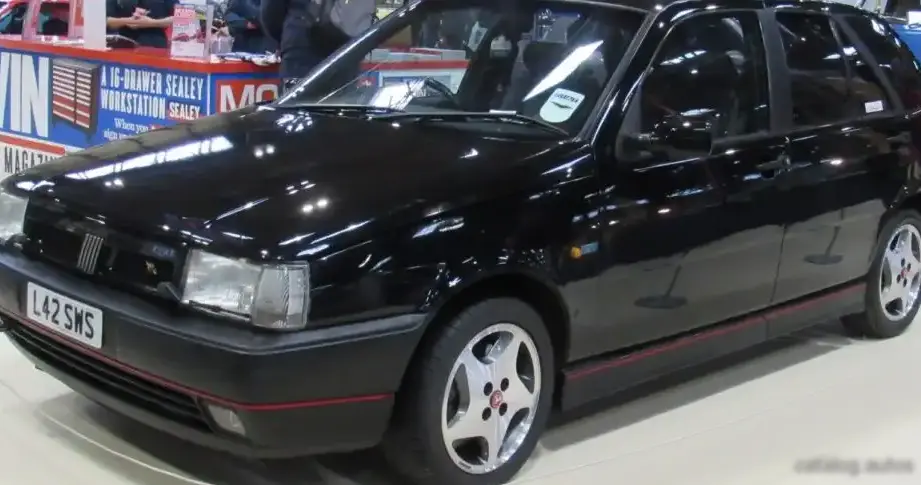
The Fiat Tipo (160) 1.1, designated internally as 160.AA and producing 56 horsepower, was an entry-level variant of the Tipo range produced between 1988 and 1991. Positioned as the most affordable option in the Tipo lineup, it aimed to provide economical transportation for budget-conscious buyers. The Tipo (160) itself represented a significant step forward for Fiat, replacing the aging Ritmo and Regata models. It was built on the Tipo project’s new platform, internally known as the Type 2, and offered a more modern design and improved mechanicals compared to its predecessors. The 1.1-liter version was particularly important in markets where smaller displacement engines were favored due to tax regulations and fuel economy concerns.
Technical Specifications
| Brand | Fiat |
| Model | Tipo |
| Generation | Tipo (160) |
| Type (Engine) | 1.1 (160.AA) (56 Hp) |
| Start of production | 1988 |
| End of production | 1991 |
| Powertrain Architecture | Internal Combustion engine |
| Body type | Hatchback |
| Seats | 5 |
| Doors | 3-5 |
| Fuel consumption (urban) | 7.7 l/100 km (30.5 US mpg) |
| Fuel consumption (extra urban) | 4.9 l/100 km (48 US mpg) |
| Fuel consumption (combined) | 6.7 l/100 km (35.1 US mpg) |
| Fuel Type | Petrol (Gasoline) |
| Acceleration 0 – 100 km/h | 17.2 sec |
| Acceleration 0 – 62 mph | 17.2 sec |
| Acceleration 0 – 60 mph | 16.3 sec |
| Maximum speed | 150 km/h (93.21 mph) |
| Weight-to-power ratio | 16.2 kg/Hp |
| Weight-to-torque ratio | 10.2 kg/Nm |
| Power | 56 Hp @ 5500 rpm |
| Power per litre | 50.5 Hp/l |
| Torque | 89 Nm @ 2900 rpm (65.64 lb.-ft. @ 2900 rpm) |
| Engine layout | Front, Transverse |
| Engine Model/Code | 160 A3.000 |
| Engine displacement | 1108 cm3 (67.61 cu. in.) |
| Number of cylinders | 4 |
| Engine configuration | Inline |
| Cylinder Bore | 70 mm (2.76 in.) |
| Piston Stroke | 72 mm (2.83 in.) |
| Compression ratio | 9.6:1 |
| Number of valves per cylinder | 2 |
| Fuel injection system | Carburettor |
| Engine aspiration | Naturally aspirated engine |
| Valvetrain | OHC |
| Engine oil capacity | 3.7 l (3.91 US qt | 3.26 UK qt) |
| Coolant capacity | 5.5 l (5.81 US qt | 4.84 UK qt) |
| Kerb Weight | 905 kg (1995.18 lbs.) |
| Trunk (boot) space – minimum | 350 l (12.36 cu. ft.) |
| Trunk (boot) space – maximum | 710 l (25.07 cu. ft.) |
| Fuel tank capacity | 48 l (12.68 US gal | 10.56 UK gal) |
| Length | 3958 mm (155.83 in.) |
| Width | 1700 mm (66.93 in.) |
| Height | 1450 mm (57.09 in.) |
| Wheelbase | 2540 mm (100 in.) |
| Front track | 1429 mm (56.26 in.) |
| Rear track | 1415 mm (55.71 in.) |
| Drivetrain Architecture | Front wheel drive |
| Number of gears | 5 gears, manual transmission |
| Front suspension | Spring Strut |
| Rear suspension | Coil spring |
| Front brakes | Disc |
| Rear brakes | Drum |
| Assisting systems | ABS (Anti-lock braking system) |
| Steering type | Steering rack and pinion |
| Tires size | 165/70 R13 |
Powertrain & Engine Architecture
The heart of the Tipo 1.1 was the 160 A3.000 engine, a 1108cc inline-four cylinder unit. This engine utilized a single overhead camshaft (OHC) design and was equipped with a carburetor for fuel delivery – a relatively common setup for the time, particularly in lower-priced vehicles. The carburetor system, while simpler and cheaper than fuel injection, resulted in slightly lower fuel efficiency and less precise control over the air-fuel mixture. The engine produced 56 horsepower at 5500 rpm and 89 Nm (65.64 lb-ft) of torque at 2900 rpm. The engine’s relatively low output was a consequence of its small displacement and the limitations of the carbureted fuel system. The engine was transversely mounted in the front of the vehicle, driving the front wheels. The transmission was a standard five-speed manual gearbox, chosen to maximize fuel economy and provide adequate performance for the intended market segment.
Driving Characteristics
The Tipo 1.1’s driving experience was characterized by its modest performance. Acceleration was slow, taking approximately 17.2 seconds to reach 62 mph (100 km/h). Top speed was limited to around 93 mph (150 km/h). The 5-speed manual transmission helped to keep the engine in its optimal power band, but the lack of overall power meant that overtaking maneuvers required careful planning. Compared to higher-spec Tipo models, such as the 1.6 or 2.0-liter versions, the 1.1 felt significantly underpowered. However, the light weight of the vehicle (around 905 kg or 1995 lbs) helped to mitigate some of the performance deficit. The steering was light and responsive, making the car easy to maneuver in urban environments. The suspension provided a comfortable ride, although it could feel somewhat soft and wallowy when pushed hard.
Equipment & Trim Levels
The Tipo 1.1 was typically offered with a basic level of equipment, reflecting its position as the entry-level model. Standard features generally included cloth upholstery, a basic instrument cluster, and manual windows and door locks. Power steering was often an optional extra, as were features like a radio and upgraded interior trim. The interior design was functional and straightforward, prioritizing practicality over luxury. The dashboard layout was clean and uncluttered, with easy-to-read gauges. The 3-door version was more common in some markets, offering a slightly sportier appearance and lower price point, while the 5-door version prioritized practicality and passenger space.
Chassis & Braking
The Tipo 1.1 utilized a relatively simple chassis design. The front suspension consisted of MacPherson strut coil springs, while the rear suspension employed a twist-beam axle with coil springs. This setup provided a good balance between ride comfort and handling. The braking system featured disc brakes on the front wheels and drum brakes on the rear wheels. ABS (Anti-lock Braking System) was available as an option, enhancing safety by preventing wheel lockup during hard braking. The steering system was a rack-and-pinion type, providing precise and responsive steering feel. Tire size was typically 165/70 R13.
Market Reception & Comparison
The Fiat Tipo 1.1 was generally well-received as an affordable and practical family car. Critics praised its spacious interior, comfortable ride, and reasonable fuel economy. However, the engine’s lack of power was a common criticism. Compared to other small hatchbacks of the time, such as the Volkswagen Golf or Ford Escort, the Tipo 1.1 offered a competitive price point but lacked the refinement and performance of its rivals. The 1.1-liter engine offered better fuel economy than the larger 1.6 and 2.0-liter engines in the Tipo range, making it a popular choice for drivers who prioritized running costs. However, the higher-spec models offered a more enjoyable driving experience and a greater level of equipment.
Legacy
The Fiat Tipo 1.1, while not known for its performance, proved to be a reliable and durable vehicle. The 160 A3.000 engine, despite its simplicity, was generally robust and capable of covering high mileages with proper maintenance. Today, the Tipo 1.1 is a relatively rare sight on the roads, but it remains a popular choice among classic Fiat enthusiasts. Parts availability can be a challenge, but many components are still available through specialist suppliers. The Tipo 1.1 represents a significant chapter in Fiat’s history, marking a move towards more modern and sophisticated vehicle designs. Its affordability and practicality made it a popular choice for families in the late 1980s and early 1990s, and it continues to be remembered as a dependable and economical car.
