
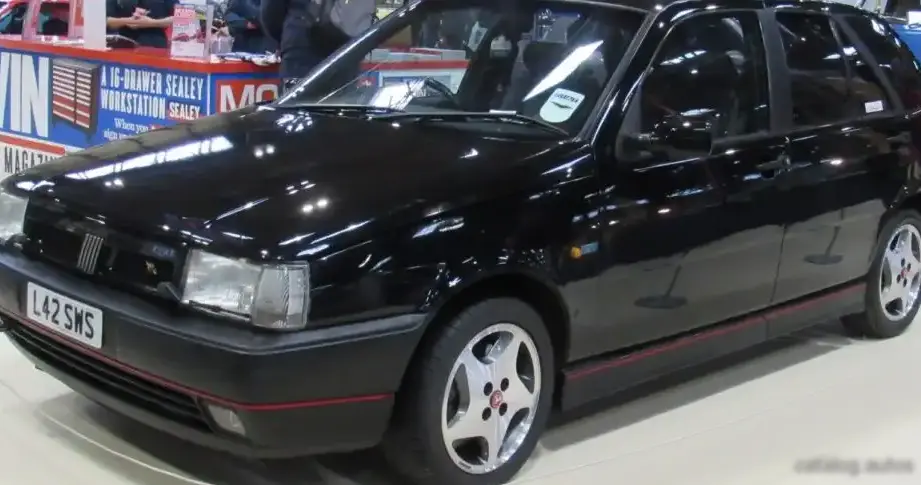
The Fiat Tipo (160) 1.4, producing 71 horsepower, was a mainstay of the Tipo range during its initial production run from 1987 to 1989. Positioned as the entry-level model, it offered affordable transportation within the broader Tipo family, which was Fiat’s replacement for the aging Ritmo. The Tipo (160) represented a significant step forward for Fiat in terms of design, engineering, and build quality, and quickly became a popular choice in the European C-segment. This particular 1.4-liter variant was designed to appeal to buyers prioritizing economy and practicality over outright performance.
Technical Specifications
| Brand | Fiat |
| Model | Tipo |
| Generation | Tipo (160) |
| Type (Engine) | 1.4 (71 Hp) |
| Start of production | 1987 |
| End of production | 1989 |
| Powertrain Architecture | Internal Combustion engine |
| Body type | Hatchback |
| Seats | 5 |
| Doors | 3-5 |
| Fuel consumption (urban) | 8.9 l/100 km (26.4 US mpg, 31.7 UK mpg, 11.2 km/l) |
| Fuel consumption (extra urban) | 5.4 l/100 km (43.6 US mpg, 52.3 UK mpg, 18.5 km/l) |
| Fuel consumption (combined) | 7.3 l/100 km (32.2 US mpg, 38.7 UK mpg, 13.7 km/l) |
| Fuel Type | Petrol (Gasoline) |
| Acceleration 0 – 100 km/h | 12.6 sec |
| Acceleration 0 – 62 mph | 12.6 sec |
| Acceleration 0 – 60 mph | 12 sec |
| Maximum speed | 161 km/h (100.04 mph) |
| Weight-to-power ratio | 16 kg/Hp, 62.6 Hp/tonne |
| Weight-to-torque ratio | 10.5 kg/Nm, 95.2 Nm/tonne |
| Power | 71 Hp @ 6000 rpm |
| Power per litre | 51.7 Hp/l |
| Torque | 108 Nm @ 3000 rpm (79.66 lb.-ft. @ 3000 rpm) |
| Engine layout | Front, Transverse |
| Engine Model/Code | 160 A1.048 |
| Engine displacement | 1372 cm3 (83.72 cu. in.) |
| Number of cylinders | 4 |
| Engine configuration | Inline |
| Cylinder Bore | 80.5 mm (3.17 in.) |
| Piston Stroke | 67.4 mm (2.65 in.) |
| Compression ratio | 9.2:1 |
| Number of valves per cylinder | 2 |
| Fuel injection system | Single-point injection |
| Engine aspiration | Naturally aspirated engine |
| Valvetrain | OHC |
| Engine oil capacity | 3.7 l (3.91 US qt | 3.26 UK qt) |
| Coolant | 5.5 l (5.81 US qt | 4.84 UK qt) |
| Kerb Weight | 1134 kg (2500.04 lbs.) |
| Max. weight | 1650 kg (3637.63 lbs.) |
| Max load | 516 kg (1137.59 lbs.) |
| Trunk (boot) space – minimum | 350 l (12.36 cu. ft.) |
| Trunk (boot) space – maximum | 710 l (25.07 cu. ft.) |
| Fuel tank capacity | 48 l (12.68 US gal | 10.56 UK gal) |
| Length | 3958 mm (155.83 in.) |
| Width | 1700 mm (66.93 in.) |
| Height | 1450 mm (57.09 in.) |
| Wheelbase | 2540 mm (100 in.) |
| Front track | 1429 mm (56.26 in.) |
| Rear (Back) track | 1415 mm (55.71 in.) |
| Drivetrain Architecture | The Internal combustion engine (ICE) drives the front wheels of the vehicle. |
| Drive wheel | Front wheel drive |
| Number of gears and type of gearbox | 5 gears, manual transmission |
| Front suspension | Spring Strut |
| Rear suspension | Coil spring |
| Front brakes | Disc |
| Rear brakes | Drum |
| Assisting systems | ABS (Anti-lock braking system) |
| Steering type | Steering rack and pinion |
| Tires size | 165/70 R13 |
Powertrain & Engine Architecture
The Fiat Tipo 1.4 was powered by the 160 A1.048 engine, a 1372cc inline-four cylinder unit. This engine featured a single overhead camshaft (OHC) and utilized single-point fuel injection, a relatively common technology for the time. The engine produced 71 horsepower at 6000 rpm and 108 Nm (79.66 lb-ft) of torque at 3000 rpm. The engine’s design prioritized fuel efficiency and reliability over high performance. The five-speed manual transmission was the standard offering, providing a reasonable spread of gears for everyday driving. The engine’s transverse mounting and front-wheel-drive configuration were typical for European hatchbacks of the era, maximizing interior space and improving packaging.
Driving Characteristics
The 1.4-liter Tipo was not a particularly quick car, with a 0-60 mph time of around 12 seconds and a top speed of 100 mph. However, it offered adequate performance for urban and highway driving. The engine felt somewhat strained when pushed hard, and acceleration was noticeably slower compared to the higher-powered 1.6 and 2.0-liter versions. The five-speed gearbox was well-matched to the engine’s characteristics, providing smooth shifts and allowing the driver to keep the engine in its optimal power band. The steering was light and precise, making the car easy to maneuver in tight spaces. Overall, the driving experience was comfortable and predictable, but lacked the excitement of more powerful variants.
Equipment & Trim Levels
The 1.4-liter Tipo typically came with a basic level of equipment. Standard features included cloth upholstery, a basic instrument cluster, and manual windows and door locks. Power steering was often an optional extra. The interior was functional and durable, but lacked the refinement of more expensive models. Optional extras included a sunroof, upgraded stereo system, and central locking. The trim level was generally considered the entry point to the Tipo range, appealing to budget-conscious buyers.
Chassis & Braking
The Tipo 1.4 featured a relatively simple chassis design. The front suspension utilized MacPherson struts, while the rear suspension employed a coil spring setup. The brakes were discs on the front wheels and drums on the rear, providing adequate stopping power for the car’s weight and performance. ABS (Anti-lock Braking System) was available as an option, enhancing safety in emergency braking situations. The suspension was tuned for comfort, providing a smooth ride over most road surfaces. The car’s relatively light weight contributed to its nimble handling characteristics.
Market Reception & Comparison
The Fiat Tipo 1.4 was generally well-received by critics as an affordable and practical family car. It was praised for its spacious interior, comfortable ride, and fuel efficiency. However, it was also criticized for its lack of power and somewhat basic interior. Compared to the 1.6 and 2.0-liter versions, the 1.4 offered significantly less performance but at a lower price point. The 1.4 also offered better fuel economy than the larger-engined models, making it an attractive option for drivers who prioritized running costs. Against competitors like the Volkswagen Golf and Ford Escort, the Tipo 1.4 offered a compelling value proposition.
Legacy
The Fiat Tipo 1.4, while not the most exciting variant in the range, proved to be a reliable and durable car. The 160 A1.048 engine is known for its longevity, and many examples are still on the road today. The Tipo’s simple design and readily available parts make it relatively easy to maintain. In the used car market, the 1.4-liter model remains an affordable option for those seeking a classic European hatchback. Its fuel efficiency and practicality continue to appeal to budget-conscious buyers, ensuring its place as a significant part of Fiat’s history.
