
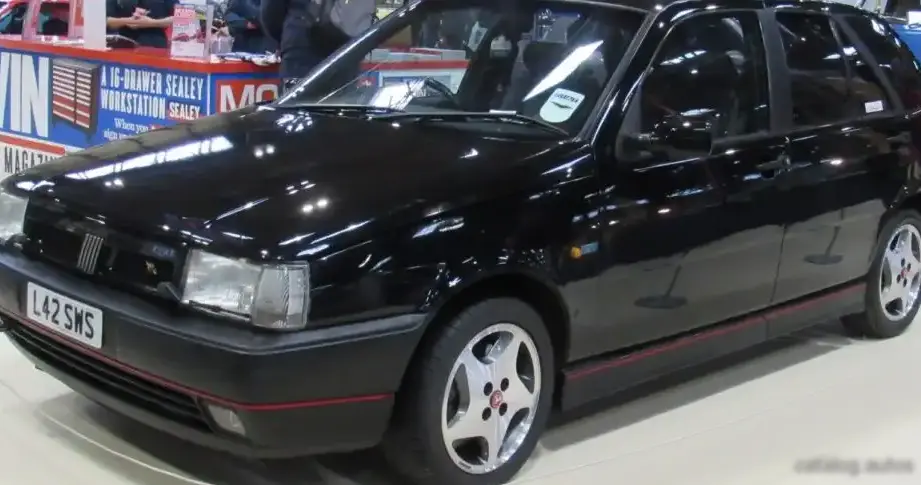
The Fiat Tipo 1.6 i.e., produced between 1992 and 1995, represented an entry-level offering within the Tipo (160) range. Positioned as a practical and affordable family car, it was a key component of Fiat’s strategy to offer a modern, spacious, and well-equipped vehicle to the European market. The Tipo, designed by I.De.A Torino, aimed to replace the aging Fiat Ritmo and Uno, offering a significant step up in terms of size, comfort, and technology. The 1.6 i.e. variant, designated with chassis codes 160.A1, 160.EC, and 160.EB, was primarily aimed at buyers prioritizing economy and usability over outright performance. It was available in both 3-door and 5-door hatchback configurations.
Technical Specifications
| Brand | Fiat |
| Model | Tipo |
| Generation | Tipo (160) |
| Type (Engine) | 1.6 i.e. (160.A1,160.EC,160.EB (75 Hp) |
| Start of production | 1992 |
| End of production | 1995 |
| Powertrain Architecture | Internal Combustion engine |
| Body type | Hatchback |
| Seats | 5 |
| Doors | 3-5 |
| Fuel consumption (combined) | 8.1 l/100 km (29 US mpg, 34.9 UK mpg, 12.3 km/l) |
| Fuel Type | Petrol (Gasoline) |
| Acceleration 0 – 100 km/h | 12.4 sec |
| Acceleration 0 – 62 mph | 12.4 sec |
| Acceleration 0 – 60 mph | 11.8 sec |
| Maximum speed | 170 km/h (105.63 mph) |
| Weight-to-power ratio | 13.8 kg/Hp, 72.5 Hp/tonne |
| Weight-to-torque ratio | 8.3 kg/Nm, 120.9 Nm/tonne |
| Power | 75 Hp @ 6000 rpm |
| Power per litre | 47.4 Hp/l |
| Torque | 125 Nm @ 3000 rpm (92.2 lb.-ft. @ 3000 rpm) |
| Engine layout | Front, Transverse |
| Engine Model/Code | 159 A3.048 |
| Engine displacement | 1581 cm3 (96.48 cu. in.) |
| Number of cylinders | 4 |
| Engine configuration | Inline |
| Cylinder Bore | 86.4 mm (3.4 in.) |
| Piston Stroke | 67.4 mm (2.65 in.) |
| Compression ratio | 9.2:1 |
| Number of valves per cylinder | 2 |
| Fuel injection system | Single-point injection |
| Engine aspiration | Naturally aspirated engine |
| Valvetrain | OHC |
| Engine oil capacity | 3.7 l (3.91 US qt | 3.26 UK qt) |
| Coolant | 6.5 l (6.87 US qt | 5.72 UK qt) |
| Kerb Weight | 1034 kg (2279.58 lbs.) |
| Max. weight | 1550 kg (3417.17 lbs.) |
| Max load | 516 kg (1137.59 lbs.) |
| Trunk (boot) space – minimum | 350 l (12.36 cu. ft.) |
| Trunk (boot) space – maximum | 710 l (25.07 cu. ft.) |
| Fuel tank capacity | 48 l (12.68 US gal | 10.56 UK gal) |
| Length | 3958 mm (155.83 in.) |
| Width | 1700 mm (66.93 in.) |
| Height | 1450 mm (57.09 in.) |
| Wheelbase | 2540 mm (100 in.) |
| Front track | 1418 mm (55.83 in.) |
| Rear (Back) track | 1415 mm (55.71 in.) |
| Drivetrain Architecture | The Internal combustion engine (ICE) drives the front wheels of the vehicle. |
| Drive wheel | Front wheel drive |
| Number of gears and type of gearbox | 5 gears, manual transmission |
| Front suspension | Spring Strut |
| Rear suspension | Coil spring |
| Front brakes | Disc |
| Rear brakes | Disc |
| Assisting systems | ABS (Anti-lock braking system) |
| Steering type | Steering rack and pinion |
| Power steering | Hydraulic Steering |
| Tires size | 165/65 R14 S |
Powertrain & Engine Architecture
The Fiat Tipo 1.6 i.e. was powered by the 159 A3.048 engine, a 1.6-liter inline-four cylinder gasoline engine. This engine was a relatively simple design, utilizing a single overhead camshaft (OHC) and two valves per cylinder. The engine employed a Bosch Mono-Motronic single-point fuel injection system, which was a cost-effective solution for the time, but less sophisticated than multi-point injection systems found in higher-spec Tipo models. This system injected fuel into a common manifold before the intake valves. The engine produced 75 horsepower at 6000 rpm and 125 Nm (92.2 lb-ft) of torque at 3000 rpm. The engine’s relatively low compression ratio of 9.2:1 contributed to its ability to run on lower octane fuel, common in many European markets. The engine was transversely mounted, driving the front wheels. The standard transmission was a five-speed manual gearbox, offering a fairly conventional gear ratio spread designed for fuel efficiency and everyday usability.
Driving Characteristics
The 1.6 i.e. Tipo offered modest performance. Acceleration from 0 to 60 mph took around 11.8 seconds, and top speed was approximately 105.63 mph. Compared to the more powerful 1.8 and 2.0-liter versions, or even the diesel variants, the 1.6 i.e. felt noticeably slower, particularly when fully loaded or tackling inclines. The five-speed manual transmission was well-matched to the engine’s characteristics, but required frequent downshifts to maintain momentum. The single-point fuel injection system resulted in slightly less refined throttle response compared to multi-point injection engines. However, the engine was generally reliable and provided adequate power for typical urban and highway driving. The suspension setup prioritized comfort over sporty handling, resulting in a relatively soft ride quality.
Equipment & Trim Levels
The 1.6 i.e. typically represented the base trim level for the Tipo. Standard equipment generally included power steering, central locking, and basic instrumentation. Interior upholstery was typically cloth, and the dashboard featured a simple, functional design. Optional extras included power windows, a sunroof, and upgraded audio systems. The 1.6 i.e. was often seen as a blank canvas for buyers who wanted to add options to suit their needs and budget. Higher trim levels, such as the 1.8 i.e. and 2.0 i.e., offered more luxurious interiors, additional features, and improved performance.
Chassis & Braking
The Tipo 1.6 i.e. utilized a MacPherson strut front suspension and a coil spring rear suspension. This setup provided a good balance between ride comfort and handling. Brakes were disc brakes on all four wheels, offering adequate stopping power for the vehicle’s weight and performance. An Anti-lock Braking System (ABS) was often included as standard equipment, enhancing safety. The steering was a rack and pinion system with hydraulic power assistance, providing light and precise steering feel. The 1.6 i.e. typically rode on 165/65 R14 tires, which contributed to the comfortable ride quality.
Market Reception & Comparison
The Fiat Tipo 1.6 i.e. was generally well-received as a practical and affordable family car. Critics praised its spacious interior, comfortable ride, and good value for money. However, the engine’s modest performance was often cited as a drawback. Compared to the 1.8 and 2.0-liter versions, the 1.6 i.e. offered lower running costs but less excitement. The diesel variants provided even better fuel economy but were slower still. The Tipo as a whole was a strong competitor in the European C-segment, challenging models like the Volkswagen Golf, Ford Escort, and Opel Astra.
Legacy
The Fiat Tipo 1.6 i.e. powertrain proved to be relatively reliable, with many examples still on the road today. The 159 A3.048 engine is known for its durability and ease of maintenance. However, like all older vehicles, they are susceptible to age-related issues such as corrosion and wear and tear on rubber components. In the used car market, the 1.6 i.e. Tipo remains an affordable option for those seeking a classic 1990s hatchback. Its simplicity and relatively low running costs make it an attractive choice for enthusiasts and budget-conscious buyers alike. While not the most powerful or refined version of the Tipo, the 1.6 i.e. represents a significant part of Fiat’s history and a testament to the brand’s commitment to providing practical and affordable transportation.
