
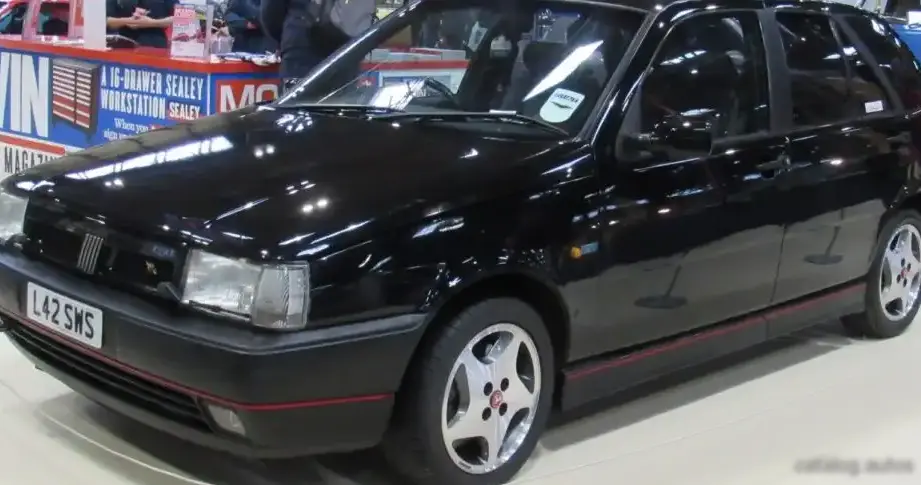
The Fiat Tipo (160) 1.8 i, produced between 1990 and 1993, represented a mid-range offering within the broader Tipo lineup. The Tipo, launched in 1988, was Fiat’s replacement for the aging Ritmo and Uno, aiming to provide a modern, spacious, and affordable family car. The 160 project, encompassing three and five-door hatchback, sedan, and station wagon body styles, was a significant undertaking for Fiat, and the 1.8 i variant occupied a position between the base 1.4-liter models and the more performance-oriented 2.0-liter versions. It was primarily marketed towards buyers seeking a balance of fuel efficiency and adequate power for everyday driving, particularly in European markets.
Technical Specifications
| Brand | Fiat |
| Model | Tipo |
| Generation | Tipo (160) |
| Type (Engine) | 1.8 i (107 Hp) |
| Start of production | 1990 |
| End of production | 1993 |
| Powertrain Architecture | Internal Combustion engine |
| Body type | Hatchback |
| Seats | 5 |
| Doors | 3-5 |
| Fuel consumption (urban) | 11 l/100 km (21.4 US mpg, 25.7 UK mpg, 9.1 km/l) |
| Fuel consumption (extra urban) | 6.9 l/100 km (34.1 US mpg, 40.9 UK mpg, 14.5 km/l) |
| Fuel consumption (combined) | 8.5 l/100 km (27.7 US mpg, 33.2 UK mpg, 11.8 km/l) |
| Fuel Type | Petrol (Gasoline) |
| Acceleration 0 – 100 km/h | 12 sec |
| Acceleration 0 – 62 mph | 12 sec |
| Acceleration 0 – 60 mph | 11.4 sec |
| Maximum speed | 183 km/h (113.71 mph) |
| Weight-to-power ratio | 10.3 kg/Hp, 97.3 Hp/tonne |
| Weight-to-torque ratio | 7.9 kg/Nm, 127.3 Nm/tonne |
| Power | 107 Hp @ 6000 rpm |
| Power per litre | 60.9 Hp/l |
| Torque | 140 Nm @ 3000 rpm (103.26 lb.-ft. @ 3000 rpm) |
| Engine layout | Front, Transverse |
| Engine Model/Code | 159 A4.000 |
| Engine displacement | 1756 cm3 (107.16 cu. in.) |
| Number of cylinders | 4 |
| Engine configuration | Inline |
| Cylinder Bore | 84 mm (3.31 in.) |
| Piston Stroke | 79.2 mm (3.12 in.) |
| Compression ratio | 9.5:1 |
| Number of valves per cylinder | 2 |
| Fuel injection system | Multi-port manifold injection |
| Engine aspiration | Naturally aspirated engine |
| Engine oil capacity | 5.2 l (5.49 US qt | 4.58 UK qt) |
| Coolant capacity | 6.9 l (7.29 US qt | 6.07 UK qt) |
| Kerb Weight | 1100 kg (2425.08 lbs.) |
| Max. weight | 1600 kg (3527.4 lbs.) |
| Max load | 500 kg (1102.31 lbs.) |
| Trunk (boot) space – minimum | 350 l (12.36 cu. ft.) |
| Trunk (boot) space – maximum | 710 l (25.07 cu. ft.) |
| Fuel tank capacity | 48 l (12.68 US gal | 10.56 UK gal) |
| Length | 3958 mm (155.83 in.) |
| Width | 1700 mm (66.93 in.) |
| Height | 1450 mm (57.09 in.) |
| Wheelbase | 2540 mm (100 in.) |
| Front track | 1429 mm (56.26 in.) |
| Rear track | 1415 mm (55.71 in.) |
| Drivetrain Architecture | Front wheel drive |
| Number of gears | 5 |
| Gearbox type | Manual transmission |
| Front suspension | Spring Strut |
| Rear suspension | Coil spring |
| Front brakes | Disc |
| Rear brakes | Drum |
| Assisting systems | ABS (Anti-lock braking system) |
| Steering type | Steering rack and pinion |
| Tires size | 185/60 R14 |
Powertrain & Engine Architecture
The Fiat Tipo 1.8 i utilized the 159 A4.000 engine, a 1756 cc inline-four cylinder gasoline engine. This engine was a relatively conventional design for the time, featuring a cast iron block and an aluminum cylinder head. It employed a multi-port fuel injection system, which improved fuel atomization and efficiency compared to earlier carburetor-based systems. The engine boasted two valves per cylinder, operated by a single overhead camshaft. The 1.8-liter engine produced 107 horsepower at 6000 rpm and 140 Nm (103 lb-ft) of torque at 3000 rpm. The engine was transversely mounted, driving the front wheels. The transmission was a five-speed manual gearbox, offering a balance between fuel economy and driver control. While an automatic transmission was available on some Tipo models, it was less common with the 1.8-liter engine.
Driving Characteristics
The 1.8 i Tipo offered a noticeable step up in performance compared to the 1.4-liter models. Acceleration from 0 to 60 mph took around 11.4 seconds, and it could achieve a top speed of approximately 114 mph. While not a sports car, the 1.8-liter engine provided sufficient power for comfortable highway cruising and overtaking. The five-speed manual transmission allowed drivers to keep the engine in its optimal power band. Compared to the more powerful 2.0-liter versions, the 1.8 i felt less strained at higher speeds, and the power delivery was more linear. The gear ratios were tuned for a balance of acceleration and fuel economy, making it a practical choice for daily commuting.
Equipment & Trim Levels
The 1.8 i Tipo typically came equipped with features such as power steering, central locking, and electric front windows. Interior upholstery was generally cloth, with a simple and functional dashboard layout. Optional extras included air conditioning, a sunroof, and upgraded audio systems. Trim levels varied depending on the market, but the 1.8 i generally sat in the mid-range of the Tipo lineup, offering a good balance of features and affordability. The interior plastics were durable but not particularly luxurious, reflecting the car’s focus on practicality and value.
Chassis & Braking
The Tipo 1.8 i featured a MacPherson strut front suspension and a coil spring rear suspension. This setup provided a comfortable ride quality, although it wasn’t particularly sporty. The front brakes were ventilated discs, while the rear brakes were drums. ABS (Anti-lock Braking System) was available as an option, enhancing safety. The steering was a rack and pinion system, providing precise and responsive handling. The car’s relatively light weight (around 2425 lbs) contributed to its nimble handling characteristics.
Market Reception & Comparison
The Fiat Tipo 1.8 i was generally well-received by automotive critics as a practical and affordable family car. It was praised for its spacious interior, comfortable ride, and decent performance. However, some critics noted that the interior materials were somewhat basic and that the handling wasn’t as sharp as some of its competitors. Compared to the 1.4-liter models, the 1.8 i offered a significant improvement in performance, while remaining relatively fuel-efficient. Compared to the 2.0-liter versions, it offered a more balanced driving experience, with less emphasis on outright speed. The 1.8 i represented a sweet spot in the Tipo lineup for buyers seeking a versatile and reliable family car.
Legacy
The Fiat Tipo 160, including the 1.8 i variant, enjoyed a relatively good reputation for reliability. The 159 A4.000 engine is known to be durable and relatively easy to maintain. Today, the Tipo 1.8 i is a relatively rare sight on the roads, but well-maintained examples are sought after by classic car enthusiasts. Parts availability can be a challenge, but many components are still available through specialist suppliers. The Tipo’s simple mechanical design makes it a relatively straightforward car to work on for DIY mechanics. The 1.8 i variant remains a testament to Fiat’s ability to produce affordable and practical family cars that stood the test of time.
