
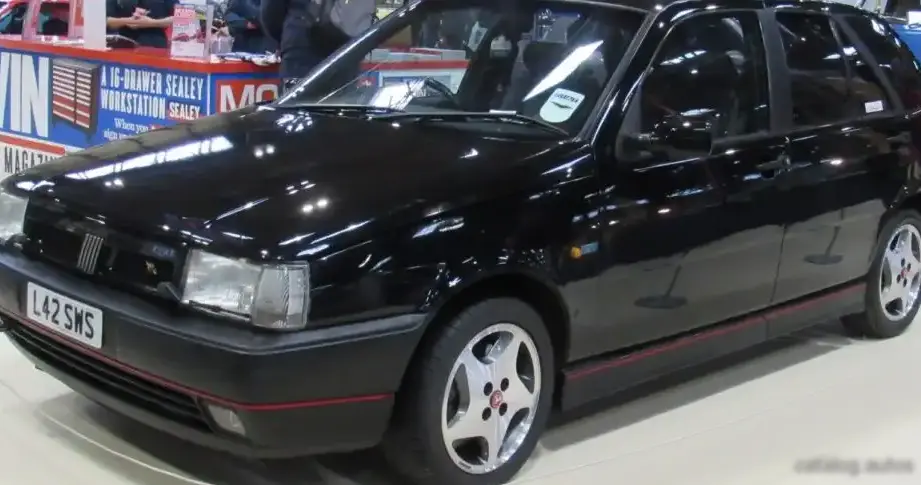
The Fiat Tipo 1.8 i.e. (90 Hp) was a variant of the Tipo (160) series produced between 1993 and 1995. Positioned as a mid-range offering within the Tipo lineup, it aimed to provide a balance between performance and affordability. The Tipo (160) itself was a significant model for Fiat, representing a move towards more modern design and engineering, and competing in the crowded European small family car segment. This particular 1.8-liter engine and automatic transmission combination offered a more relaxed driving experience compared to the base models, appealing to buyers prioritizing comfort over outright speed. It was a key part of Fiat’s strategy to offer a diverse range of options within the Tipo family, catering to a broad spectrum of customer needs.
Technical Specifications
| Brand | Fiat |
| Model | Tipo |
| Generation | Tipo (160) |
| Type (Engine) | 1.8 i.e. (90 Hp) |
| Start of production | 1993 |
| End of production | 1995 |
| Powertrain Architecture | Internal Combustion engine |
| Body type | Hatchback |
| Seats | 5 |
| Doors | 3 |
| Fuel consumption (combined) | 8.8 l/100 km |
| Fuel consumption (US mpg) | 26.7 US mpg |
| Fuel consumption (UK mpg) | 32.1 UK mpg |
| Fuel consumption (km/l) | 11.4 km/l |
| Fuel Type | Petrol (Gasoline) |
| Acceleration 0 – 100 km/h | 12.6 sec |
| Acceleration 0 – 62 mph | 12.6 sec |
| Acceleration 0 – 60 mph | 12 sec |
| Maximum speed | 178 km/h (110.6 mph) |
| Weight-to-power ratio | 12.6 kg/Hp |
| Weight-to-torque ratio | 8.9 kg/Nm |
| Power | 90 Hp @ 6000 rpm |
| Power per litre | 51.3 Hp/l |
| Torque | 128 Nm @ 3250 rpm (94.41 lb.-ft. @ 3250 rpm) |
| Engine layout | Front, Transverse |
| Engine Model/Code | 149 C2.046 |
| Engine displacement | 1756 cm3 (107.16 cu. in.) |
| Number of cylinders | 4 |
| Engine configuration | Inline |
| Cylinder Bore | 84 mm (3.31 in.) |
| Piston Stroke | 79.2 mm (3.12 in.) |
| Compression ratio | 9.5:1 |
| Number of valves per cylinder | 2 |
| Fuel injection system | Multi-port manifold injection |
| Engine aspiration | Naturally aspirated engine |
| Valvetrain | DOHC |
| Engine oil capacity | 5.2 l (5.49 US qt | 4.58 UK qt) |
| Coolant capacity | 6.9 l (7.29 US qt | 6.07 UK qt) |
| Kerb Weight | 1134 kg (2500.04 lbs.) |
| Max. weight | 1650 kg (3637.63 lbs.) |
| Max load | 516 kg (1137.59 lbs.) |
| Trunk (boot) space – minimum | 350 l (12.36 cu. ft.) |
| Trunk (boot) space – maximum | 710 l (25.07 cu. ft.) |
| Fuel tank capacity | 48 l (12.68 US gal | 10.56 UK gal) |
| Length | 3958 mm (155.83 in.) |
| Width | 1700 mm (66.93 in.) |
| Height | 1450 mm (57.09 in.) |
| Wheelbase | 2540 mm (100 in.) |
| Front track | 1429 mm (56.26 in.) |
| Rear (Back) track | 1415 mm (55.71 in.) |
| Drivetrain Architecture | The Internal combustion engine (ICE) drives the front wheels of the vehicle. |
| Drive wheel | Front wheel drive |
| Number of gears and type of gearbox | 5 gears, manual transmission |
| Front suspension | Spring Strut |
| Rear suspension | Coil spring |
| Front brakes | Disc |
| Rear brakes | Disc |
| Assisting systems | ABS (Anti-lock braking system) |
| Steering type | Steering rack and pinion |
| Power steering | Hydraulic Steering |
| Tires size | 185/60 R14 T |
INTRODUCTION
The Fiat Tipo 1.8 i.e. (90 Hp) was produced as part of the Tipo (160) series from 1993 to 1995. The Tipo range, launched in 1988, was Fiat’s replacement for the aging Uno and Ritmo models, and represented a significant step forward in terms of design, space, and technology. The 160 project aimed to create a modern, versatile, and affordable family car. The 1.8 i.e. variant, with its larger engine, was positioned as a step up from the base 1.4 and 1.6-liter models, offering improved performance and a more refined driving experience. It was primarily sold in European markets, where compact hatchbacks were – and remain – a popular choice.
Powertrain & Engine Architecture
The heart of the Tipo 1.8 i.e. is the 149 C2.046 engine, a 1.8-liter inline-four cylinder gasoline engine. This engine featured a dual overhead camshaft (DOHC) valvetrain with two valves per cylinder. It utilized a multi-port fuel injection system, which improved fuel atomization and combustion efficiency compared to earlier carburetor-based systems. The engine produced 90 horsepower at 6000 rpm and 128 Nm (94.41 lb-ft) of torque at 3250 rpm. The engine’s design prioritized reliability and ease of maintenance. The 5-speed manual transmission was the standard offering, designed to efficiently transfer power to the front wheels. The transmission’s gear ratios were tuned to provide a balance between acceleration and fuel economy, although the automatic transmission option altered this balance somewhat.
Driving Characteristics
The Tipo 1.8 i.e. offered a noticeable improvement in performance over the lower-displacement models. While not a sports car, the 90 hp engine provided adequate power for everyday driving and comfortable highway cruising. Acceleration from 0 to 100 km/h (0-62 mph) took approximately 12.6 seconds, and the top speed was around 178 km/h (110.6 mph). The automatic transmission, while offering convenience, did slightly diminish the car’s responsiveness compared to the manual version. Gear changes were not particularly quick, and some power was lost through the torque converter. However, it made the Tipo more accessible to drivers who preferred the ease of an automatic gearbox, particularly in urban environments. The suspension provided a comfortable ride, absorbing bumps and imperfections in the road reasonably well.
Equipment & Trim Levels
The Tipo 1.8 i.e. typically came equipped with a reasonable level of standard features for its time. These included power steering, central locking, electric front windows, and an adjustable steering column. Interior upholstery was typically cloth, with a relatively simple but functional dashboard layout. Optional extras included air conditioning, a sunroof, and upgraded audio systems. The trim level often dictated the quality of the interior materials and the availability of additional features. Higher trim levels might have included features like alloy wheels and a more comprehensive instrument cluster.
Chassis & Braking
The Tipo (160) utilized a front-engine, front-wheel-drive layout. The front suspension consisted of a MacPherson strut setup, while the rear suspension employed a coil spring arrangement. This configuration provided a good balance between ride comfort and handling. The braking system featured disc brakes on all four wheels, providing adequate stopping power for the vehicle’s weight and performance. An Anti-lock Braking System (ABS) was often included as standard equipment, enhancing safety by preventing wheel lockup during hard braking. The steering was a rack and pinion system, offering precise and responsive steering feel.
Market Reception & Comparison
The Fiat Tipo 1.8 i.e. was generally well-received by automotive critics as a practical and affordable family car. It was praised for its spacious interior, comfortable ride, and relatively good fuel economy. However, some critics noted that the automatic transmission could feel sluggish, and the interior materials were not as refined as those found in some of its competitors. Compared to the 1.4 and 1.6-liter versions, the 1.8 i.e. offered a noticeable performance boost, making it a more appealing option for drivers who frequently traveled on highways or carried passengers and luggage. Compared to rivals like the Volkswagen Golf or Ford Escort, the Tipo offered a competitive price point and a generous amount of interior space.
Legacy
The Fiat Tipo (160) 1.8 i.e. has proven to be a relatively reliable vehicle over the long term, particularly the engine itself. The 149 C2.046 engine is known for its durability and relatively simple construction, making it easier and more affordable to maintain. Today, the Tipo (160) is a popular choice among classic car enthusiasts and collectors, particularly well-maintained examples. Parts availability is generally good, and the car’s relatively simple mechanical design makes it a suitable project for home mechanics. While not a particularly rare or valuable classic, the Tipo 1.8 i.e. represents a significant chapter in Fiat’s history and remains a fondly remembered family car from the 1990s.
