
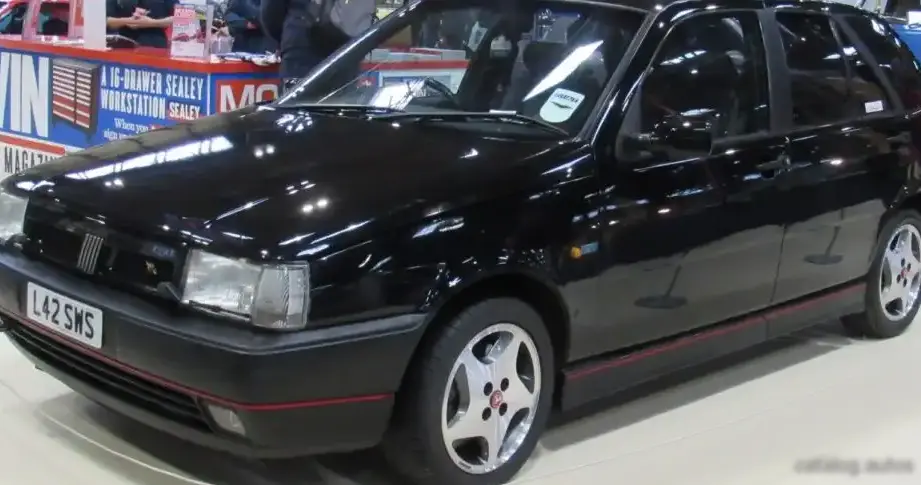
The Fiat Tipo (160) 1.9 TD, produced from 1992 to 1993, represented a practical and economical offering within the Tipo range. Positioned as a diesel-powered variant, it catered to buyers prioritizing fuel efficiency and durability over outright performance. This model occupied a middle ground in the Tipo lineup, slotting below the more powerful gasoline engines and above the base-level diesel options. It was primarily sold in European markets, where diesel engines enjoyed significant popularity due to favorable taxation and fuel costs. The Tipo (160) itself was a significant model for Fiat, representing a move towards more modern design and engineering compared to its predecessors.
Technical Specifications
| Brand | Fiat |
| Model | Tipo |
| Generation | Tipo (160) |
| Type (Engine) | 1.9 TD (82 Hp) |
| Start of production | 1992 |
| End of production | 1993 |
| Powertrain Architecture | Internal Combustion engine |
| Body type | Hatchback |
| Seats | 5 |
| Doors | 3-5 |
| Fuel consumption (urban) | 7 l/100 km (33.6 US mpg, 40.4 UK mpg, 14.3 km/l) |
| Fuel consumption (extra urban) | 5.3 l/100 km (44.4 US mpg, 53.3 UK mpg, 18.9 km/l) |
| Fuel consumption (combined) | 7 l/100 km (33.6 US mpg, 40.4 UK mpg, 14.3 km/l) |
| Fuel Type | Diesel |
| Acceleration 0 – 100 km/h | 14 sec |
| Acceleration 0 – 62 mph | 14 sec |
| Acceleration 0 – 60 mph | 13.3 sec |
| Maximum speed | 168 km/h (104.39 mph) |
| Weight-to-power ratio | 12.9 kg/Hp, 77.4 Hp/tonne |
| Weight-to-torque ratio | 6.1 kg/Nm, 163.2 Nm/tonne |
| Power | 82 Hp @ 4000 rpm |
| Power per litre | 42.5 Hp/l |
| Torque | 173 Nm @ 2800 rpm (127.6 lb.-ft. @ 2800 rpm) |
| Engine layout | Front, Transverse |
| Engine Model/Code | 160 B6.046 |
| Engine displacement | 1929 cm3 (117.71 cu. in.) |
| Number of cylinders | 4 |
| Engine configuration | Inline |
| Cylinder Bore | 82.6 mm (3.25 in.) |
| Piston Stroke | 90 mm (3.54 in.) |
| Compression ratio | 19.2:1 |
| Number of valves per cylinder | 2 |
| Fuel injection system | Precombustion chamber injection |
| Engine aspiration | Turbocharger |
| Engine oil capacity | 5 l (5.28 US qt | 4.4 UK qt) |
| Coolant capacity | 8.8 l (9.3 US qt | 7.74 UK qt) |
| Kerb Weight | 1060 kg (2336.9 lbs.) |
| Max. weight | 1590 kg (3505.35 lbs.) |
| Max load | 530 kg (1168.45 lbs.) |
| Trunk (boot) space – minimum | 350 l (12.36 cu. ft.) |
| Trunk (boot) space – maximum | 710 l (25.07 cu. ft.) |
| Fuel tank capacity | 48 l (12.68 US gal | 10.56 UK gal) |
| Length | 3958 mm (155.83 in.) |
| Width | 1700 mm (66.93 in.) |
| Height | 1450 mm (57.09 in.) |
| Wheelbase | 2540 mm (100 in.) |
| Front track | 1429 mm (56.26 in.) |
| Rear track | 1415 mm (55.71 in.) |
| Drivetrain Architecture | Front wheel drive |
| Number of gears | 5 |
| Gearbox type | Manual transmission |
| Front suspension | Spring Strut |
| Rear suspension | Coil spring |
| Front brakes | Disc |
| Rear brakes | Drum |
| Assisting systems | ABS (Anti-lock braking system) |
| Steering type | Steering rack and pinion |
| Tires size | 175/65 R14 |
Powertrain & Engine Architecture
The heart of the Tipo 1.9 TD was the 160 B6.046 engine, a 1929cc inline-four cylinder diesel. This engine utilized a precombustion chamber injection system, a common technology for diesel engines of the era. This system involved injecting fuel into a small precombustion chamber within the cylinder head, where it ignited and then ignited the main charge in the cylinder. The engine was turbocharged, which significantly boosted power output compared to naturally aspirated diesel engines. The turbocharger helped to overcome the inherent limitations of diesel engines, providing increased torque and improved responsiveness. The five-speed manual transmission was the only gearbox option available with this engine, prioritizing fuel economy and simplicity. The engine produced 82 horsepower at 4000 rpm and 173 Nm (127.6 lb-ft) of torque at 2800 rpm.
Driving Characteristics
The 1.9 TD Tipo offered a distinctly different driving experience compared to its gasoline-powered siblings. While lacking the outright acceleration of the 1.6 or 2.0-liter petrol engines, it provided ample torque for everyday driving and highway cruising. The five-speed manual transmission allowed drivers to keep the engine in its optimal power band. Acceleration to 60 mph took around 13.3 seconds, and top speed was approximately 104 mph. The turbocharger provided a noticeable boost in power, but turbo lag was present, requiring drivers to downshift for quicker acceleration. The focus was on fuel efficiency and relaxed cruising rather than sporty performance. The gear ratios were tuned for economy, with a relatively long fifth gear for highway driving.
Equipment & Trim Levels
The 1.9 TD typically came with a modest level of equipment, reflecting its position as a value-oriented model. Standard features generally included power steering, central locking, and basic instrumentation. Interior upholstery was typically cloth, and the dashboard featured a functional, if somewhat basic, design. Optional extras included air conditioning, electric windows, and a radio/cassette player. Trim levels varied slightly depending on the market, but the 1.9 TD was generally positioned as a practical and affordable option, prioritizing functionality over luxury.
Chassis & Braking
The Tipo 1.9 TD utilized a relatively simple chassis design. Front suspension consisted of MacPherson struts, while the rear employed a coil spring setup. Brakes were discs on the front wheels and drums on the rear, a common configuration for vehicles in this class at the time. ABS (Anti-lock Braking System) was often included as standard equipment, enhancing safety. The suspension was tuned for comfort and ride quality, rather than sporty handling. Stabilizer bars were present, but were relatively modest in size, reflecting the car’s focus on practicality.
Market Reception & Comparison
The Fiat Tipo 1.9 TD was generally well-received in European markets as a practical and economical family car. Critics praised its fuel efficiency and durability, but noted its lack of outright performance compared to gasoline-powered rivals. Compared to the 1.6 or 2.0-liter gasoline versions, the 1.9 TD offered significantly better fuel economy but slower acceleration. Against other diesel-powered competitors, such as the Volkswagen Golf TDI, the Tipo 1.9 TD offered a competitive price point and a spacious interior. Reliability was generally good, although the turbocharger could be a potential source of maintenance issues over the long term.
Legacy
The Fiat Tipo 1.9 TD, while not a particularly rare or collectible vehicle today, remains a popular choice among enthusiasts seeking a classic, economical, and reliable diesel car. The 160 B6.046 engine is known for its durability, and well-maintained examples can still provide years of service. Parts availability is generally good, although some components may be becoming increasingly difficult to find. The Tipo 1.9 TD represents a significant chapter in Fiat’s history, showcasing the company’s commitment to providing affordable and practical transportation to a wide range of customers. In the used car market, these models are often sought after for their simplicity, fuel efficiency, and relatively low maintenance costs.
