
Technical Specifications
| Brand | Fiat |
| Model | Tipo |
| Generation | Tipo (160) |
| Type (Engine) | 2.0 16V (160.AV) (146 Hp) |
| Start of production | 1991 |
| End of production | 1995 |
| Powertrain Architecture | Internal Combustion engine |
| Body type | Hatchback |
| Seats | 5 |
| Doors | 3-5 |
| Fuel consumption (urban) | 11.5 l/100 km (20.5 US mpg) |
| Fuel consumption (extra urban) | 7.5 l/100 km (31.4 US mpg) |
| Fuel consumption (combined) | 9.3 l/100 km (25.3 US mpg) |
| Fuel Type | Petrol (Gasoline) |
| Acceleration 0 – 100 km/h | 8.4 sec |
| Acceleration 0 – 62 mph | 8.4 sec |
| Acceleration 0 – 60 mph | 8 sec |
| Maximum speed | 207 km/h (128.62 mph) |
| Weight-to-power ratio | 8.1 kg/Hp |
| Weight-to-torque ratio | 6.8 kg/Nm |
| Power | 146 Hp @ 6250 rpm |
| Torque | 173 Nm @ 5000 rpm (127.6 lb.-ft. @ 5000 rpm) |
| Engine layout | Front, Transverse |
| Engine Model/Code | 160 A8.046 |
| Engine displacement | 1995 cm3 (121.74 cu. in.) |
| Number of cylinders | 4 |
| Engine configuration | Inline |
| Cylinder Bore | 84 mm (3.31 in.) |
| Piston Stroke | 90 mm (3.54 in.) |
| Compression ratio | 10.5:1 |
| Number of valves per cylinder | 4 |
| Fuel injection system | Multi-port manifold injection |
| Engine aspiration | Naturally aspirated |
| Valvetrain | DOHC |
| Engine oil capacity | 5.2 l (5.49 US qt | 4.58 UK qt) |
| Coolant capacity | 6.9 l (7.29 US qt | 6.07 UK qt) |
| Kerb Weight | 1180 kg (2601.45 lbs.) |
| Max. weight | 1680 kg (3703.77 lbs.) |
| Max load | 500 kg (1102.31 lbs.) |
| Trunk (boot) space – minimum | 350 l (12.36 cu. ft.) |
| Trunk (boot) space – maximum | 710 l (25.07 cu. ft.) |
| Fuel tank capacity | 48 l (12.68 US gal | 10.56 UK gal) |
| Length | 3958 mm (155.83 in.) |
| Width | 1700 mm (66.93 in.) |
| Height | 1450 mm (57.09 in.) |
| Wheelbase | 2540 mm (100 in.) |
| Front track | 1429 mm (56.26 in.) |
| Rear track | 1415 mm (55.71 in.) |
| Drivetrain Architecture | Front wheel drive |
| Number of gears | 5 |
| Gearbox type | Manual transmission |
| Front suspension | Spring Strut |
| Rear suspension | Coil spring |
| Front brakes | Disc |
| Rear brakes | Disc |
| Assisting systems | ABS (Anti-lock braking system) |
| Steering type | Steering rack and pinion |
| Tires size | 195/50 R15 |
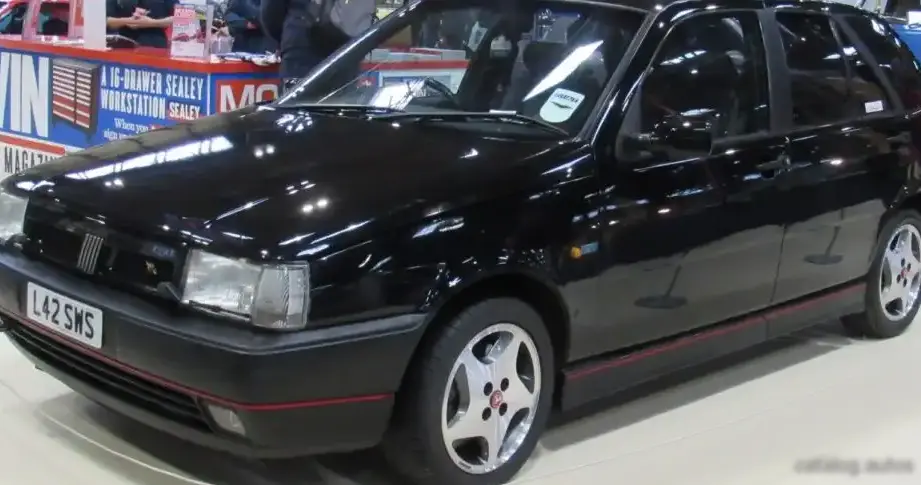
The Fiat Tipo (160) 2.0 16V, internally designated as 160.AV, was a performance-oriented variant of the Tipo range produced between 1991 and 1995. Positioned as the top-of-the-line engine option for the second-generation Tipo (the 160 series), it offered a significant power upgrade over the base models, appealing to drivers seeking a more engaging driving experience. The Tipo itself was Fiat’s offering in the competitive C-segment hatchback and sedan market, intended to replace the aging Ritmo/Strada. The 2.0 16V model aimed to provide a sporty alternative to rivals like the Volkswagen Golf GTI and Opel Astra GSi.
Powertrain & Engine Architecture
The heart of the Tipo 2.0 16V was the 160 A8.046 engine, a 1995cc inline-four cylinder unit. This engine was a significant departure from the smaller displacement engines offered in the Tipo range. It featured a dual overhead camshaft (DOHC) valvetrain operating four valves per cylinder, contributing to its higher power output. Fuel delivery was handled by a multi-port fuel injection system, providing precise fuel metering for improved efficiency and performance. The engine’s 10.5:1 compression ratio further enhanced its responsiveness. The engine was transversely mounted, driving the front wheels. A five-speed manual transmission was the only gearbox option available with this engine, emphasizing the sporty intent of the variant. The transmission featured ratios geared towards maximizing acceleration and providing a more engaging driving experience.
Driving Characteristics
The 2.0 16V Tipo offered a noticeable performance improvement over its lower-powered siblings. The 146 horsepower output translated to a 0-60 mph time of around 8 seconds and a top speed of 128.62 mph. While not groundbreaking by modern standards, this performance was competitive within its class in the early 1990s. The engine delivered a relatively linear power curve, with peak torque arriving at 5000 rpm. This made it a flexible engine, capable of providing good acceleration in everyday driving situations. Compared to the 1.6-liter and 1.4-liter models, the 2.0 16V felt significantly more responsive, particularly at higher speeds. The five-speed manual transmission allowed drivers to fully exploit the engine’s power, while the front-wheel-drive configuration provided predictable handling. However, it was prone to torque steer under hard acceleration.
Equipment & Trim Levels
The 2.0 16V typically came with a higher level of standard equipment than the base Tipo models. This often included features such as power steering, central locking, electric windows, and an upgraded interior trim. Interior upholstery was typically cloth, but leather options were sometimes available. The dashboard featured a sporty instrument cluster with additional gauges, such as a rev counter. Optional extras could include air conditioning, a sunroof, and alloy wheels. The trim level was generally positioned as a mid-range to upper-mid-range offering, bridging the gap between the more basic models and any potential limited-edition or performance-focused variants.
Chassis & Braking
The Tipo 2.0 16V utilized a relatively simple suspension setup, consisting of a spring strut front suspension and a coil spring rear suspension. The suspension was tuned to provide a balance between comfort and handling. Braking duties were handled by disc brakes on all four wheels, providing adequate stopping power for the vehicle’s performance capabilities. An Anti-lock Braking System (ABS) was often included as standard equipment, enhancing safety. The Tipo’s chassis was relatively lightweight, contributing to its agile handling characteristics. Stabilizer bars were fitted to both the front and rear axles to reduce body roll during cornering.
Market Reception & Comparison
The Fiat Tipo 2.0 16V was generally well-received by automotive critics. It was praised for its lively performance, comfortable ride, and relatively affordable price. However, some critics noted that the interior quality was not as refined as some of its rivals. Compared to the lower-powered Tipo models, the 2.0 16V offered a significantly more engaging driving experience. Fuel economy was reasonable for a 2.0-liter engine of that era, averaging around 25.3 US mpg in combined driving. Reliability was generally good, although some owners reported minor issues with the electrical system. Compared to competitors like the Volkswagen Golf GTI, the Tipo 2.0 16V offered a similar level of performance at a lower price point.
Legacy
The Fiat Tipo 2.0 16V remains a popular choice among classic car enthusiasts. The engine is known for its durability and relatively simple maintenance requirements. Parts availability is generally good, although some specific components may be becoming increasingly difficult to find. Today, well-maintained examples of the Tipo 2.0 16V are sought after by collectors and enthusiasts who appreciate its sporty character and classic Italian styling. The 160 A8.046 engine itself is considered a robust and reliable unit, capable of providing years of enjoyable driving with proper maintenance. The Tipo 2.0 16V represents a high point in Fiat’s C-segment offerings, offering a compelling blend of performance, practicality, and affordability.
