
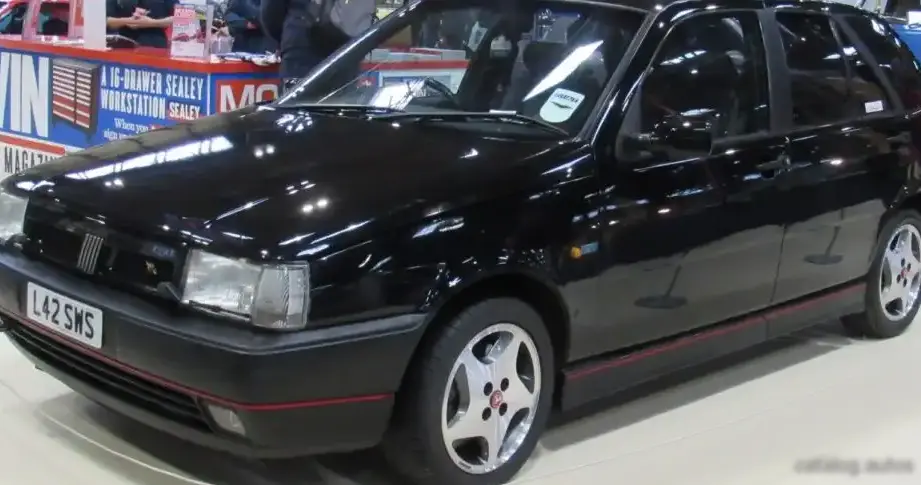
Technical Specifications
| Brand | Fiat |
| Model | Tipo |
| Generation | Tipo (160) |
| Type (Engine) | 2.0 i.e. (113 Hp) |
| Start of production | 1990 |
| End of production | 1995 |
| Powertrain Architecture | Internal Combustion engine |
| Body type | Hatchback |
| Seats | 5 |
| Doors | 3 |
| Fuel consumption (combined) | 8.9 l/100 km |
| Fuel consumption (US mpg) | 26.4 US mpg |
| Fuel consumption (UK mpg) | 31.7 UK mpg |
| Fuel consumption (km/l) | 11.2 km/l |
| Fuel Type | Petrol (Gasoline) |
| Acceleration 0 – 100 km/h | 10.5 sec |
| Acceleration 0 – 62 mph | 10.5 sec |
| Acceleration 0 – 60 mph | 10 sec |
| Maximum speed | 190 km/h (118.06 mph) |
| Weight-to-power ratio | 9.9 kg/Hp |
| Power per tonne | 100.5 Hp/tonne |
| Weight-to-torque ratio | 7.2 kg/Nm |
| Torque per tonne | 138.8 Nm/tonne |
| Power | 113 Hp @ 5750 rpm |
| Power per litre | 56.6 Hp/l |
| Torque | 156 Nm @ 3300 rpm (115.06 lb.-ft. @ 3300 rpm) |
| Engine layout | Front, Transverse |
| Engine Model/Code | 159 A6.046 |
| Engine displacement | 1995 cm3 (121.74 cu. in.) |
| Number of cylinders | 4 |
| Engine configuration | Inline |
| Cylinder Bore | 84 mm (3.31 in.) |
| Piston Stroke | 90 mm (3.54 in.) |
| Compression ratio | 9.5:1 |
| Number of valves per cylinder | 2 |
| Fuel injection system | Multi-port manifold injection |
| Engine aspiration | Naturally aspirated engine |
| Valvetrain | DOHC |
| Engine oil capacity | 5.2 l (5.49 US qt | 4.58 UK qt) |
| Coolant capacity | 6.9 l (7.29 US qt | 6.07 UK qt) |
| Kerb Weight | 1124 kg (2478 lbs.) |
| Max. weight | 1650 kg (3637.63 lbs.) |
| Max load | 526 kg (1159.63 lbs.) |
| Trunk (boot) space – minimum | 350 l (12.36 cu. ft.) |
| Trunk (boot) space – maximum | 710 l (25.07 cu. ft.) |
| Fuel tank capacity | 48 l (12.68 US gal | 10.56 UK gal) |
| Length | 3958 mm (155.83 in.) |
| Width | 1700 mm (66.93 in.) |
| Height | 1430 mm (56.3 in.) |
| Wheelbase | 2540 mm (100 in.) |
| Front track | 1455 mm (57.28 in.) |
| Rear track | 1441 mm (56.73 in.) |
| Drivetrain Architecture | ICE, Front Wheel Drive |
| Drive wheel | Front wheel drive |
| Number of gears | 5 |
| Gearbox type | Manual transmission |
| Front suspension | Spring Strut |
| Rear suspension | Coil spring |
| Front brakes | Ventilated discs |
| Rear brakes | Disc |
| Assisting systems | ABS (Anti-lock braking system) |
| Steering type | Steering rack and pinion |
| Power steering | Hydraulic Steering |
| Tires size | 185/60 R14 V |
The Fiat Tipo (160) 2.0 i.e., produced between 1990 and 1995, represented a significant step up in performance and refinement within the Tipo range. Positioned as a mid-range offering, it catered to buyers seeking more power than the base 1.4 and 1.6 liter engines, but without the expense of the later 2.0 16V models. The Tipo (160) itself was Fiat’s replacement for the aging Ritmo/Strada, aiming to provide a modern, spacious, and well-equipped compact family car. This 2.0 i.e. variant was primarily sold in European markets, offering a blend of practicality and respectable performance for its time.
Powertrain & Engine Architecture
At the heart of the Tipo 2.0 i.e. lies the 159 A6.046 engine, a 1995cc inline-four cylinder unit. This engine featured a dual overhead camshaft (DOHC) valvetrain with two valves per cylinder. The “i.e.” designation signified the use of Bosch multi-point fuel injection, a significant upgrade over earlier carburetor-equipped Fiat engines. This system improved fuel efficiency and throttle response. The engine produced 113 horsepower at 5750 rpm and 156 Nm (115 lb-ft) of torque at 3300 rpm. The engine’s design prioritized reliability and ease of maintenance. The 5-speed manual transmission was the standard offering, providing a reasonably direct connection to the front wheels. The transmission was known for its relatively smooth shift action, though not particularly sporty feel.
Driving Characteristics
The 2.0 i.e. offered a noticeable performance improvement over the 1.4 and 1.6 liter Tipo models. Acceleration to 60 mph took around 10.5 seconds, and it could achieve a top speed of approximately 118 mph. While not a sports car, the 2.0 i.e. provided sufficient power for comfortable highway cruising and overtaking. The gear ratios in the 5-speed manual transmission were well-spaced, allowing the engine to operate efficiently at various speeds. Compared to the later 2.0 16V models, the 8-valve engine delivered a broader, more usable torque curve, making it more forgiving in everyday driving situations. However, it lacked the high-end power and responsiveness of the 16-valve variant.
Equipment & Trim Levels
The 2.0 i.e. typically came equipped with a reasonable level of standard features. These included power steering, central locking, and electric front windows. Interior upholstery was typically cloth, with a relatively simple but functional dashboard layout. Optional extras included air conditioning, a sunroof, and upgraded audio systems. The trim level often dictated the quality of the interior materials and the availability of additional features. Higher trim levels might have included alloy wheels and a more comprehensive instrument cluster.
Chassis & Braking
The Tipo (160) utilized a front-wheel-drive layout with a MacPherson strut suspension at the front and a coil spring suspension at the rear. The suspension setup provided a comfortable ride, though it wasn’t particularly sporty. Braking was handled by ventilated discs at the front and solid discs at the rear. An anti-lock braking system (ABS) was often included as standard equipment, enhancing safety. The chassis was relatively lightweight, contributing to the car’s decent handling characteristics. Stabilizer bars were fitted to both the front and rear axles to reduce body roll during cornering.
Market Reception & Comparison
The Fiat Tipo 2.0 i.e. was generally well-received by automotive critics. It was praised for its spacious interior, comfortable ride, and respectable performance. Compared to rivals like the Volkswagen Golf and Opel Astra, the Tipo offered a good value proposition. However, some critics noted that the interior materials weren’t as high quality as those found in some of its competitors. In terms of fuel economy, the 2.0 i.e. was reasonably efficient for its time, achieving around 26.4 US mpg in combined driving. The 1.6 liter Tipo offered better fuel economy, while the 2.0 16V sacrificed fuel efficiency for increased power.
Legacy
The Fiat Tipo 2.0 i.e. has proven to be a relatively reliable car, with many examples still on the road today. The 159 A6.046 engine is known for its durability, provided it is properly maintained. Common issues include oil leaks and wear on the timing belt. In the used car market, the 2.0 i.e. is often sought after by enthusiasts who appreciate its blend of practicality and performance. It represents a significant chapter in Fiat’s history, showcasing the company’s ability to produce well-rounded and affordable family cars. While not a collector’s item, it remains a popular choice for those seeking a classic European hatchback.
