
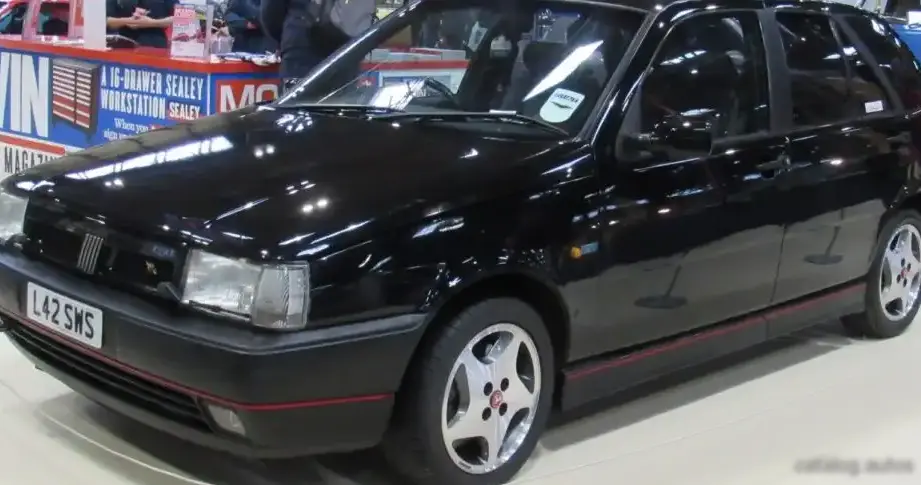
The Fiat Tipo (160) 2.0 i.e. Automatic, produced between 1990 and 1995, represented a significant offering in Fiat’s lineup during that period. Positioned as a mid-range trim within the Tipo family – which included 1.1L, 1.4L, 1.6L, and 1.9 diesel variants – the 2.0 i.e. Automatic aimed to provide a blend of performance and convenience for buyers seeking a more refined driving experience. The Tipo (160) itself was a compact hatchback, designed as a replacement for the aging Uno and Ritmo models, and was a key component of Fiat’s strategy to modernize its product range. It was a popular choice in Europe, particularly in Italy and Germany, offering a practical and relatively affordable option in the competitive C-segment.
Technical Specifications
| Brand | Fiat |
| Model | Tipo |
| Generation | Tipo (160) |
| Type (Engine) | 2.0 i.e. (113 Hp) Automatic |
| Start of production | 1990 |
| End of production | 1995 |
| Powertrain Architecture | Internal Combustion engine |
| Body type | Hatchback |
| Seats | 5 |
| Doors | 3 |
| Fuel consumption (combined) | 8.9 l/100 km (26.4 US mpg, 31.7 UK mpg, 11.2 km/l) |
| Fuel Type | Petrol (Gasoline) |
| Acceleration 0 – 100 km/h | 10.5 sec |
| Acceleration 0 – 62 mph | 10.5 sec |
| Acceleration 0 – 60 mph | 10 sec |
| Maximum speed | 190 km/h (118.06 mph) |
| Weight-to-power ratio | 9.9 kg/Hp, 100.5 Hp/tonne |
| Weight-to-torque ratio | 7.2 kg/Nm, 138.8 Nm/tonne |
| Power | 113 Hp @ 5750 rpm |
| Power per litre | 56.6 Hp/l |
| Torque | 156 Nm @ 3300 rpm (115.06 lb.-ft. @ 3300 rpm) |
| Engine layout | Front, Transverse |
| Engine Model/Code | 159 A6.046 |
| Engine displacement | 1995 cm3 (121.74 cu. in.) |
| Number of cylinders | 4 |
| Engine configuration | Inline |
| Cylinder Bore | 84 mm (3.31 in.) |
| Piston Stroke | 90 mm (3.54 in.) |
| Compression ratio | 9.5:1 |
| Number of valves per cylinder | 2 |
| Fuel injection system | Multi-port manifold injection |
| Engine aspiration | Naturally aspirated engine |
| Valvetrain | DOHC |
| Engine oil capacity | 5.2 l (5.49 US qt | 4.58 UK qt) |
| Coolant | 6.9 l (7.29 US qt | 6.07 UK qt) |
| Kerb Weight | 1124 kg (2478 lbs.) |
| Max. weight | 1650 kg (3637.63 lbs.) |
| Max load | 526 kg (1159.63 lbs.) |
| Trunk (boot) space – minimum | 350 l (12.36 cu. ft.) |
| Trunk (boot) space – maximum | 710 l (25.07 cu. ft.) |
| Fuel tank capacity | 48 l (12.68 US gal | 10.56 UK gal) |
| Length | 3958 mm (155.83 in.) |
| Width | 1700 mm (66.93 in.) |
| Height | 1430 mm (56.3 in.) |
| Wheelbase | 2540 mm (100 in.) |
| Front track | 1455 mm (57.28 in.) |
| Rear (Back) track | 1441 mm (56.73 in.) |
| Drivetrain Architecture | The Internal combustion engine (ICE) drives the front wheels of the vehicle. |
| Drive wheel | Front wheel drive |
| Number of gears and type of gearbox | 4 gears, automatic transmission |
| Front suspension | Spring Strut |
| Rear suspension | Coil spring |
| Front brakes | Ventilated discs |
| Rear brakes | Disc |
| Assisting systems | ABS (Anti-lock braking system) |
| Steering type | Steering rack and pinion |
| Power steering | Hydraulic Steering |
| Tires size | 185/60 R14 V |
| Wheel rims size | 14 |
Powertrain & Engine Architecture
The heart of the Tipo 2.0 i.e. Automatic was the 159 A6.046 engine, a 1995cc inline-four cylinder gasoline engine. This engine featured a dual overhead camshaft (DOHC) valvetrain with two valves per cylinder. Fuel delivery was handled by a multi-port fuel injection system, a relatively modern technology for the early 1990s, contributing to improved fuel efficiency and smoother operation compared to carbureted engines. The engine produced 113 horsepower at 5750 rpm and 156 Nm (115 lb-ft) of torque at 3300 rpm. Paired with this engine was a four-speed automatic transmission. While not the most advanced automatic available at the time, it provided a level of convenience that appealed to a broader range of drivers. The transmission was designed to prioritize smooth shifts and ease of use over outright performance.
Driving Characteristics
The 2.0 i.e. Automatic offered a noticeable step up in performance compared to the lower-displacement Tipo models. Acceleration to 60 mph took around 10.5 seconds, and it had a top speed of approximately 118 mph. However, the automatic transmission did impact performance somewhat. Manual transmission versions of the 2.0 i.e. were demonstrably quicker, offering more direct control and better acceleration. The four-speed automatic, while comfortable, lacked the close gear ratios of a manual or more modern automatic, resulting in slightly less responsive acceleration and potentially higher engine speeds during highway cruising. The power delivery was relatively linear, making it easy to drive in everyday conditions, but it didn’t offer the same level of excitement as the sportier Tipo variants.
Equipment & Trim Levels
The 2.0 i.e. Automatic typically came equipped with a reasonable level of standard features for its time. This included power steering, central locking, electric front windows, and an adjustable steering column. Interior upholstery was typically cloth, with options for upgraded materials available. Optional extras could include air conditioning, a sunroof, and a more advanced audio system. The dashboard layout was functional and straightforward, prioritizing usability over flashy design. The trim level generally sat above the base models but below the more luxurious or performance-oriented versions of the Tipo.
Chassis & Braking
The Tipo (160) featured a relatively simple but effective chassis design. Front suspension utilized a MacPherson strut setup, while the rear employed a coil spring arrangement. Braking consisted of ventilated discs on the front wheels and solid discs on the rear. An anti-lock braking system (ABS) was often included as standard equipment, enhancing safety. The suspension was tuned for comfort, providing a reasonably smooth ride over most road surfaces. The weight distribution was fairly balanced, contributing to predictable handling characteristics.
Market Reception & Comparison
The Fiat Tipo 2.0 i.e. Automatic received generally positive reviews from automotive critics. It was praised for its comfortable ride, spacious interior, and relatively affordable price. However, the automatic transmission was sometimes criticized for its lack of responsiveness compared to the manual gearbox. Compared to other C-segment hatchbacks of the era, such as the Volkswagen Golf and Ford Escort, the Tipo offered a compelling value proposition. It was often more affordable than its German rivals while providing a similar level of practicality and comfort. Fuel economy was respectable for the time, averaging around 26.4 US mpg in combined driving.
Legacy
The Fiat Tipo (160) 2.0 i.e. Automatic, while not a particularly rare or collectible vehicle today, remains a reasonably reliable and affordable option in the used car market. The 159 A6.046 engine is known for its durability, and with proper maintenance, it can provide many years of service. However, like any older vehicle, it’s important to be aware of potential issues such as corrosion and wear on suspension components. The automatic transmission, while generally reliable, may require occasional servicing. The Tipo (160) represents a significant chapter in Fiat’s history, marking a move towards more modern and sophisticated vehicle designs.
