
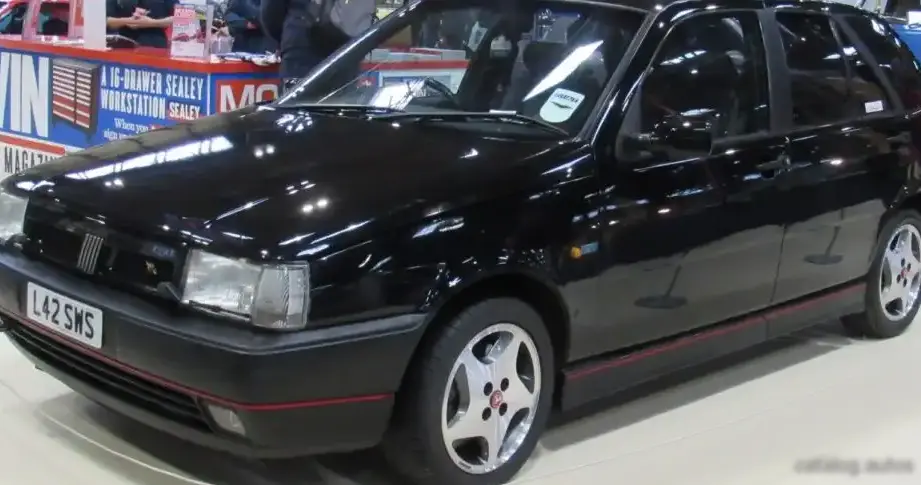
The Fiat Tipo (160) 2.0 i.e., produced between 1990 and 1995, represented a significant step up in performance and refinement within the Tipo range. Positioned as a mid-range offering, it catered to buyers seeking more power than the base 1.4 and 1.6-liter engines, but without the expense of the later 2.0 16V models. The Tipo (160) itself was Fiat’s replacement for the aging Ritmo/Strada, aiming to provide a modern, spacious, and well-equipped family car. This 2.0 i.e. variant was available in both 3-door and 5-door hatchback configurations, becoming a popular choice in European markets where compact family cars were in high demand.
Technical Specifications
| Brand | Fiat |
| Model | Tipo |
| Generation | Tipo (160) |
| Type (Engine) | 2.0 i.e. (115 Hp) |
| Start of production | 1990 |
| End of production | 1995 |
| Powertrain Architecture | Internal Combustion engine |
| Body type | Hatchback |
| Seats | 5 |
| Doors | 3-5 |
| Fuel consumption (urban) | 11 l/100 km (21.4 US mpg) |
| Fuel consumption (extra urban) | 7 l/100 km (33.6 US mpg) |
| Fuel consumption (combined) | 8.7 l/100 km (27 US mpg) |
| Fuel Type | Petrol (Gasoline) |
| Acceleration 0 – 100 km/h | 10.5 sec |
| Acceleration 0 – 62 mph | 10.5 sec |
| Acceleration 0 – 60 mph | 10 sec |
| Maximum speed | 190 km/h (118.06 mph) |
| Weight-to-power ratio | 9.6 kg/Hp |
| Weight-to-torque ratio | 6.9 kg/Nm |
| Power | 115 Hp @ 5750 rpm |
| Torque | 159 Nm @ 3300 rpm (117.27 lb.-ft. @ 3300 rpm) |
| Engine layout | Front, Transverse |
| Engine Model/Code | 159 A6.046 |
| Engine displacement | 1995 cm3 (121.74 cu. in.) |
| Number of cylinders | 4 |
| Engine configuration | Inline |
| Cylinder Bore | 84 mm (3.31 in.) |
| Piston Stroke | 90 mm (3.54 in.) |
| Compression ratio | 9.3:1 |
| Number of valves per cylinder | 2 |
| Fuel injection system | Multi-port manifold injection |
| Engine aspiration | Naturally aspirated |
| Engine oil capacity | 5.2 l (5.49 US qt | 4.58 UK qt) |
| Coolant capacity | 6.9 l (7.29 US qt | 6.07 UK qt) |
| Kerb Weight | 1100 kg (2425.08 lbs.) |
| Max. weight | 1600 kg (3527.4 lbs.) |
| Max load | 500 kg (1102.31 lbs.) |
| Trunk (boot) space – minimum | 350 l (12.36 cu. ft.) |
| Trunk (boot) space – maximum | 710 l (25.07 cu. ft.) |
| Fuel tank capacity | 48 l (12.68 US gal | 10.56 UK gal) |
| Length | 3958 mm (155.83 in.) |
| Width | 1700 mm (66.93 in.) |
| Height | 1450 mm (57.09 in.) |
| Wheelbase | 2540 mm (100 in.) |
| Front track | 1429 mm (56.26 in.) |
| Rear track | 1415 mm (55.71 in.) |
| Drivetrain Architecture | Front wheel drive |
| Number of gears | 5 |
| Gearbox type | Manual transmission |
| Front suspension | Spring Strut |
| Rear suspension | Coil spring |
| Front brakes | Disc |
| Rear brakes | Disc |
| Assisting systems | ABS (Anti-lock braking system) |
| Steering type | Steering rack and pinion |
| Tires size | 185/60 R14 |
Powertrain & Engine Architecture
The heart of the Tipo 2.0 i.e. is the 159 A6.046 engine, a 1995cc inline-four cylinder unit. This engine featured multi-port fuel injection, a relatively sophisticated system for its time, contributing to improved fuel efficiency and smoother power delivery compared to earlier carbureted Fiat engines. The engine utilized a two-valve per cylinder configuration, and a relatively modest 9.3:1 compression ratio. The engine’s design prioritized reliability and ease of maintenance over outright performance. The five-speed manual transmission was the standard offering, providing a good balance between fuel economy and driver engagement. The transmission’s gear ratios were tuned for everyday usability, rather than aggressive acceleration.
Driving Characteristics
The 2.0 i.e. Tipo offered a noticeable performance improvement over the lower-displacement models. The 115 horsepower output, while not exceptional by modern standards, provided brisk acceleration and comfortable cruising speeds. Zero to 60 mph was achievable in around 10 seconds, and the car could reach a top speed of approximately 118 mph. The manual transmission allowed for good control over the engine’s power, and the gear ratios were well-suited to both city driving and highway journeys. Compared to the later 2.0 16V versions, the 8-valve engine delivered its power in a more linear fashion, lacking the high-end rush of the 16V. However, this also made it more forgiving to drive and easier to modulate in slippery conditions.
Equipment & Trim Levels
The 2.0 i.e. Tipo typically came equipped with features such as power steering, central locking, and electric front windows. Interior trim levels varied, but generally included cloth upholstery and a functional, if somewhat basic, dashboard layout. Optional extras included a sunroof, alloy wheels, and upgraded audio systems. The 5-door version offered greater practicality for families, while the 3-door model appealed to those seeking a sportier aesthetic. The trim level often dictated the quality of the interior materials and the availability of additional comfort features.
Chassis & Braking
The Tipo (160) utilized a relatively simple but effective chassis design. Front suspension consisted of MacPherson struts, while the rear employed a coil spring setup. Disc brakes were fitted to all four wheels, providing adequate stopping power for the car’s weight and performance. An anti-lock braking system (ABS) was often included as standard equipment, enhancing safety. The suspension was tuned for comfort, providing a reasonably smooth ride over most road surfaces. Stabilizer bars were fitted to both the front and rear axles to reduce body roll during cornering.
Market Reception & Comparison
The Fiat Tipo 2.0 i.e. was generally well-received by automotive critics. It was praised for its spacious interior, comfortable ride, and relatively affordable price. Compared to its rivals, such as the Volkswagen Golf and Ford Escort, the Tipo offered a good value proposition. Fuel economy was respectable for the time, averaging around 27 mpg in combined driving. Reliability was generally considered to be good, although some owners reported issues with electrical components. The 2.0 i.e. offered a compelling alternative to the more expensive 2.0 16V models, providing a good balance of performance, economy, and practicality.
Legacy
Today, the Fiat Tipo (160) 2.0 i.e. is gaining recognition as a classic of the early 1990s. The engine, while not particularly powerful by modern standards, is known for its durability and relative simplicity. Parts availability is generally good, making it a relatively easy car to maintain. Well-maintained examples are becoming increasingly sought after by enthusiasts, particularly those who appreciate the Tipo’s understated styling and practical nature. The 2.0 i.e. represents a sweet spot in the Tipo range, offering a good balance of performance and affordability, and a testament to Fiat’s engineering capabilities during that era.
