
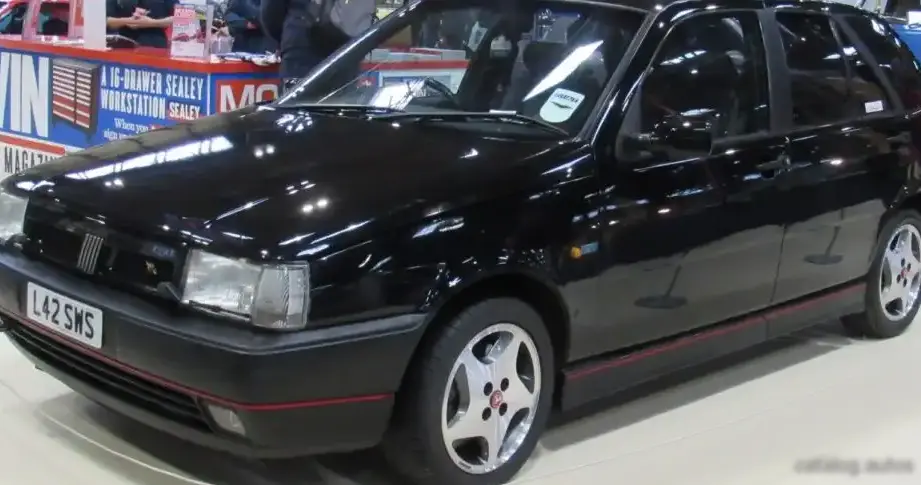
The Fiat Tipo (160) 2.0 i.e. Automatic, produced between 1990 and 1995, represented a significant offering in Fiat’s lineup during that period. Positioned as a mid-range trim within the Tipo family – which included 1.1L, 1.4L, 1.6L, and 1.9 diesel engine options – the 2.0 i.e. Automatic aimed to provide a blend of performance and convenience for buyers seeking a more refined driving experience. The Tipo (160) itself was a crucial model for Fiat, designed to replace the aging Uno and Ritmmo, and offered as a 3-door or 5-door hatchback, and later a station wagon and sedan. This variant utilized the 159 A6.046 engine paired with a four-speed automatic transmission, catering to a market segment prioritizing ease of use over outright sportiness.
Technical Specifications
| Brand | Fiat |
| Model | Tipo |
| Generation | Tipo (160) |
| Type (Engine) | 2.0 i.e. (115 Hp) Automatic |
| Start of production | 1990 |
| End of production | 1995 |
| Powertrain Architecture | Internal Combustion engine |
| Body type | Hatchback |
| Seats | 5 |
| Doors | 3-5 |
| Fuel consumption (urban) | 12 l/100 km (19.6 US mpg) |
| Fuel consumption (extra urban) | 7.3 l/100 km (32.2 US mpg) |
| Fuel consumption (combined) | 9 l/100 km (26.1 US mpg) |
| Fuel Type | Petrol (Gasoline) |
| Acceleration 0 – 100 km/h | 13 sec |
| Acceleration 0 – 62 mph | 13 sec |
| Acceleration 0 – 60 mph | 12.4 sec |
| Maximum speed | 185 km/h (114.95 mph) |
| Weight-to-power ratio | 9.6 kg/Hp |
| Weight-to-torque ratio | 6.9 kg/Nm |
| Power | 115 Hp @ 5750 rpm |
| Torque | 159 Nm @ 3300 rpm (117.27 lb.-ft. @ 3300 rpm) |
| Engine layout | Front, Transverse |
| Engine Model/Code | 159 A6.046 |
| Engine displacement | 1995 cm3 (121.74 cu. in.) |
| Number of cylinders | 4 |
| Engine configuration | Inline |
| Cylinder Bore | 84 mm (3.31 in.) |
| Piston Stroke | 90 mm (3.54 in.) |
| Compression ratio | 9.3:1 |
| Number of valves per cylinder | 2 |
| Fuel injection system | Multi-port manifold injection |
| Engine aspiration | Naturally aspirated |
| Engine oil capacity | 5.2 l (5.49 US qt | 4.58 UK qt) |
| Coolant capacity | 6.9 l (7.29 US qt | 6.07 UK qt) |
| Kerb Weight | 1100 kg (2425.08 lbs.) |
| Max. weight | 1600 kg (3527.4 lbs.) |
| Max load | 500 kg (1102.31 lbs.) |
| Trunk (boot) space – minimum | 350 l (12.36 cu. ft.) |
| Trunk (boot) space – maximum | 710 l (25.07 cu. ft.) |
| Fuel tank capacity | 48 l (12.68 US gal | 10.56 UK gal) |
| Length | 3958 mm (155.83 in.) |
| Width | 1700 mm (66.93 in.) |
| Height | 1450 mm (57.09 in.) |
| Wheelbase | 2540 mm (100 in.) |
| Front track | 1429 mm (56.26 in.) |
| Rear track | 1415 mm (55.71 in.) |
| Drivetrain Architecture | Front wheel drive |
| Number of gears | 4 |
| Gearbox type | Automatic transmission |
| Front suspension | Spring Strut |
| Rear suspension | Coil spring |
| Front brakes | Disc |
| Rear brakes | Disc |
| Assisting systems | ABS (Anti-lock braking system) |
| Steering type | Steering rack and pinion |
| Tires size | 185/60 R14 |
| Wheel rims size | 14 |
Powertrain & Engine Architecture
The heart of the Tipo 2.0 i.e. Automatic was the 159 A6.046, a 1995cc inline-four cylinder engine. This engine featured a cast iron block and an aluminum cylinder head, employing a single overhead camshaft (SOHC) design with two valves per cylinder. Fuel delivery was managed by a Bosch multi-port fuel injection system, providing a balance between efficiency and performance for the time. The engine’s 9.3:1 compression ratio contributed to its 115 horsepower output at 5750 rpm and 159 Nm (117.27 lb-ft) of torque at 3300 rpm. The four-speed automatic transmission, while offering convenience, was a relatively conventional unit, lacking the sophistication of modern electronically controlled automatics. It was designed for smooth, if not particularly rapid, gear changes.
Driving Characteristics
The 2.0 i.e. Automatic offered a noticeably more relaxed driving experience compared to the lower-displacement Tipo models. While not a sports car by any means, the larger engine provided adequate power for highway cruising and overtaking. Acceleration from 0-60 mph took around 12.4 seconds, and top speed was approximately 115 mph. The automatic transmission, while smooth, did result in some power loss compared to the available five-speed manual gearbox. Gear ratios were tuned for fuel economy and comfort, rather than outright performance. The automatic transmission also impacted the driving experience by reducing engine braking, and requiring a more cautious approach to downhill driving.
Equipment & Trim Levels
The 2.0 i.e. Automatic typically came equipped with features considered fairly generous for its time. Standard equipment often included power steering, central locking, electric front windows, and an upgraded interior trim compared to the base models. Interior upholstery was usually a cloth material, with options for velour or leather available at extra cost. Optional extras could include air conditioning, a sunroof, and a higher-end stereo system. The dashboard layout was functional and straightforward, typical of Italian automotive design of the early 1990s.
Chassis & Braking
The Tipo (160) utilized a front-wheel-drive layout with independent front suspension using MacPherson struts and a twist-beam rear suspension. The 2.0 i.e. Automatic, due to its increased weight, often featured slightly stiffer spring rates compared to the lighter models. Braking was handled by disc brakes on all four wheels, a notable upgrade over the rear drum brakes found on some lower-spec Tipo variants. An Anti-lock Braking System (ABS) was often included as standard equipment, enhancing safety and control during emergency braking situations. Stabilizer bars were fitted to both the front and rear axles to reduce body roll during cornering.
Market Reception & Comparison
The Fiat Tipo 2.0 i.e. Automatic was generally well-received by automotive critics as a practical and comfortable family car. However, the automatic transmission was sometimes criticized for its lack of responsiveness and its impact on fuel economy. Compared to the manual transmission versions, the automatic offered less engaging driving experience. Against competitors like the Volkswagen Golf, Opel Astra, and Ford Escort, the Tipo offered a distinctive Italian style and a competitive price point. Fuel economy was reasonable for the time, averaging around 26 mpg in combined driving, but lagged behind some of its more fuel-efficient rivals.
Legacy
The Fiat Tipo (160) 2.0 i.e. Automatic, while not a particularly rare or collectible model today, remains a relatively reliable and affordable classic car. The 159 A6.046 engine is known for its durability, provided it has been properly maintained. Common issues include oil leaks and wear on the timing belt. The automatic transmission, while generally robust, can be prone to wear and tear with high mileage. In the used car market, these Tipos are often sought after by enthusiasts looking for a nostalgic and practical Italian hatchback. Parts availability is generally good, although some specific trim pieces may be difficult to find. The Tipo’s impact lies in its role as a successful and affordable family car that helped modernize Fiat’s lineup in the early 1990s.
